
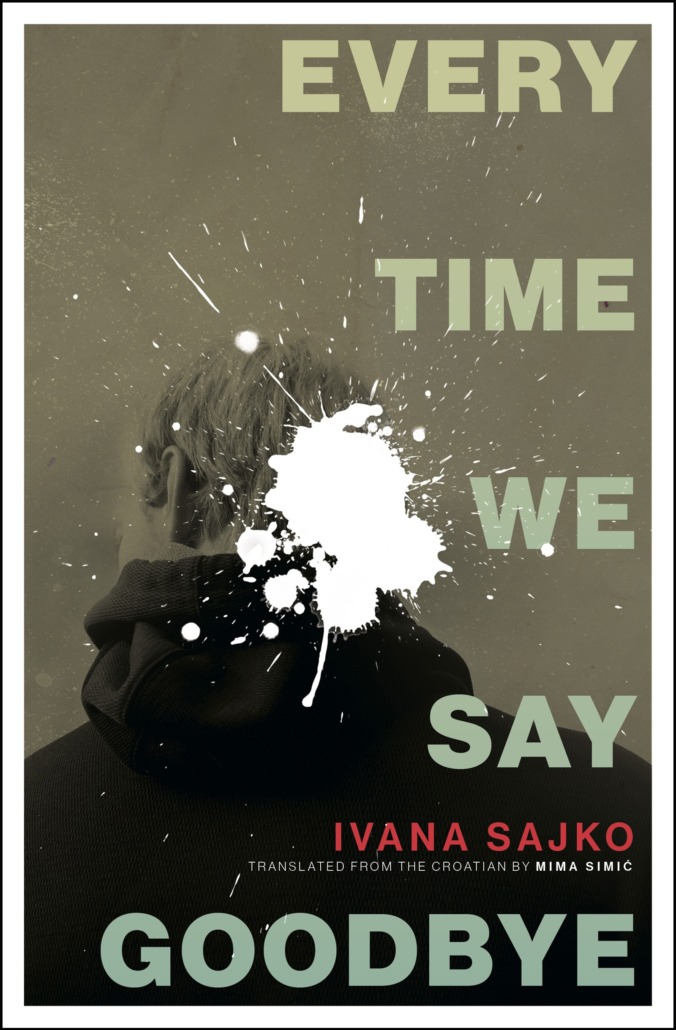
Description
A soliloquy of self-examination, upheaval, loss, hope, disillusionment, ambition and failure—Ivana Sajko paints a portrait of an intellectual at a crossroads.
A man on a train, propelled from a small town on the south-eastern coast of Europe to Berlin. As the wheels turn, his mind feverishly clacks along, tracing his own past—and that of Europe—to a moment of violence he must flee, moving him further and farther away from the one person he loves.
Shipwrecks and border pushbacks; epidemics and industrial ruins; a family separated by economic necessity; a brother lost to crime; love and fear and memories of happier times in Berlin—yet through it all runs a silver thread of hope spun by a far-off friend. Every Time We Say Goodbye is an extended soliloquy of self-examination, upheaval, loss, hope, disillusionment, ambition, and failure, and is a profoundly stark and furious novel.
Praise for Every Time We Say Goodbye
“Readers familiar with Sajko’s Love Novel will remember the author’s long, absorbing stream-of-consciousness sentences. In Every Time We Say Goodbye, every chapter is a single sentence running for pages. The translator, Mima Simić, approaches her task inventively . . . the prose flows in sync with the protagonist’s thoughts: now rolling along, now jolting on the tracks, now braking hard.”
—Anna Aslanyan, Times Literary Supplement
“[A] captivating new novel . . . translator Mima Simić shows great dexterity in her rendering of Sajko’s lyrical, run-on sentences. They hurtle forward like a TGV, making manifest Iv.’s struggle to speak of his despair and the continent’s.”
—Ken Kalfus, New York Times
“The form suits the novel’s action, which involves a disillusioned Croatian journalist travelling by train to Berlin, where he reflects on a Europe in crisis, personal trauma and the losses that have left him alienated from his work, past and sense of belonging.”
—Emily Donaldson, Globe and Mail
“Sajko’s prose—in Mimi Simić’s artful translation—sharpens and resounds with deeply wrung emotion.”
—Regan Mies, Asymptote
“Translated by Mima Simić, Sajko’s longtime translator, the words in Every Time We Say Goodbye flow on the page like a river in springtime, so natural and powerful that readers might not realize they weren’t written in English. The sombre spirit is captured, the despair relayed, yet for all its bleakness this is not a depressing book . . . The river taking the reader this far has an energizing effect.”
—Pamela Hensley, The Miramichi Reader
“Sajko vividly captures the way in which travel suspends both time and place in scenes that are at once real and dreamlike . . . evoking generations of exile and migration, the inevitable aftershock of the wars and purges that have defined the Balkans. Every Time We Say Goodbye is a threnody to leave-taking—elegant, mournful, and profoundly human.”
—Frank Wynne, Irish Times
“However grim the subject matter, the writing remains exceptionally good, with long, majestic sentences that curl unpredictably around the subject. This profound novel is superbly translated by Simić, whose translator’s note is in itself fascinating.”
—Declan O’Driscoll, Irish Times
“The relentless nature of the narrative style heightens the emotional intensity of this novel, allowing for an in depth portrait of one man’s past and present to emerge in a relatively limited space.”
—Joseph Schreiber, roughghosts
“A darkly meditative work from a strong and unflinching voice.”
—Kirkus Reviews
“Sajko’s blackhearted modernist novel is worth a look.”
—Publishers Weekly
“[Sajko’s] characteristic style resonates throughout the text in rapid changes of condensed scenes, concise and emotionally charged literary clusters of a confident pen for whom prose is always a measured experiment of rapids and explosions.”
—Ana Fazekas
“As the unnamed protagonist travels from a Croatian to Berlin, the story unfolds in fragmented, single-sentence chapters that blur past and present, memory and movement. Sajko vividly paints the emotional burden of exile and migration through prose that is intense and devastating. Challenging but deeply rewarding, the novel captures the suspension of time that accompanies travel and loss, becoming a deeply moving meditation on humanity.”
—Luisa Smith, Book Passage (Corte Madera, CA)
“I read Every Time We Say Goodbye not just in one sitting, but in a near-fugue state, completely absorbed in its stunning swirl of the personal and historical. Sajko’s rippling stream of a narrative gives clarity to both the lingering power of departures and the inconclusive essence of arrivals—this is a novel entirely built around transience, occupying both physical and interior spaces that are entirely ‘in between.’ As haunting, lyrical, and affecting a book as you can find under 200 pages.”
—Bryan Seitz, Literati Bookstore (Ann Arbor, MI)
“Centering around whatever the term for anti-nostalgia might be, a man presides over the ‘shipwreck’ of a long, doomed relationship that he flees by taking a train north out of his home country and deep into Germany . . . Composed of long, ruminative, stream-of-conscious sentences, this chapter-less story moves back and forth in time. It’s an effective portrayal of a ‘good man with good intentions’ who is nonetheless flailing and failing along with the rest of ‘good’ Europe . . . All the while Sajko deftly and subtly ties all of this all-too recognizable man’s fate to the larger political landscape. This is powerful book from a brilliant writer.”
—Douglas Riggs, Bank Square Books (Mystic, CT)
“A man on a train is leaving his life behind and traveling to Berlin as he examines his life and grapples with themes of lost love, war, violence, and belonging. The narrator’s stream of consciousness evokes the movement of the train on the tracks and completely swept me away with it’s rhythm and poignant language.”
—Nikki Deal, Market Block Books (Troy, NY)
Praise for Love Novel
“A devastating book, humane, original, and deeply relevant.”
—Kirkus Reviews (starred review)
“A sharp and claustrophobic portrait of a fraying marriage . . . Sajko never takes her foot off the gas in this potent and incendiary outing.”
—Publisher’s Weekly
“Sajko takes no prisoners . . . [Love Novel] gloriously marries sociopolitical commentary on failed capitalism in a failed state to the inevitability of failed marriage, locating the narrative in an extraordinary violence of mind and body . . . Matching form with content, it depicts lives that involve walking constantly on tightropes with a ferocity of prose that allows no breathing space, consummately conveying the claustrophobic existence of the characters as external as well as personal circumstances close in on them.”
—Dublin Literary Award Judges’ Citation
“Love Novel is a universal story about passion and poverty that’s told in rich language.”
—Suzanne Kamata, Foreword Reviews
“Love Novel is not a comfortable read, but it is a timely exploration of socio-economic inequality, a raw confrontation of the pain humans are capable of inflicting on one another, and a fearless engagement with the challenges of poverty and parenthood.”
—Helen Vassallo, Reading in Translation