
In strange company
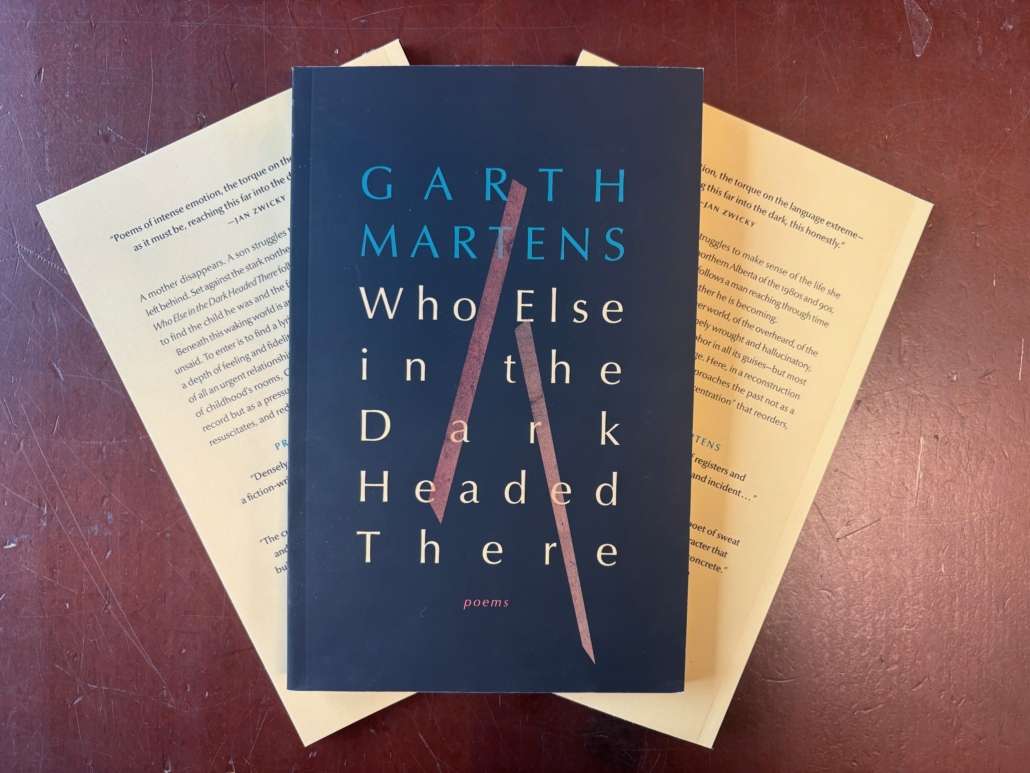
Poems from Who Else in the Dark Headed There by Garth Martens
Since it’s Poetry Month, and we’re standing at the threshold of the long Easter weekend, I want to write a little something in defense of literary suffering.
So much of my job involves trying to get people to read our books. And there’s always a vague external pressure to swaddle my book pitches in positive language. Readers want hope to shine through our frequently bleak books. And people are often less willing to engage with difficult texts, texts that require long hours alone flailing through another’s dimly-lit interiority. There’s an unspoken publicity agreement that despair, suffering, etc. be made palatable to a potential audience.
Yet literary portrayals of suffering seem valuable and interesting to me regardless of any transcendent qualities the mind feels compelled to impose on them. And what makes suffering interesting to read isn’t its universality: it’s the weird, inaccessible, hyper-particular reaches of a stranger’s consciousness. I want more of that. Not the performative, uplifting attempt to reach as many readers as possible, for a text to be seen as a knowable quantity. I want literature that feels alien, difficult to understand, that I have to circle again and again, banging my head against the walls of, trying to get further in. Earned moments of affinity or empathy feel so much more vital than the stuff popularized in the name of the heartwarmingly universal.
This has nothing to do with needing a little escapism, which is valid. I spend a desperate amount of time, like anyone, trying to put some distance between myself and all reminders of being a body-mind complex hurtling through time. That’s why I watch as much hockey as I do. But the Victoire clinching their playoff spot last night, and the Habs’ six-game winning streak, isn’t what keeps me going. Those are small pleasures—a little thrill for the prefrontal cortex.
What does keep me going, rather, has been consistent my entire life. It’s the unusual, painful companionship I found in Woolf when I was fourteen, or again in the poet Paul Celan when I was twenty-two, or again—just last year—when our managing editor, Vanessa, sent me Garth Martens’ poetry manuscript. It’s something about what happens when I’m alone with a voice that keens its own indescribable aloneness. The ease with which understanding comes—between reader and text, author and world—has so little to do with the kind of affinity that feels miraculous and life-altering.
With that, I’ll leave you with a handful of Garth Martens poems from his forthcoming collection Who Else in the Dark Headed There (April 14). I hope they reach you with the force of their individual darkness, and keep you in strange company over the long weekend.
Dominique
Publicity & Marketing Coordinator
Excerpts from Who Else in the Dark Headed There
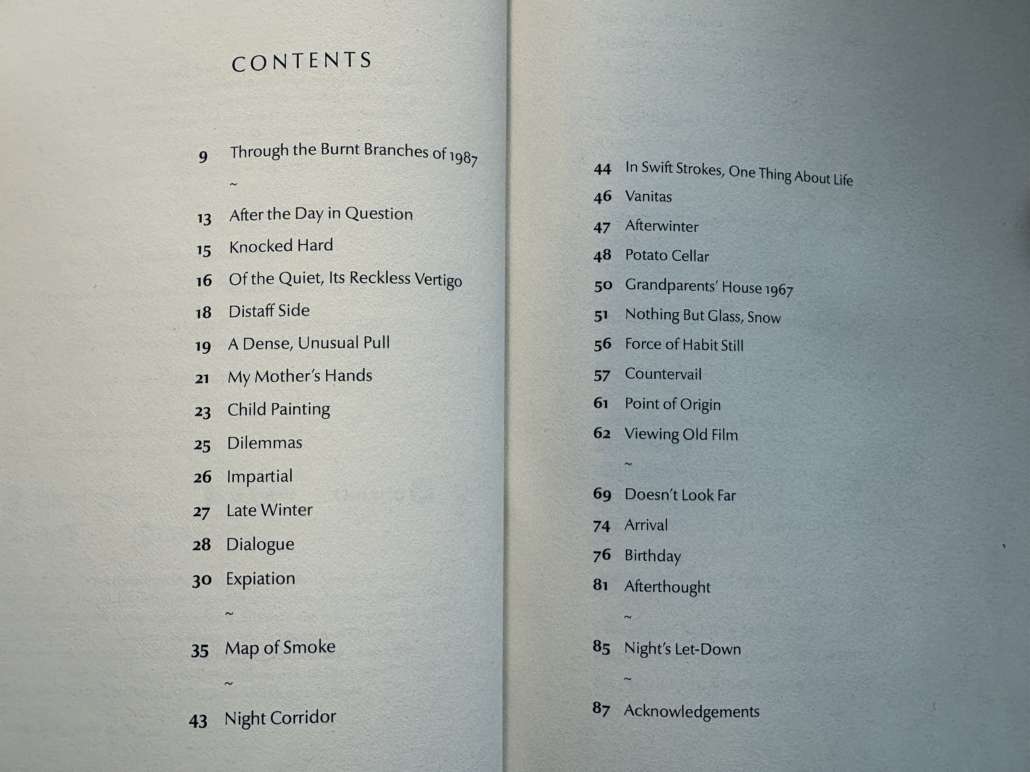
Late Winter
Gloved, I undercut
the snowcrust, its changeable
emergencies,
until the shelves fell.
Worlds that mirror this one
swung like white revolving doors.
Deciduous rods,
snow: it lifted higher: higher.
What rough potato
overrode the limit of the pail?
From what
precarity is it chored up?
Ice-strip on the move,
on high
or on my tongue,
not here, but here.
A tug of breath from a tap.
A snort through dense hedges.
Transfusion
of allusive, useless ideas.
Snow leapt and plunged.
I waited for the rendezvous.
I waited for the switch.
Dilemmas
Nobody asks for them.
They come
unpermitted. The sickroom
sweats on every hard bud
and somnolent,
those cut loose by those departed.
With a spade, the boy turns up
a tidy
padlock of steam.
A sole strand
air-slips
as through a keyway.
His whole life mist
rinses
and perspires: rock, barrel, bough. Alters
his world: a nook, a bridge,
an apple tree
whose full bearings
are shadowless, odd trespasser.
Distaff Side
She left behind a vanity mirror.
The boy held it face-up
at his chest. Walked without seeing his feet
as if upside down, as if blank, into
blurred
big blades, chunks of wall. Nauseous.
It bears saying he didn’t need
to do it to feel—a rush, out of place
or in danger in this house.
This was the closest he got
to putting on make-up,
erased from the waist down.
In deprived air, he detected
heated dust in the drapes, a pang
of flight. Wasp-like focus or glare.
From the bay window he beamed drivers.
Not to hurt them. To see
in their flinch a second face.
Afterwinter
Blowing gas through a wand,
I see a fruitfly drift into the seal.
I remember canola’s upstart gold flow. It went
as far as justified, our one
paved road in six directions.
Past this, there is of one
element not enough
and of another too much. Swans
in the flooded field.
Investors sprinting
pints of treacle
among tired farmers. Gossip
like crushed egg. That too,
for hold-outs who refuse their glass of milk.
And me? In a near playground
a pink, hooded jacket foisted on a bollard
like one doubled over
in despair. There is inside me a Pillarist
who infinitely extends
this moment of the gut punch. It’s far
from overrated, far from fair.
So full of my own blood
I am nauseous as anyone
who sells too well their steal.
In good publicity news:
- Precarious: The Lives of Migrant Workers by Marcello Di Cintio has been named a finalist for two 2026 Alberta Literary Awards: the City of Calgary W.O. Mitchell Book Prize and the Wilfrid Eggleston Award for Nonfiction. Huge congrats to Marcello!
- Cherry Beach by Don Gillmor was listed in Toronto Life, and was reviewed in The Seaboard Review: “A largely captivating novel, the sentences by turns clipped and spare or expansive and stunning. And befitting of an author who’s spent so much time in journalism, Gillmor doesn’t pull any punches. The world he gives is an ugly one, much like our own.”
- Every Time We Say Goodbye by Ivana Sajko (trans. Mima Simic) was reviewed in roughghosts: “The relentless nature of the narrative style heightens the emotional intensity of this novel, allowing for an in depth portrait of one man’s past and present to emerge in a relatively limited space.”