“Richard Kelly Kemick’s Decadence provides a narrative about interiority that is funny, curious, self-deprecating, and occasionally and gloriously ridiculous. Beneath Kemick’s wit and (truly) random obsessions is an exceptionally attentive meditation about the emotional weight of quotidian life and the strange difficulty of becoming an adult. Across a range of explorations about love, grief, loneliness, failure, family, and self-worth, Kemick is refreshingly honest about the limits of introspection, even as he offers an elaborate examination of his own catalogue of shortcomings. The result of this ‘accidental memoir of a sort’ is a deeply genuine, anxiously original, and immensely enjoyable portrait of life in progress.”
The Hilary Weston Writers’ Trust Prize for Nonfiction was first awarded in 1997. It is given annually for excellence in the category of literary nonfiction, which includes essays, history, biography, memoir, commentary, and criticism. Each finalist is awarded $5,000, and the winner receives a prize purse of $75,000. The award was first sponsored in 2011 by the Irish-Canadian businesswoman, philanthropist and writer who served as lieutenant-governor of Ontario. She died last year at 83. The prize is now funded by the Hilary and Galen Weston Foundation. The winner will be announced at the Writers’ Trust Awards on Tuesday, November 10.
Finalist for the 2026 Hilary Weston Writers’ Trust Prize for Nonfiction
“The genre of memoir is bullshit (as I humbly posit). No one actually lives like they are moving along some grand Freytag’s triangle. Rather, we live within isolated instances, specific struggles and victories, which, when compiled, form a narrative.”—Richard Kelly Kemick
In Decadence, Richard Kelly Kemick’s “accidental memoir of a sort,” the author ranges widely through his myriad preoccupations and obsessions—volleyball, municipal landfills, dogs, high school plays, Christmas villages, love—out of which the shape of a unique sensibility is revealed. Reminiscent of the three Davids—Rakoff, Sedaris, and Wallace—these essays accrete into a portrait of a man trying to make sense of a world in which there are no goddamn rules; and yet one in which every action has sometimes profound consequences. A book of intelligence and care and kindness and humour and yearning and the occasional epiphany, Decadence gathers up from the odds and ends of living what makes a modern life—quiet and desperate as it may at times be—worth celebrating.
Richard Kelly Kemick is an award-winning poet, journalist, and fiction writer. His debut collection of short stories, Hello, Horse, was published by Biblioasis in 2024. He is also the author of I Am Herod (available on audiobook), the poetry collection Caribou Run, and the stage play Amor De Cosmos: A Delusional Musical. Richard’s limited series podcast, Natural Life, is an intimate and unexpectedly honest documentary on his cousin, who is serving a life sentence without parole in Michigan.
https://www.biblioasis.com/wp-content/uploads/2026/09/hwwt_finalists.png8002000biblioasishttp://biblioasis.com/wp-content/uploads/2014/12/BIBLIOASIS-Logo-500x500-White-300x300.pngbiblioasis2026-09-09 11:05:212026-09-09 11:05:21DECADENCE a finalist for the 2026 Hilary Weston Writers’ Trust Prize for Nonfiction!
An interview with Richard Kelly Kemick, author of Decadence
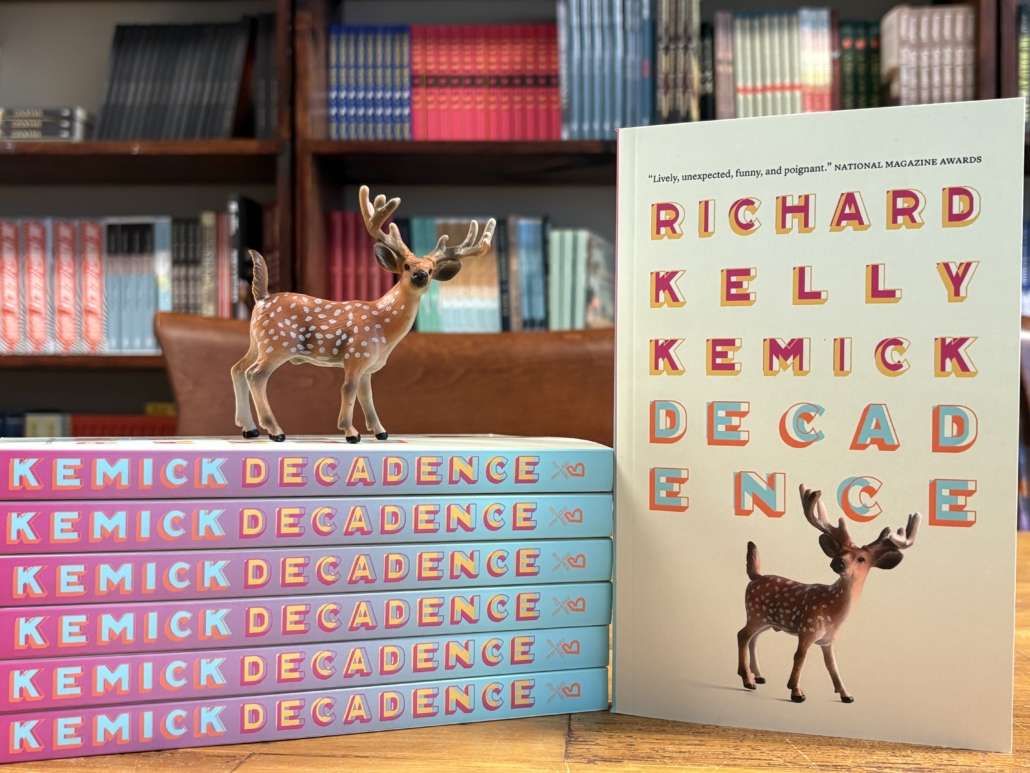
Photo: Decadence by Richard Kelly Kemick. Cover designed by Ingrid Paulson. Books supervised by the cover model.
I think what I love most about Richard Kelly Kemick’s work—regardless of whether he’s writing poetry, fiction, or nonfiction—is his emotional range. He doesn’t simply accept whatever emotion feels most natural or pressing to a scene or image. He steps back, and reconsiders the possibilities of feeling, and leads us towards feeling more. And with less certainty.
What comes out of this range is a humour that feels honest rather than fabricated—the distillation of many ways of thinking through experience. I often think of this opening to the collection’s final essay, “Rules”:
“Litia and I had been together for ten years (almost to the day) when she came home from work and told me she was gay. That summary sounds much less shocking—less plunging—than the revelation actually was. I reacted with all the clichés: the gasp, the floor falling away, the sound of the ocean in my ears. At one point, I stopped crying long enough to say, “Then I will become a woman.”’
The scene is silly, at least partly comical for its depiction of grand emotion and for its final statement, but there’s also a sweetness that makes the work ultimately feel more vulnerable than ironic. And this, in my opinion, is where humour thrives the most naturally: when the world turns on its head, and the rules have flown out the window, and the narrator is thrown into a clearing of not-knowing.
Decadenceis for readers who like a strong voice, which is to say: there’s a thoughtful, weird, nuanced personhood in this book, which is also to say: what comes through, in each essay, is the immense care of its author for the people and things occupying the Kemickian universe.
I had the pleasure of asking Kemick a few questions about Decadence, his lovely collection of personal essays coming out next Tuesday, which he answers below with his characteristic thoughtfulness, gentle self-deprecation, and wit.
Decadence spans a decade of some of your best magazine writing, and covers a wide range of topics and obsessions. Do you see a throughline, in hindsight (or even as you were writing)? And do you notice any shifts in your approach / preoccupations as time passes in Decadence?
While I was writing the pieces, I did not see any throughlines. My only preoccupations were: 1) Will an editor accept this pitch, and 2) Will they pay me for it? However, when I assembled these pieces into the manuscript, I saw that I kept coming back to similar ideas and themes, no matter the topic at hand. My relationship with Litia, my relationship with my friends, my relationships with my sworn enemies—all of it kept resurfacing throughout the decade it took me to finish this book.
My approach shifted as I became less concerned with arguing a standpoint or (god forbid) a thesis, but rather just exploring the parameters of the issue at hand. I used to start an article knowing what I thought about the topic; now, I am most interested in writing about topics that I am unsure how I feel towards. There’s nothing more obnoxious than a Canadian writer who thinks they have something to teach.
Also, halfway through writing this book (about year five), I deleted all social media and lost much of my fear of being cancelled. (I still have some fear of it, of course. Like, I am always very careful what specific insults I say to other drivers.) But I think this changed my humour overall.
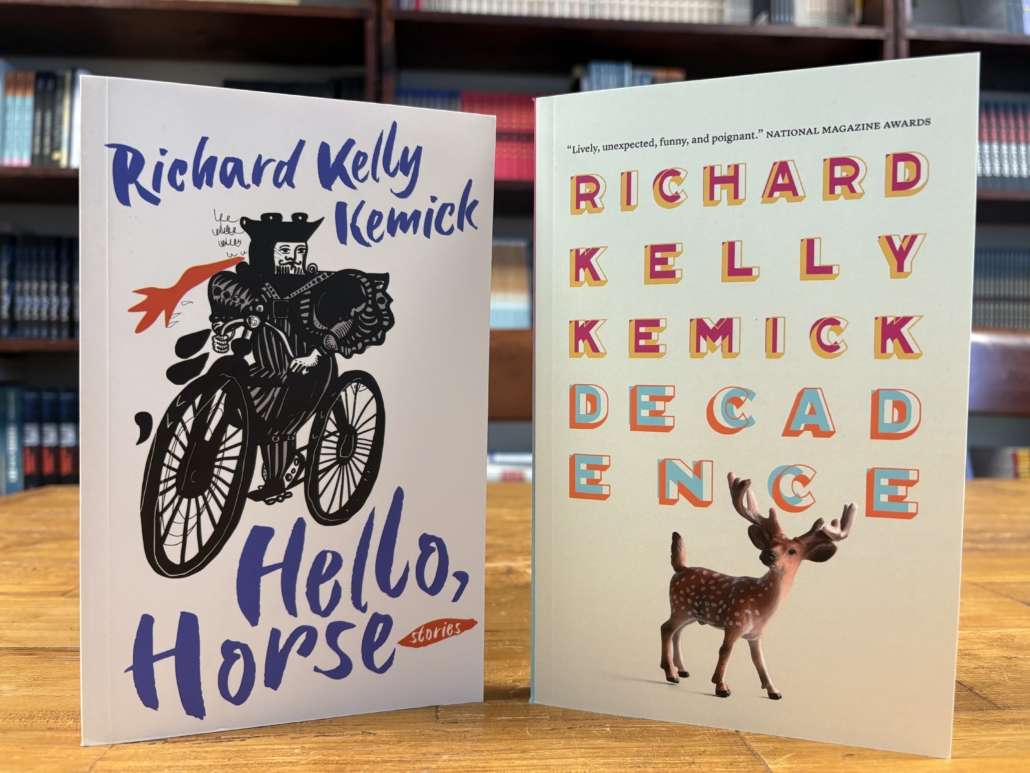
Photo: Kemick’s collection of short stories, Hello, Horse (Biblioasis, 2024), next to Decadence.
You’ve written poetry, short fiction, personal essays, and you also wrote a podcast series about your incarcerated cousin. What do you think separates the kind of nonfiction we get in Decadence from your other work? What propels this formal restlessness?
It takes me a lo(ooo)ng time to edit. When I am finally done with a manuscript, I am so over-stuffed with the genre that the idea of starting another project in the same vein is akin to ordering another cabbage when you have spent the past ten years of your life eating cabbage.
Decadence begins with an epigraph by another Biblioasis author, Marcello Di Cintio. It’s a lovely quote from his essay “Fatherhood”: “I call Heather again and she tells us to go to the hospital. [. . .] I can’t decide whether to drive very fast or very slow.” Can you tell us a little bit why you chose this as the epigraph?
I love this quotation from Marcello. I also love Marcello—how could you not adore a man who (and this is true) is named after an Italian marshmallow brand? But back to the quotation: I love how succinctly it summarizes most of the great fulcrums of our life: we know that we should do something, and we know that we shouldn’t do the other thing, but it’s always such a fine line between behaving perfectly and awfully. This, at least, is what I would tell my priest during my Catholic school days.
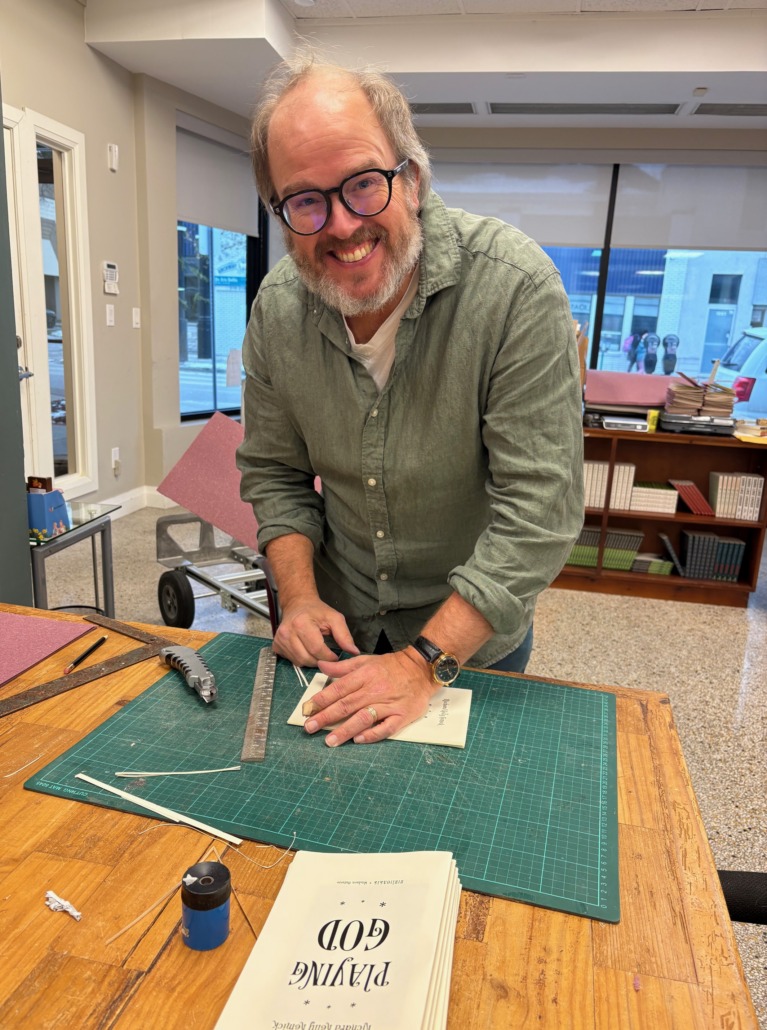
Photo: Richard Kelly Kemick with his miniature Christmas village featured in the essay “Playing God” from Decadence. Credit: Colin Way.
You’ve famously (around here) declared that “the genre of memoir is bullshit,” though Decadence of course draws heavily from your life. Could you elaborate some more on why you think it’s “bullshit”?
Sometimes I just say things and see what happens. Truthfully, I don’t even remember saying (or typing?) this, but I trust you far more than I do myself. I think most memoirs are written with a lot of clarity (admittedly, I’ve read, like, three). This clarity, however, seems disingenuous to the form because we live without any clarity—we are unsure, always, whether to drive very fast or very slow. This lack of perspective exists even when we are looking back on an event because we are just as subjective now as we were then. I’ve stumbled into writing a memoir that tries to mimic this complete lack of narrative (and marketable) form. Oftentimes, when we think we’re talking about X we are really thinking about Y. When I thought I was writing about my miniature Christmas village, it turns out I was writing about my fear of loneliness; but then, a few years later, I thought that I was actually writing about my fear of failing as a writer. Now, I think I was writing about my fears about impending fatherhood. Whatever it was, fear was involved.
What have you read or been reading lately that you’d like to recommend to your own readers?
I’ve been reading Eichmann in Jerusalem and Zolitude. Both are very good, and both I’ve been pretending to have read for years and have finally made the leap. Whatever took me so long? (Hint: The answer is two words. First word, “Vinyl.” Second word, “Cafe.”)
Photo: Our colourful stash of Decadence buttons.
In good publicity news:
Daphnis and Chloe by Colin McAdam (out Sept. 15 in Canada!) was included in Lit Hub’s list of Most Anticipated Books of 2026 Part Two: “A retelling, perhaps, of the titular myth—but spun through a modern Kelly-Link-sounding lens. Bring me myth, bring me love, bring me beauty! Plus, it has a Max Porter stamp of approval.”
Every Time We Say Goodbye by Ivana Sajko (trans. by Mima Simić) was featured in the Globe and Mail’s recent novellas round-up: “Sajko braids the personal and political into something both artful and quietly unsettling.”
Ducks, Newburyport by Lucy Ellman got a shoutout in The Guardian’s article, “Home is where the art is: the rise of the epic domestic novel.”: “Ellmann transforms the domestic experience into a philosophical, heroic one: the woman methodically latticing pastry over cherry pies is at the same time grappling with existence in all its light and shade.”
Precarious: The Lives of Migrant Workers by Marcello Di Cintio was included in The Tyee’s list of 2026 Summer Reads: “A stirring work of non-fiction that pulls back the curtain on the lives of migrant workers in Canada.”
https://www.biblioasis.com/wp-content/uploads/2024/08/unnamed-scaled.jpg6172560biblioasishttp://biblioasis.com/wp-content/uploads/2014/12/BIBLIOASIS-Logo-500x500-White-300x300.pngbiblioasis2026-07-02 16:57:222026-07-02 16:57:51Memoir is bullshit
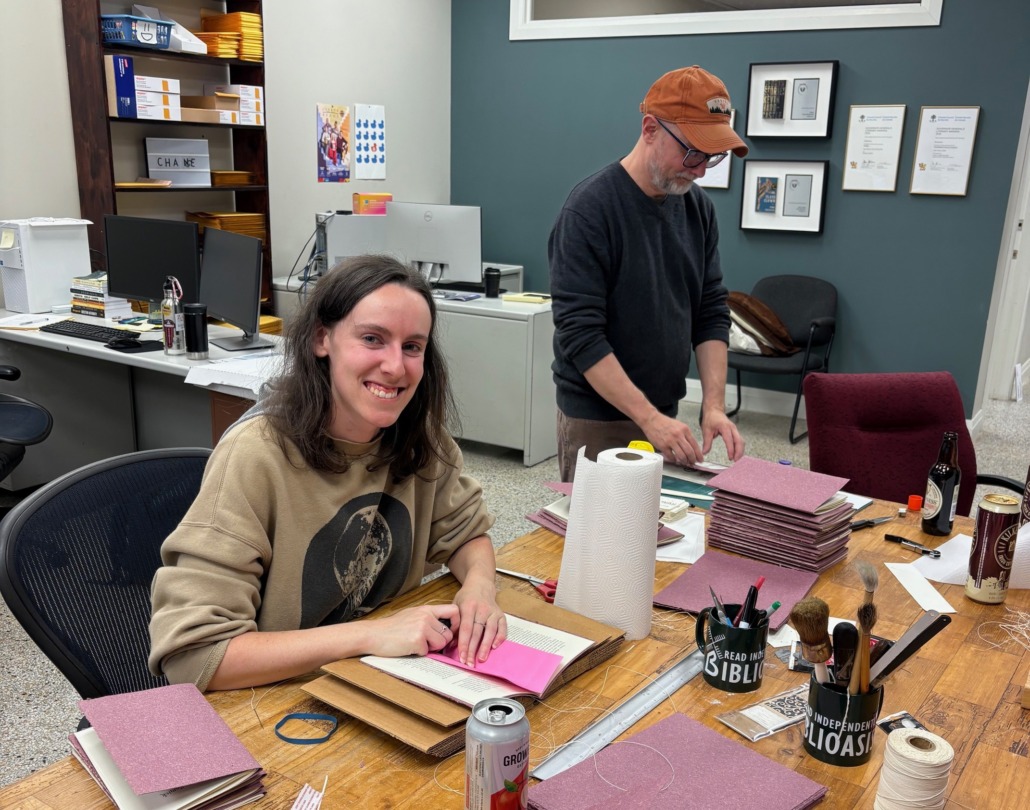
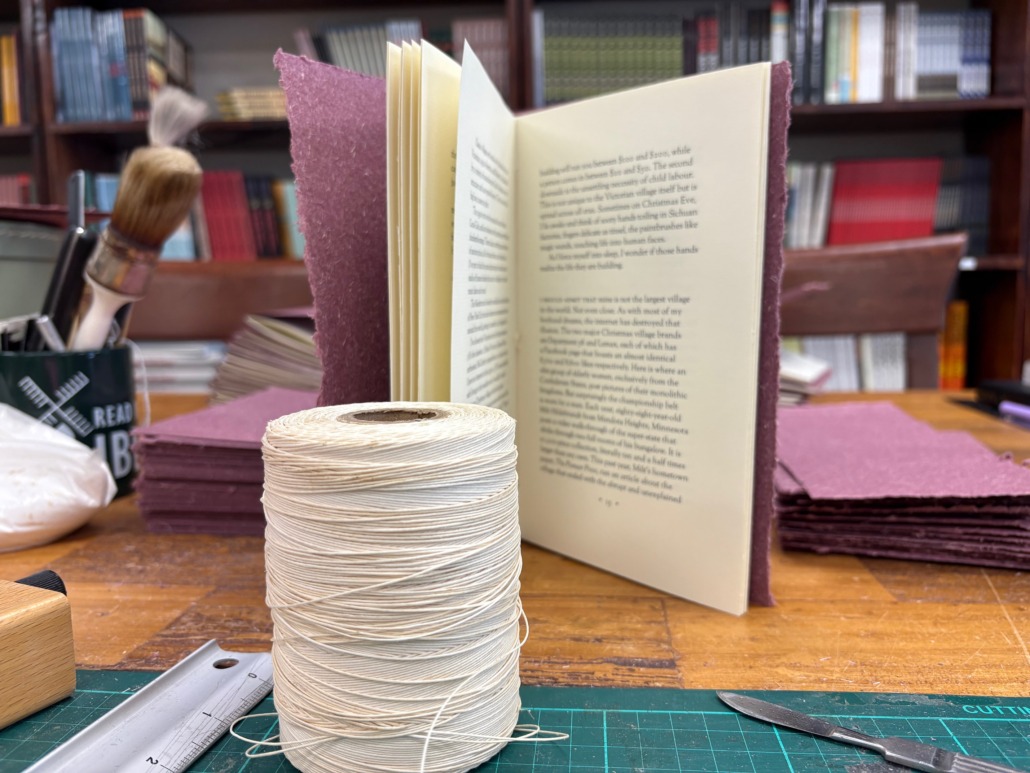
This week’s anticipated holiday post has been interrupted to hand-bind copies of Richard Kelly Kemick’s madcap tale of SCD (Seasonal Compulsive Disorder), “Playing God.”
We will resume our regular programming next week.
—The Biblioasis Crew
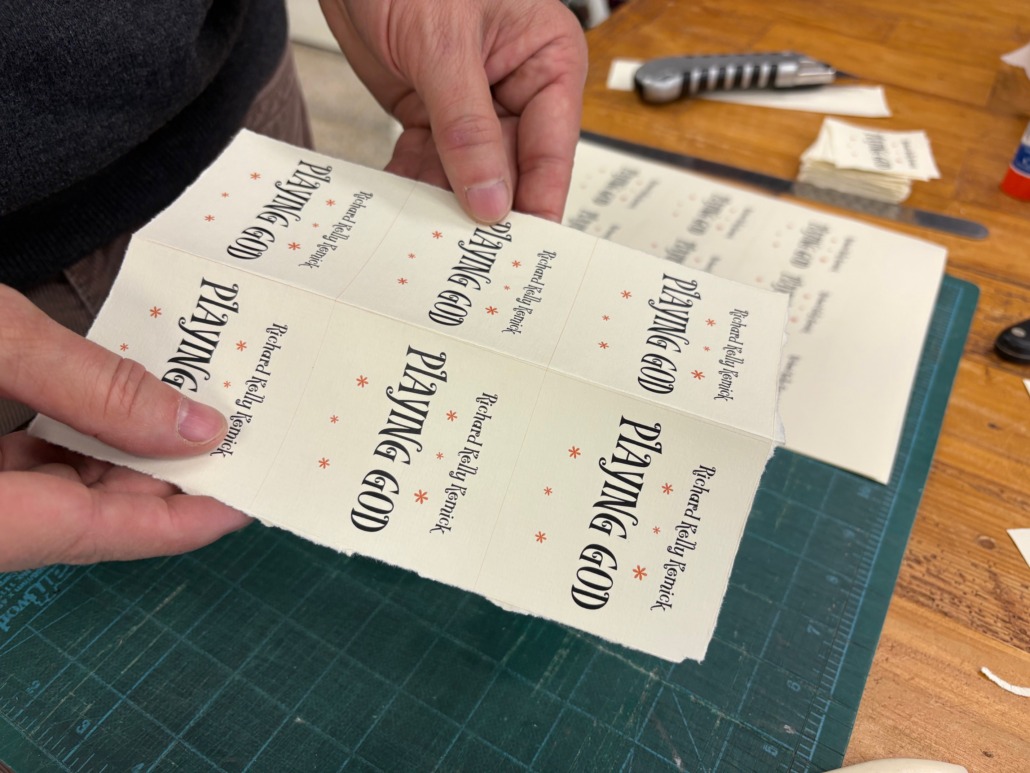
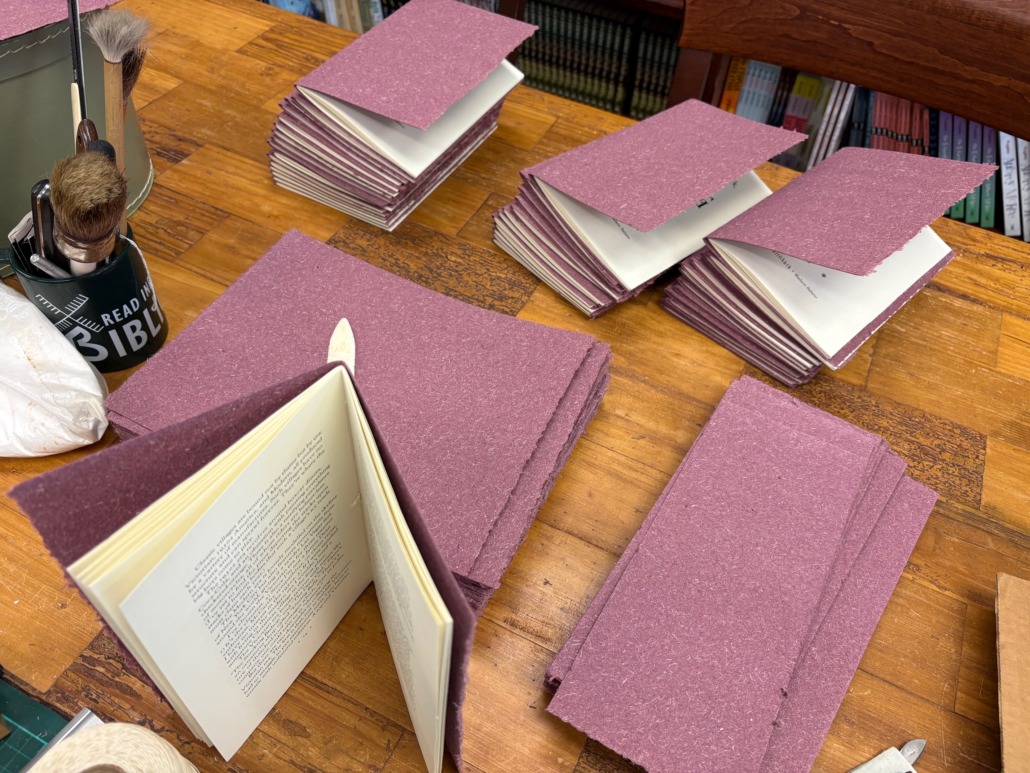
Photo: Prepping labels for the front cover of the chapbook edition of “Playing God” by Richard Kelly Kemick.Photo: Chapbooks waiting to be sewn together.Photo: Jeff and Ashley hard at work sewing and cutting labels.Photo: It’s all coming together . . .Photo: Publisher Dan Wells even emerged from the editorial pit to trim chapbooks!
In good publicity news:
Passenger Seat by Vijay Khurana appeared on the New York Times list of the staff’s “Favorite Hidden Gem Books of 2025,” recommended by Greg Cowles: “This taut, terrific novel—Khurana’s debut—ratchets up the tension in a classic formula . . . I’ve been recommending it for months to anybody who likes Richard Ford and Andre Dubus III.”
Marcello Di Cintio, author of Precarious: The Lives of Migrant Workers, was interviewed for CBC Ideas in the episode “Your tomatoes have a backstory and it’s not always pretty.” Precarious also made the Hill Times’s list of “Top 100 Best Books in 2025.”
Baldwin, Styron, and Me by Mélikah Abdelmoumen (trans. Catherine Khordoc) was listed in BOMBMagazine’s 2025 Small Press Gift Guide: “For the person who treats literary friendships like high-stakes contact sports.” The book was also picked by critic Steven W. Beattie for Quill & Quire’s “Notable Books of 2025”: “Part memoir, part literary criticism, part admiring portrait of Baldwin, one of the author’s heroes, Abdelmoumen’s book resonates clearly with our own contentious moment.”
Seth’s 2025 Christmas Ghost Stories were featured in the Chicago Tribune’s holiday book guide: “An addicting revival of the Victorian-born tradition of reading scary stories at holidays.” The stories also got a shout-out from longtime fan Patton Oswalt on social media!
Every Time We Say Goodbye by Ivana Sajko (trans. Mima Simić) was reviewed in the Irish Times: “Sajko vividly captures the way in which travel suspends both time and place in scenes that are at once real and dreamlike . . . Every Time We Say Goodbye is a threnody to leave-taking—elegant, mournful, and profoundly human.”
Benbecula by Graeme Macrae Burnet was listed in the Washington Post’s list of “11 new paperbacks to add to your shelf.”
https://www.biblioasis.com/wp-content/uploads/2024/08/unnamed-scaled.jpg6172560biblioasishttp://biblioasis.com/wp-content/uploads/2014/12/BIBLIOASIS-Logo-500x500-White-300x300.pngbiblioasis2025-12-12 15:15:582025-12-12 15:16:01The Bibliophile: Playing God


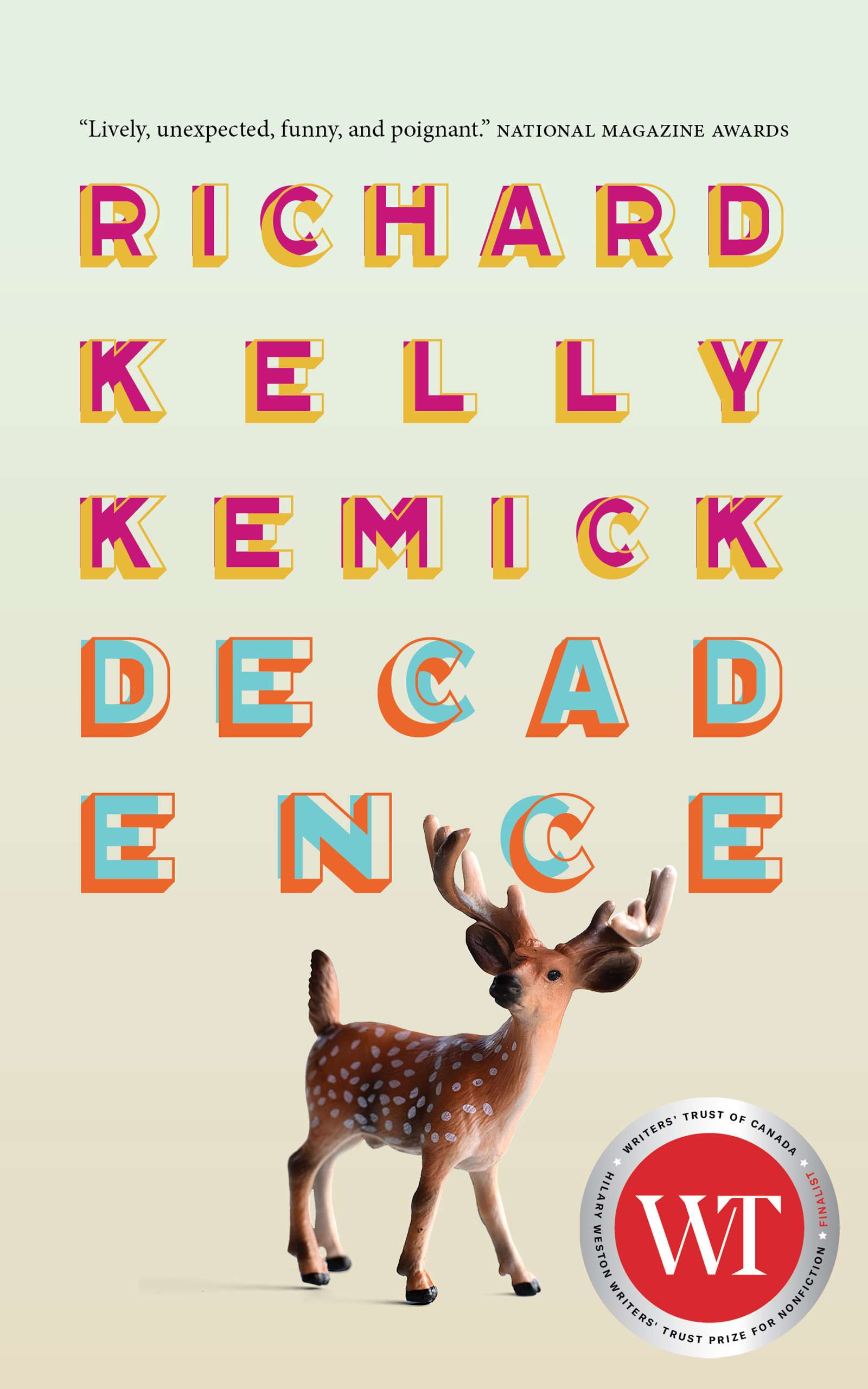 Biblioasis is thrilled to share that Decadence by Richard Kelly Kemick has been announced as a finalist for the 2026 Hilary Weston Writers’ Trust Prize for Nonfiction! You can check out all five finalists here.