As we come to the end of another busy year, we’re taking a look back at the incredible books we’ve published throughout 2025. Some were anticipated, others were unexpected but welcome drop-ins. There were debuts and long-awaited returns; authors from Canada, Ireland, Iceland, and beyond; and a rich berth of fiction, nonfiction, and poetry.
There’s been so much to read, in fact, that we’ve decided to split our staff recommendations across two weeks! So please enjoy this first half of our Biblioasis Holiday Book Guide, and keep an eye out for more great works next Friday. We hope you’ll find something new here for your holiday TBR.
Ashley Van Elswyk Editorial Assistant
Hilary Ilkay
Sales Coordinator
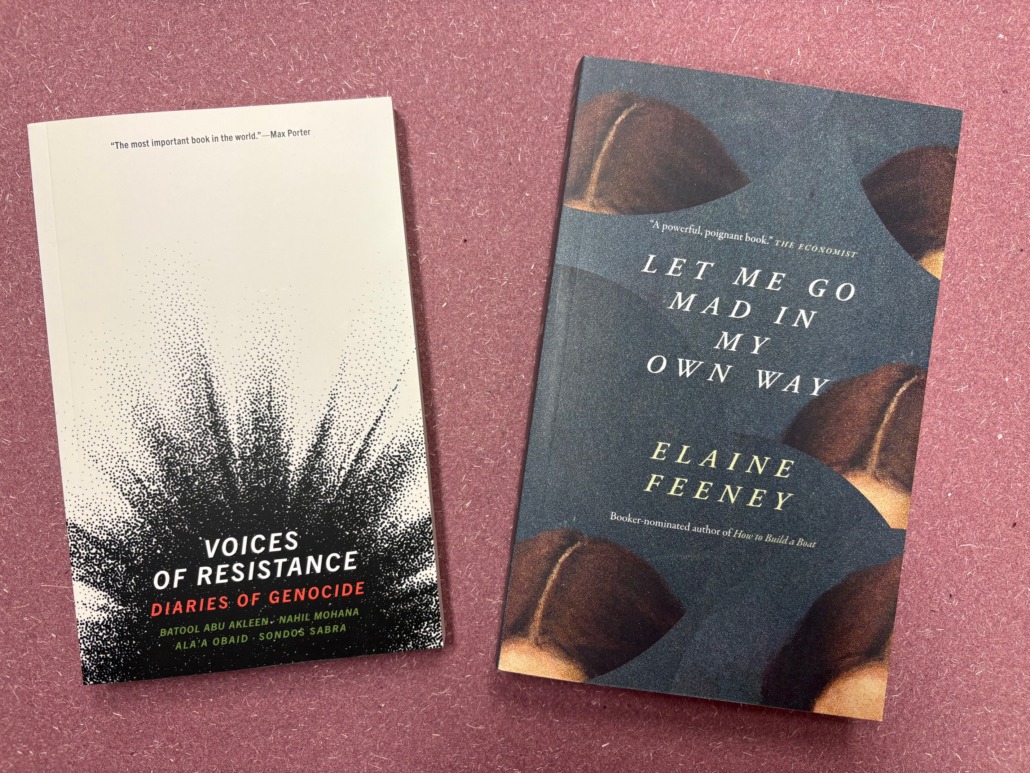
L: Voices of Resistance by Batool Abu Akleen et. al., designed by Ingrid Paulson. R: Let Me Go Mad in My Own Way by Elaine Feeney, designed by Kate Sinclair.
Elaine Feeney hooked me from the title, which is taken from Anne Carson’s translation of Sophocles’s tragedy Electra, and she didn’t disappoint. This is a novel of immense depth and substance, interweaving the present grief and past trauma of a family with western Ireland’s violent history. Let Me Go Mad in My Own Way explores the difficulty of homecoming, the relationship between domesticity and femininity, the vicissitudes of love, and losing oneself in order to discover oneself anew. Expect lyrical, dazzling prose with incisive dialogue and a wry sense of humour.
In the welcome proliferation of voices from Palestine receiving publication and translation, Voices of Resistance stands out as a deeply moving and powerful account of life in Gaza. Featuring the day-by-day diaries of four women—Batool Abu Akleen, Sondos Sabra, Nahil Mohana, and Ala’a Obaid—the book signifies a refusal to be silenced or erased and to let unfathomable loss and constant acts of violence give in to nihilism and despair. As the women suffer displacement and fear for their lives and those of their loved ones, they affirm community, solidarity, love, and hope for a different future. This is a must read.
Dominique Béchard
Publicity & Marketing Coordinator
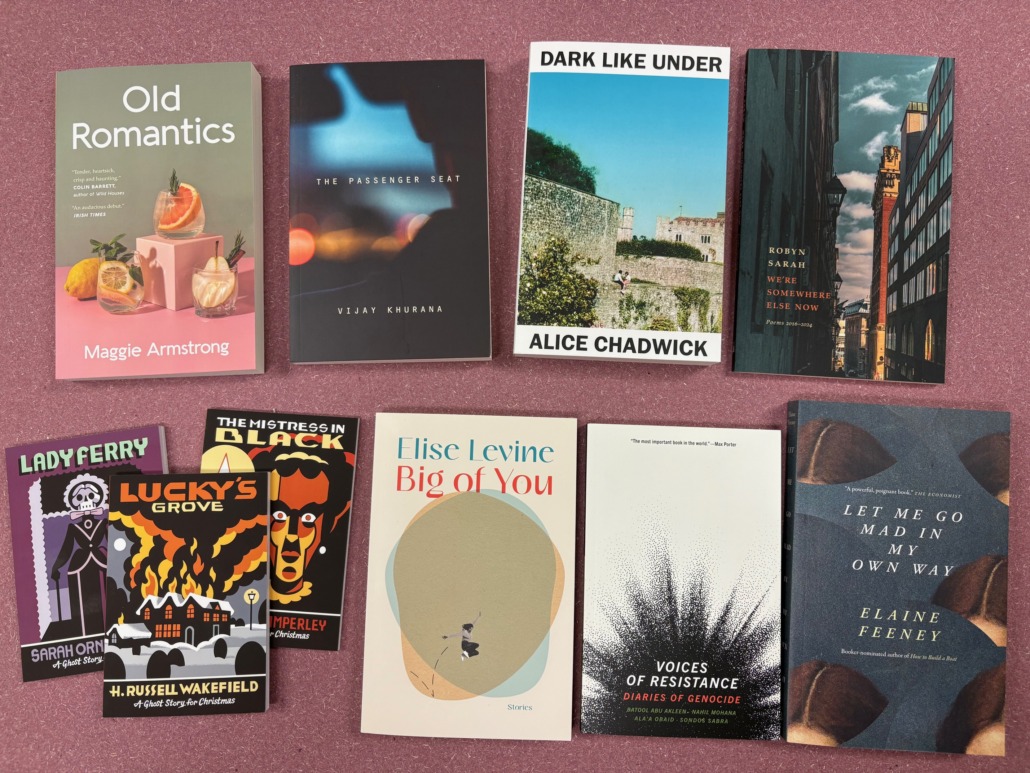
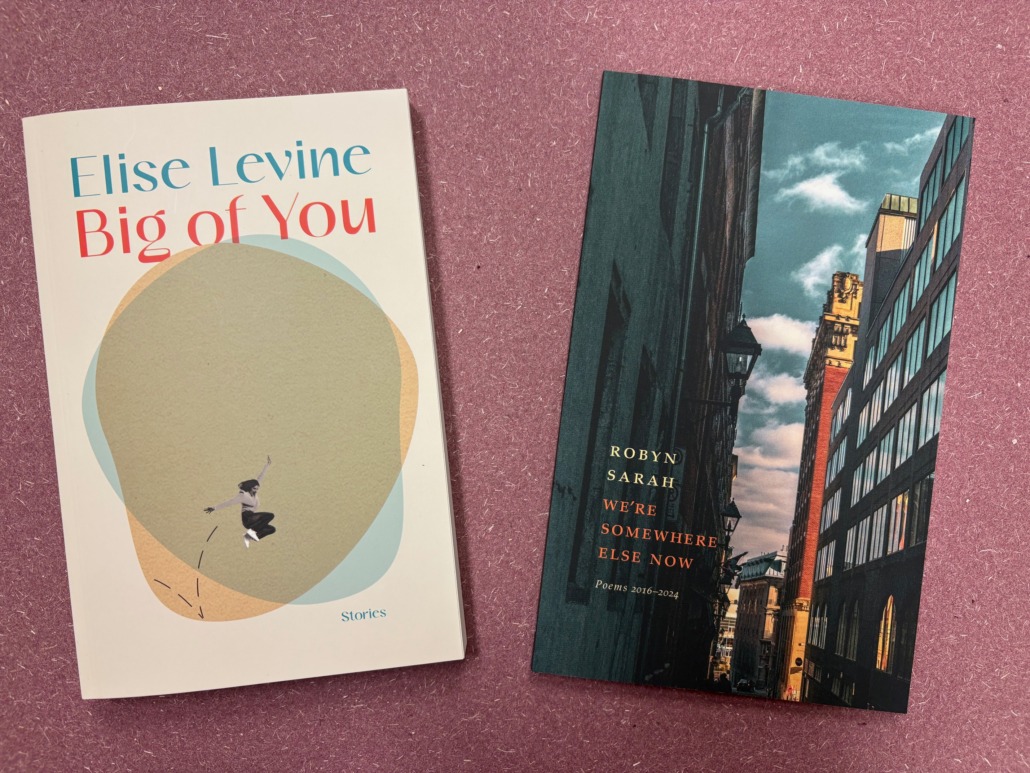
L: Big of You by Eline Levine, designed by Ingrid Paulson. R: We’re Somewhere Else Now by Robyn Sarah, designed by Vanessa Stauffer.
You can’t go wrong with a Robyn Sarah collection. These are plainspoken, thoughtful, gently philosophical poems. I’m left with a warm uncertainty after reading them: everything cast by doubt, yet in a way that feels vital and forgiving. Favourite poems are “In the Medical Building Lobby Café,” “An Abdication,” and the long, final poem “In the Wilderness,” which turns from the lyrical precision of her earlier poems, towards something opaque, shapeshifting, and uncontainable.
The sentences are just so incredible—the ways in which they twist around their speakers, revealing a suite of strange, charismatic, deeply unique characters. Elise Levine writes like nobody else, which sounds like a throwaway thing to say, but trying to come up with a comp (or even a blurb) for Levine feels like a disservice to the breadth of her writing. The story “Cooler” blew up any preconceptions I had about what a short story could do, and the last story, “Witch Well,” broke my heart. If you’re bored with the millions of formulaic books out there, this is the one to bring back that old, fundamental love of literature.
Ahmed Abdalla
Publicist
L: Old Romantics by Maggie Armstrong, designed by Fiachra McCarthy. R: The Passenger Seat by Vijay Khurana, designed by Zoe Norvell.
Maggie Armstrong told me that an “old romantic” is a hapless fool who continually authors their own destruction by way of repeated mistakes and self delusion. They tend not to make good friends, but they are rich for fiction. Old Romantics is an arresting collection of linked short stories about one such hapless fool and about love’s beginnings and ends. The collection follows Margaret from young adulthood to middle age, depicting all the drama, heartache, and trivial misfortunes that come her way. These stories are delectable and addictive, with witty, sardonic lines and entertaining scenes, they made me laugh and cringe as I recognized in Margaret the fool I have sometimes been. It’s hard to talk about what makes something funny, but I hope you’ll trust me when I say Armstrong’s dark comedy is first-rate.“The Dublin Marriage” was a particular standout story for me and one I often go back to.
This was the first book I worked on when I started at Biblioasis, so I suspect it will always have some kind of hold on me personally. It’s a damn fine piece of writing that grabs you by the shoulders, shakes you, and engages in questions—about masculinity, violence, identity, loneliness—that we tend to shy away from. It’s about two young men on an aimless summer road trip and the murders they commit for reasons they can’t even explain. It covers uncomfortable ground and gives no easy answers, but reading Khurana is a pleasurable experience for his distinctive voice and how he renders the claustrophobia of being on the open road. Perhaps not the most festive of books, but it will linger in your mind for months, maybe years, maybe forever.
Ashley Van Elswyk
Editorial Assistant
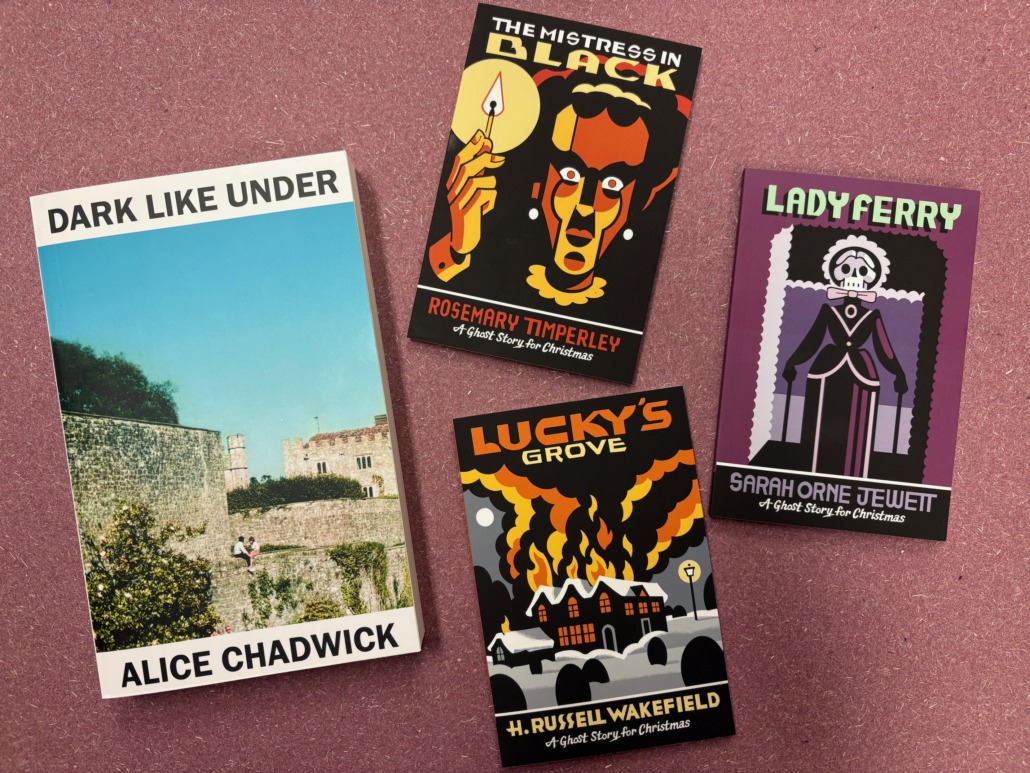
L: Dark Like Under by Alice Chadwick, designed by Kate Sinclair. R: Christmas Ghost Stories 2025, selected & designed by Seth.
I’ve been banging the drum for years about how fun these spooky little books are, and I’m at it again today! This year’s trio presents such a great range of ghost stories, and while the melancholic but beautiful Lady Ferry looks to be a favourite among readers, and The Mistress in Black is a tragic but cathartic schoolhouse tale not to be ignored, I’d have to say my personal pick is Lucky’s Grove, which involves a classic demonic haunting and takes place over Christmas (gather ’round the blazing tree!). And of course, I can’t go without praising Seth—this series wouldn’t exist without his fine illustrations, striking covers, and eye for classic ghostly tales.
We’ve published a number of stellar novels over 2025, but if I’m going to recommend one I was really drawn into, it’s Alice Chadwick’s debut Dark Like Under. In this circadian novel, Chadwick takes us through a single day following the students and staff of a rural English school in the 80s after the unexpected death of one of the teachers. The teens are restless, grappling with their own personal troubles and relationships with one another, and everyone is dealing with the sudden change in their lives. The characters of Tin and Robin are particularly fascinating to follow, complex but sympathetic. Chadwick’s voice is grounded and real, and there’s some truly beautiful writing in here as she deftly tackles grief, hope, and the hard path to moving forward.
Elaine Feeney, author of Let Me Go Mad in My Own Way, is the An Post Irish Book Awards’ Library Association of Ireland Author of the Year winner! Let Me Go Mad in My Own Way was also reviewed in the Winnipeg Free Press: “With richly textured description, Feeney takes readers through several layers of troubled Irish history and suffering across generations.”
Benbecula by Graeme Macrae Burnet was reviewed in the Winnipeg Free Press: “Continues Burnet’s stringent deconstruction of the crime genre, which began with His Bloody Project . . . Burnet catches the somewhat formal 19th-century cadences of Malcolm’s voice and wrings a kind of bleak, beautiful poetry from the harsh, impoverished lives of the MacPhee family.”
Jón Kalman Stefánsson virtually joined the Winnipeg Free Press book club to talk about Heaven and Hell. Its sequel, The Sorrow of Angels, was reviewed in roughghosts: “Stefánsson’s language is poetic, his characters are pushed to their limits—physically and emotionally—and the remoteness and ruggedness of the remote reaches of northern Iceland a century ago is portrayed with relentless intensity. A thoroughly enjoyable read.”
https://www.biblioasis.com/wp-content/uploads/2024/08/unnamed-scaled.jpg6172560biblioasishttp://biblioasis.com/wp-content/uploads/2014/12/BIBLIOASIS-Logo-500x500-White-300x300.pngbiblioasis2025-11-28 15:10:582025-11-28 15:11:00The Bibliophile: The Biblioasis Holiday Book Guide (Part I)
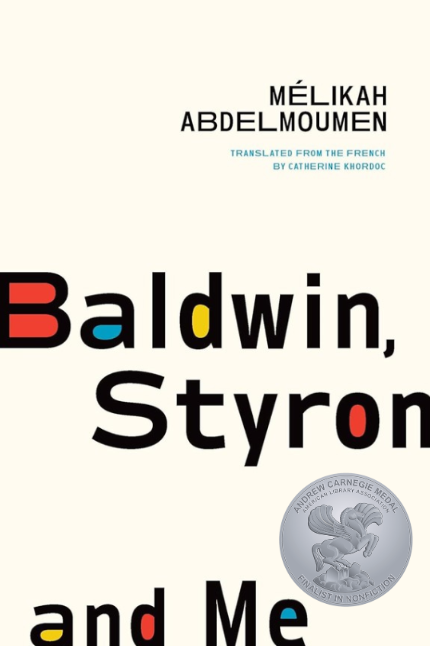
We’re excited to share that Baldwin, Styron, and Me by Mélikah Abdelmoumen, translated by Catherine Khordoc, is one of the three finalists for the Andrew Carnegie Medal for Excellence in Nonfiction! The finalist announcement was made this morning on Tuesday, November 18, and can be viewed here.
The other two nonfiction finalists are There Is No Place for Us: Working and Homeless in America by Brian Goldstone and Things in Nature Merely Grow by Yiyun Li. Read more in the ALA’s full finalists press release here.
The two medal winners for Fiction and Nonfiction will be announced on January 27, 2026. A celebratory event will take place at the ALA Annual Conference in June 2026 in Chicago.
The Andrew Carnegie Medals for Excellence in Fiction and Nonfiction, established in 2012, recognize the best fiction and nonfiction books for adult readers published in the US in the previous year and serve as a guide to help adults select quality reading material. They are the first single-book awards for adult books given by the American Library Association and reflect the expert judgment and insight of library professionals who work closely with adult readers. The winning authors (one for fiction, one for nonfiction) receive a $5,000 cash award.
Shortlisted for the 2026 Andrew Carnegie Medal for Excellence in Nonfiction • Finalist for the 2025 Governor General’s Literary Award in Translation • Finalist for the 2025 John Glassco Translation Prize
In 1961, James Baldwin spent several months in William Styron’s guest house. The two wrote during the day, then spent evenings confiding in each other and talking about race in America. During one of those conversations, Baldwin is said to have convinced his friend to write, in first person, the story of the 1831 slave rebellion led by Nat Turner. The Confessions of Nat Turner was published to critical acclaim, winning the Pulitzer Prize in 1968, and also creating outrage in part of the African American community.
Decades later, the controversy around cultural appropriation, identity, and the rights and responsibilities of the writer still resonates. In Baldwin, Styron, and Me, Mélikah Abdelmoumen considers the writers’ surprising yet vital friendship from her standpoint as a racialized woman torn by the often unidimensional versions of her identity put forth by today’s politics and media. Considering questions of identity, race, equity, and the often contentious public debates about these topics, Abdelmoumen works to create a space where the answers are found by first learning how to listen—even in disagreement.
Mélikah Abdelmoumen was born in Chicoutimi in 1972. She lived in Lyon, France, from 2005 to 2017. She holds a PhD in literary studies from the Université de Montréal and has published many articles, short stories, novels, and essays, including Les désastrées (2013), Douze ans en France (2018), and Petite-Ville (2024). She worked as an editor with the Groupe Ville-Marie Littérature in Montreal until 2021. She was the editor-in-chief of Lettres québécoises, a Québec literary magazine, from 2021 to 2024. Baldwin, Styron, and Me is her tenth book (and the first to be translated).
Catherine Khordoc is a professor of French and Canadian Studies at Carleton University in Ottawa. She is the author of Tours et détours: Le mythe de Babel dans la littérature contemporaine (University of Ottawa Press, 2012). She also considers herself in many ways a frontier-dweller.
https://www.biblioasis.com/wp-content/uploads/2025/11/Baldwin_Carnegie_shortlist.jpg8002000biblioasishttp://biblioasis.com/wp-content/uploads/2014/12/BIBLIOASIS-Logo-500x500-White-300x300.pngbiblioasis2025-11-18 13:16:452025-11-18 13:20:15BALDWIN, STYRON, AND ME a finalist for the 2026 Andrew Carnegie Medal for Excellence in Nonfiction!
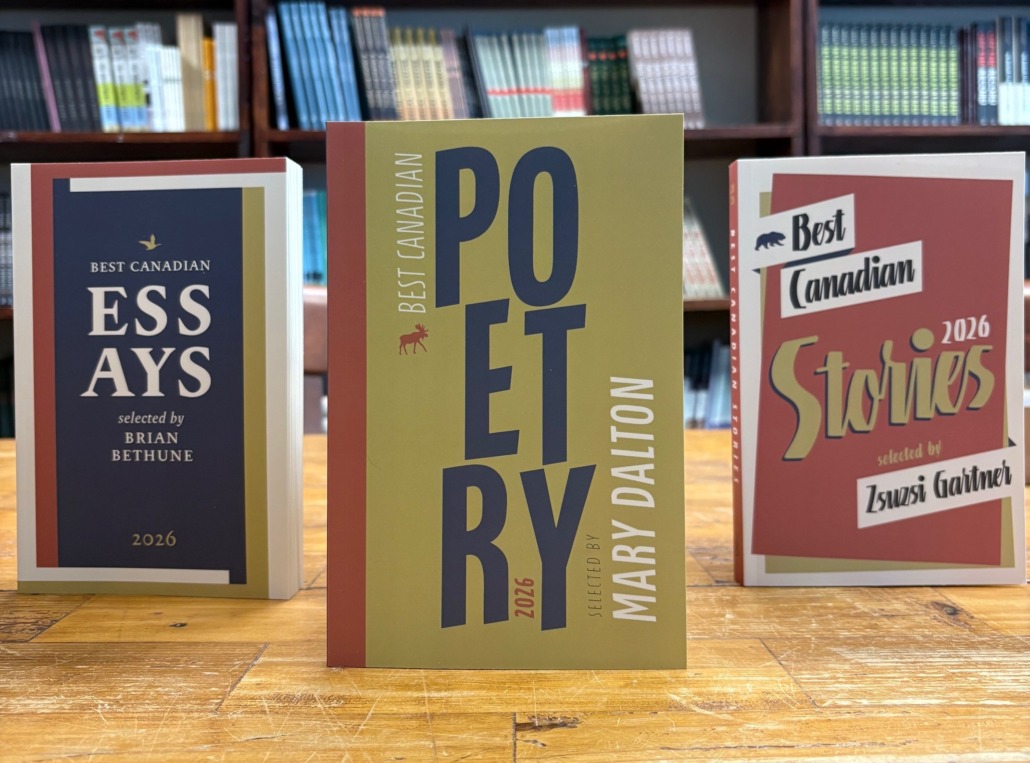
Our editors for the latest editions—Brian Bethune, Mary Dalton, and Zsuzsi Gartner—have all shown such enthusiasm and care during the selections for these anthologies (revisit our contributor announcement), and in the months since, through production and publicity, as we head towards publication next Tuesday, November 18.
On that note, we’d also like to highlight the various launches happening across Canada for each book. For those in the area, we hope you’ll join our contributors and editors in celebrating great Canadian literature and poetry:
Best Canadian Storiesin Vancouver (Nov 18 at 6:30PM)
Best Canadian Poetryin St. John’s (Nov 30 at 7:30PM)
A combined Best Canadian Poetry 2025/2026 event in Vancouver (Dec 11 at 7PM)
Best Canadian Essays in Toronto (Jan 2026: time and date TBA!)
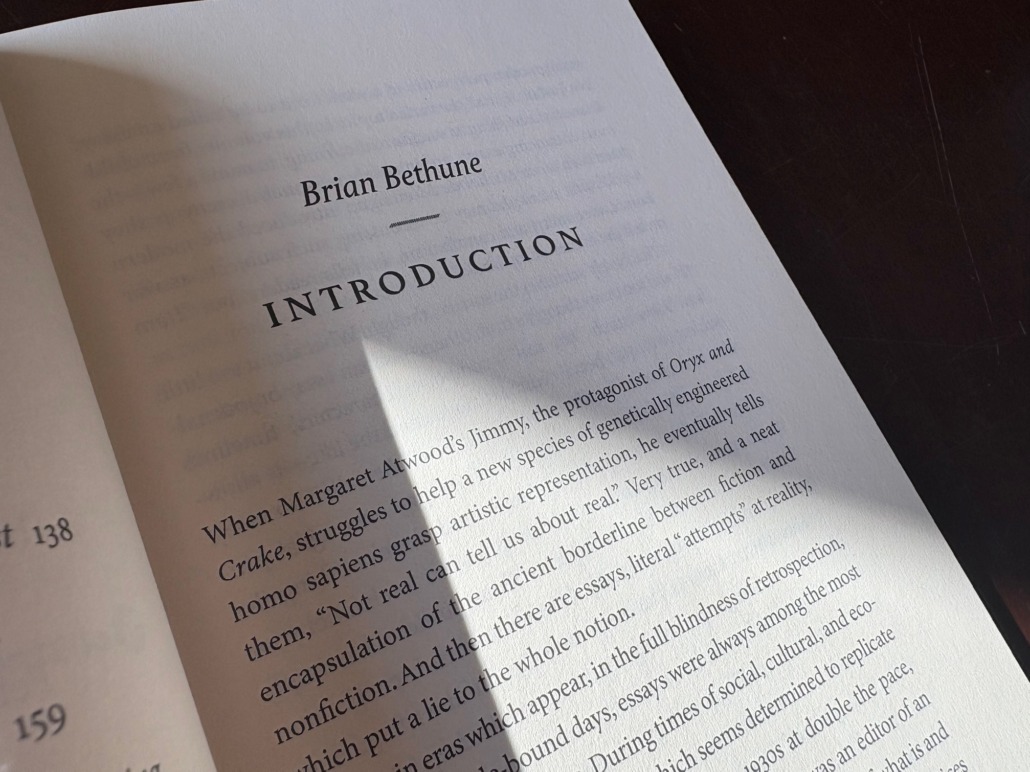
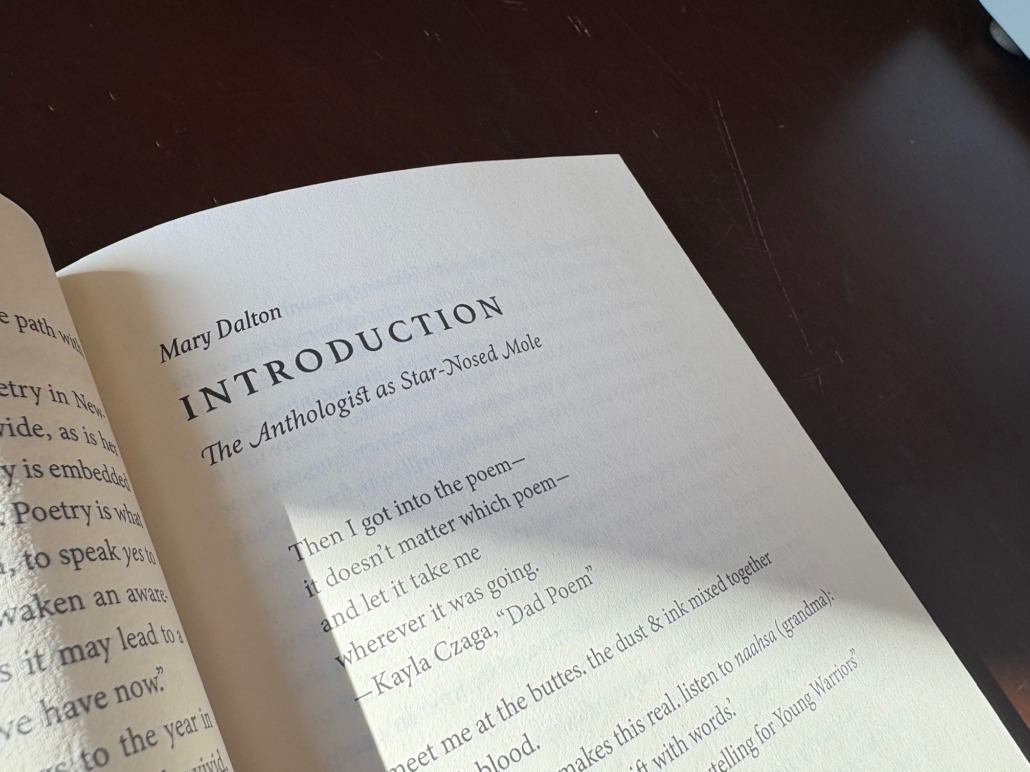
In today’s Bibliophile, we’d like to present a few brief excerpts from the introductions, letting each editor share, in their own words, a little of their journeys to finding the poems, essays, and stories that they considered to be the best.
When Margaret Atwood’s Jimmy, the protagonist of Oryx and Crake, struggles to help a new species of genetically engineered homo sapiens grasp artistic representation, he eventually tells them, “Not real can tell us about real.” Very true, and a neat encapsulation of the ancient borderline between fiction and nonfiction. And then there are essays, literal “attempts” at reality, which put a lie to the whole notion.
Even in eras which appear, in the full blindness of retrospection, to have been rule-bound days, essays were always among the most protean of literary forms. During times of social, cultural, and economic upheaval like our own, which seems determined to replicate Auden’s “low, dishonest decade” of the 1930s at double the pace, essays are slippery indeed. There surely never was an editor of an essay collection who had a good, working definition of what is and is not an essay. Or, for that matter, didn’t introduce their choices without muttering about the genre’s highly permeable edges.
I am honoured to follow that tradition. Some questions about definition are easy to answer. Can there be too much “I” and not enough other perspective in a work for it to be called an essay? No, just no. For all the varied topics in this volume, from childlessness to catfishing to suicide to mourning, to name a few—the most entrancing essays are intensely personal. Exactly as they have been since Michel de Montaigne introduced the modern world’s first essais: he may be discussing such subjects as war horses, inequality, and cannibalism, he tells readers, but “I am myself the matter of my book.”
That barely scratches the surface, though. What about too little “I” and too many thoughts from others—is it an essay or journalism? How much “not real”—composite characters, timelines subject to torque, heavily edited dialogue and the like—is allowable in a piece of “real” writing that can still be called an essay, nonfiction by definition? To which Montaigne once again provides the only answer: que sais-je? In the end, there’s nothing else to do when defining an essay’s boundaries but to channel your inner Potter Stewart, the US Supreme Court justice who simply gave up on identifying obscenity: “I know it when I see it.”
This is what I saw in the essays here. Beautiful writing, acute observation, thought-provoking arguments. And a deep interiority, a kind of personal revelation, sometimes overt, sometimes inadvertent, at times compellingly ambiguous. Sometimes, “real” presents the same human uncertainty and possibility “not real” does.
Dear Reader, in making your star-nosed way through this anthology, looking for “something written” (to echo the ideal reader of M. W. Miller’s poem), you will likely make observations and linkages other than my own. Think of the following account as one side of a conversation with you. Reading anthologies myself over the years I’ve developed a habit of leaping headlong into the works assembled; afterwards I settle comfortably into the introduction, eager to engage with the anthologist’s commentary, aware that it might send me back to the poems with some new questions, or some new perspective. Maybe that method will work for you, too?
*
Let me tell you about the star-nosed mole. It’s a curious creature, one I’ve come to associate with the process of searching out the energies pulsing in a genuine poem, whether one is maker or reader. The star-nosed mole spends most of its time in damp underground tunnels. It goes by touching, feeling its way along, navigating by means of the twenty-two fleshy tentacles (the star) at the end of its snout. Those tentacles have over 100,000 nerve fibres; the star-nosed mole has the most sensitive touch organs of any known mammal. Its nose has been called “the nose that sees.” Constantly on the move in its search for food, it is a voracious eater, needing to consume 50 percent of its body weight every day. According to The Guinness Book of Records, it is, among the mammals, the fastest eater on earth.
There’s a headlong, unwilled quality to the activity of the star-nosed mole, a blind searching quality that seems to me akin to the energies operating in the creating of a poem, as well as in the process of discovery involved in reading a good poem. When Dennis Lee, in his essay “Cadence, Country, Silence,” gives the name cadence to the particular aspect of poetry which he tries to summon forth, he is attempting to describe something similar:
I speak of “hearing” cadence, but the sensation isn’t auditory. It’s more like sensing a constantly changing tremor with your body: a play of movement and stress, torsion and flex—as with the kinaesthetic perception of the muscles.
In my reading for Best Canadian Poetry 2026 I quested like the star-nosed mole, snout aquiver for the vital pulse. I aimed to read without program, without preference for particular poetics, region, gender, age, or ethnicity—not with the territorial sweep of the eye but sniffing and snuffling along for the spoor of the genuine.
There were certain touchstones, such as Edward Hirsch’s observation that “the lyric poem exists somewhere in the region—the register—between speech and song.” As well, the myriad manners in which form may fuse with content became apparent in the course of my explorations. The poems which distinguished themselves drew in a variety of ways upon the range of resources available to the poet: among them line- and stanza-shaping, image, figure, and voice.
There is, of course, a variety of themes and types of poems. Some of the types and techniques to be found are: ghazal; ode; monologue; catalogue poems, prose poems; dream narratives; pieces inspired by diary format and online comments format; pieces drawing on vernacular and dialogue. A surreal element operates in several poems, as does humour, often of a wryly ironic sort. The dominant mode is free verse, with its music derived from chains of consonance and assonance. In some instances, anaphora drives the rhythm. The couplet, that wily stanza with its capacity to evoke now confinement and now a ramped-up surging energy, is a frequent structural device.
At this point, looking back over the terrain of the gathering I’ve made, I’m feeling my way among the poems once again, in a mole-like sensing of the contours of the collection—and recognizing again the truth of Adam Sol’s observation, made in his How A Poem Moves: A Field Guide for Readers of Poetry, that this is a golden age for the art of poetry.
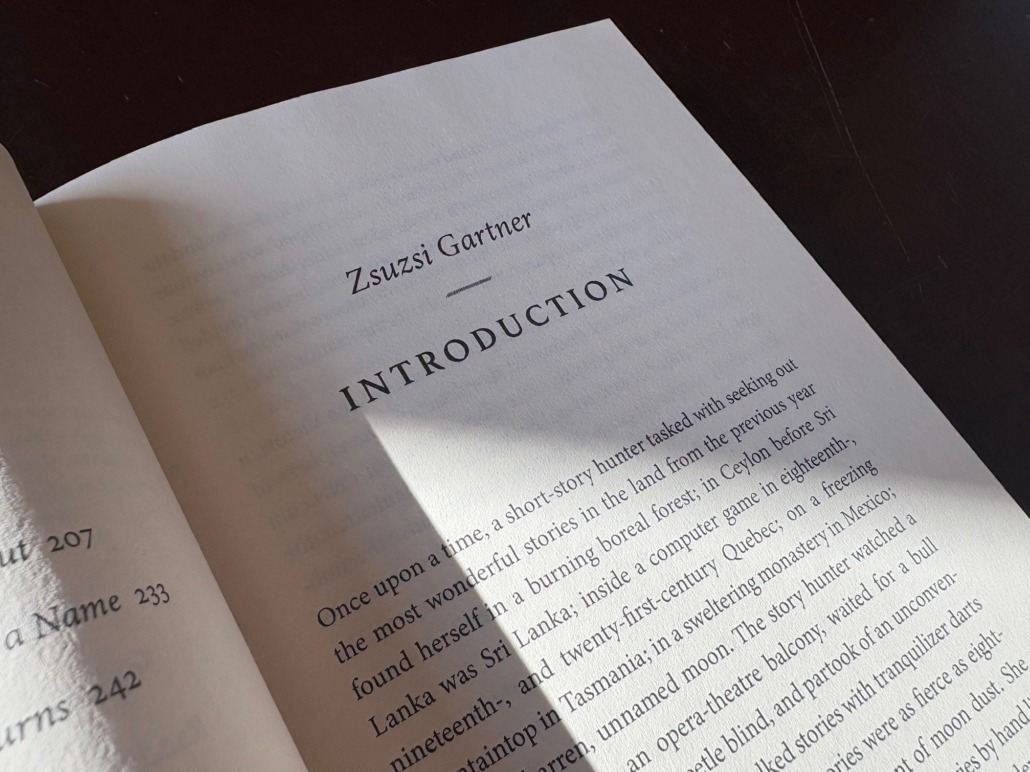
Once upon a time, a short-story hunter tasked with seeking out the most wonderful stories in the land from the previous year found herself in a burning boreal forest; in Ceylon before Sri Lanka was Sri Lanka; inside a computer game in eighteenth-, nineteenth-, and twenty-first-century Quebec; on a freezing mountaintop in Tasmania; in a sweltering monastery in Mexico; and on a barren, unnamed moon. The story hunter watched a woman fall from an opera-theatre balcony, waited for a bull moose behind a pine-beetle blind, and partook of an unconventional Christmas feast. She stalked stories with tranquilizer darts and with a butterfly net, as some stories were as fierce as eight-year-old girls, others as elusive as the scent of moon dust. She hunched next to mountain streams scooping stories by hand like a grizzly scoops salmon, tossing back the fry too undeveloped yet to satisfy her vast appetites.
Many of these marvels were not easy to find, hidden as they were amidst the forests of sameness and swamplands of meh. The cities and suburbs and ex-urbs hid stories as well. The story hunter donned mufti and went knocking door to door to find the stories inside houses where the air was crisped to sixty-four degrees while temperatures blistered outside, houses where detoxing teens oozed drugs through their pores, houses divided into apartments where the online world was more satisfying than anything IRL, and apartments in a nineteenth-century heritage building set ablaze.
Like the naturalists and scientific explorers of the Victorian era, the story hunter discovered new lexicons: the ciphers of amateur cyber cryptographers, the close parsing of CNN.com and NYT required of aspirational newcomers to Manhattan, the deceptively simple language of gaming commands, the non-linear communication style of the Intergalactic Federation of Research Camaraderie, the coded meanings of emojis, and the lingua franca of children wielding their otherworldly power at the beach: Boomshaka. Lingwalla. Boomwalla!
Boomwalla, indeed! The story hunter had tumbled down a rabbit hole and was surrounded by an eclectic array of stories all deserving her full attention, like Alice in the midst of her furred and feathered coterie. And like the Dodo after the mad Caucus-race, the story hunter determined that all were winners and all must have prizes. She hopes the authors will accept these accolades in lieu of sugary confections and a thimble.
In other good publicity news:
Benbeculaby Graeme Macrae Burnet was reviewed in the Chicago Tribune: “Burnet has written the novel from a smattering of historical documents described in an afterward, and he has brewed a powerful spell imagining the darkness surrounding these events . . . For the right reader, Benbecula will be a powerful experience.” Burnet was also interviewed about the book in the Scotsman.
Every Time We Say Goodbye by Ivana Sajko (trans. Mima Simić) was reviewed in the Irish Times: “However grim the subject matter, the writing remains exceptionally good, with long, majestic sentences that curl unpredictably around the subject. This profound novel is superbly translated by Simić.”
Baldwin, Styron, and Me by Mélikah Abdelmoumen (trans. Catherine Khordoc) got a shout-out in the Irish Times: “An intriguing set of essays by a leading Quebec writer who explores the conflicted legacies of William Styron and James Baldwin to reflect on identity politics in the contemporary world.”
Self Care by Russell Smith was reviewed in the Winnipeg Free Press: “Self Care isn’t just poking fun. It is also, in many ways, deeply sympathetic to its characters, who are struggling with a world very different from the ones their parents grew up in.”
Heaven and Hell by Jón Kalman Stefánsson was reviewed in roughghosts: “[Heaven and Hell] combines old-fashioned drama with contemporary literary sensibility, a tale of loss and bravery that makes for a truly glorious read.” Its sequel, The Sorrow of Angels was excerpted in Lit Hub.
Big of You by Elise Levine was excerpted in Open Book: “A masterclass from an author that has few equals in the form . . . Full of disarming tenderness, Big of You showcases Levine’s signature brilliance through language and craft.”
Want to get new excerpts, musings, and more from The Bibliophile right away? Sign up for our weekly online newsletter here!
***
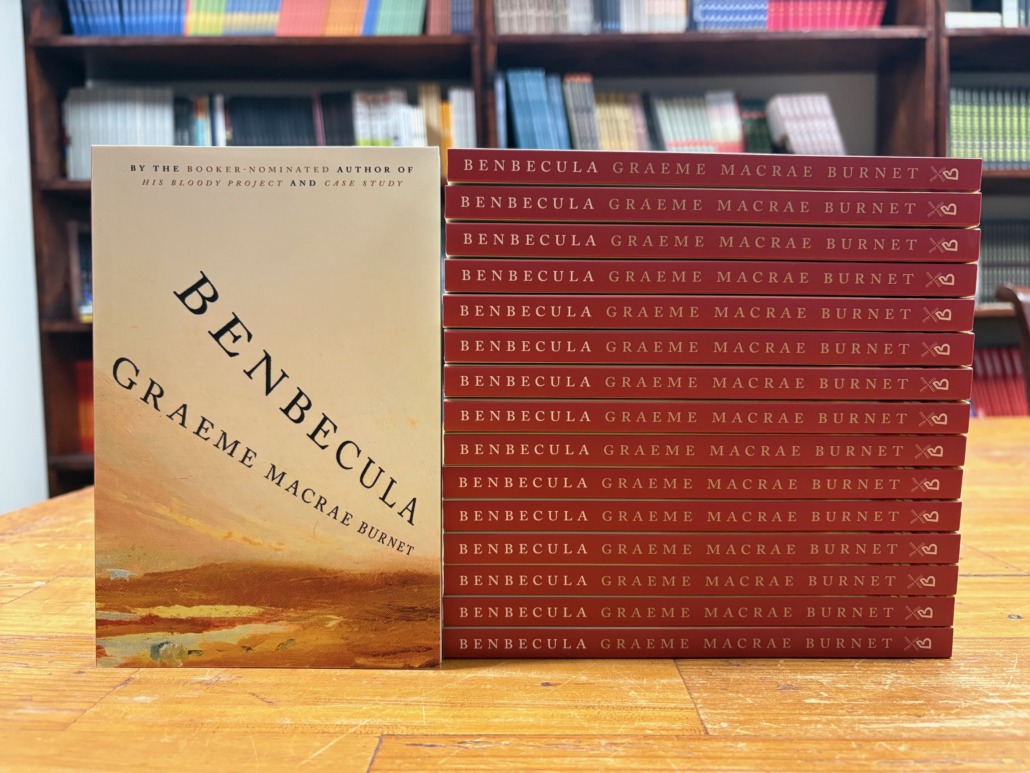
It’s a striking little book. Benbecula by Graeme Macrae Burnet. By striking I mean it is both very beautiful and violent and grotesque. It’s also funnier than you’d expect. Benbecula comes out in North America next week and it may be the book I’m most excited about. A story of madness and uncertainty told with a Samuel Beckett-esque voice, the novel is based on a true, little-known triple murder that took place on a remote Scottish island in the 1850s. It’s written from the perspective of the murderer’s brother, who describes what led to his brother’s actions, and as he tells us what’s happened, we start to question whether his brother was the only insane one.
Photo: Benbecula by Graeme Macrae Burnet. Cover designed by Kate Sinclair.
Burnet first learned of the case when he was doing research for his internationally celebrated and Booker-shortlisted novel His Bloody Project. In some ways Benbecula is the inverse of that book—where His Bloody Project was about a fictional murder presented as fact, Benbecula takes a real murder and builds a fiction around it. And like all of Burnet’s work, it keeps you guessing on what’s true and what’s not.
Benbecula was the first of Burnet’s books that I’ve read, but after doing so I quickly sought out his others. And I know this post is to let you know about Benbecula in the hope that you will read it, but I would also like to shout out his 2022 novel Case Study, because I recently read it and can’t stop thinking about it. Just as I can’t stop thinking about Benbecula. This is fiction that genuinely makes me giddy to read. I don’t know if it’s the existentialist bent to his work that appeals to me as someone who read too much Beckett and Camus in university, or his dark humour, or the vividness of his language. It’s probably all of that, but I’ll stop gushing now.
For every book we publish, we put together a press kit for the media that we send along with advance copies of the book. Some of you are no doubt already familiar with this. The kit includes a description of the book, a biography of the author, and all the lovely things critics and booksellers have said about it. We also include a short interview with the author, usually conducted by me or Dominique, which we then like to post on Substack. I’ve been at Biblioasis exactly one year as of this past Tuesday, and doing these interviews is one of my favourite parts of the job. I really enjoyed my conversation with Burnet, and hope you do too.
Ahmed Abdalla, Publicist
A Biblioasis Interview with Graeme Macrae Burnet
You’ve said that you first heard of the MacPhees’ story when you were writing His Bloody Project around twelve years ago. Why did you decide to return to it now? What about it made it stick in your mind all this time?
I was doing that research for His Bloody Project years ago and I came across the case of Angus MacPhee who killed three members of his family on this tiny Scottish island. It was of interest to me at the time because I was writing about a fictional nineteenth-century murder case in a Scottish Highland community, and here was one that actually happened, and that Angus was found to be criminally insane and so was not hanged was also interesting. At the time, it was tangential to what I was doing, but it stuck in my mind, not only because it was remarkable in itself, but because there was a French case, which actually inspired His Bloody Project, about a peasant called Pierre Riviere who killed three members of his own family. And Angus MacPhee killed three members of his own family. It just seemed so remarkable to come across cases that were so similar in some ways.
I returned to it because I was approached by a publisher here in Scotland who were doing a series of books based on real incidents in Scottish history and they asked me if I had any ideas. Once they said yes to this, I went back and really properly researched the case in the archives in Scotland and got down to the nitty gritty of it.
How extensive was that research?
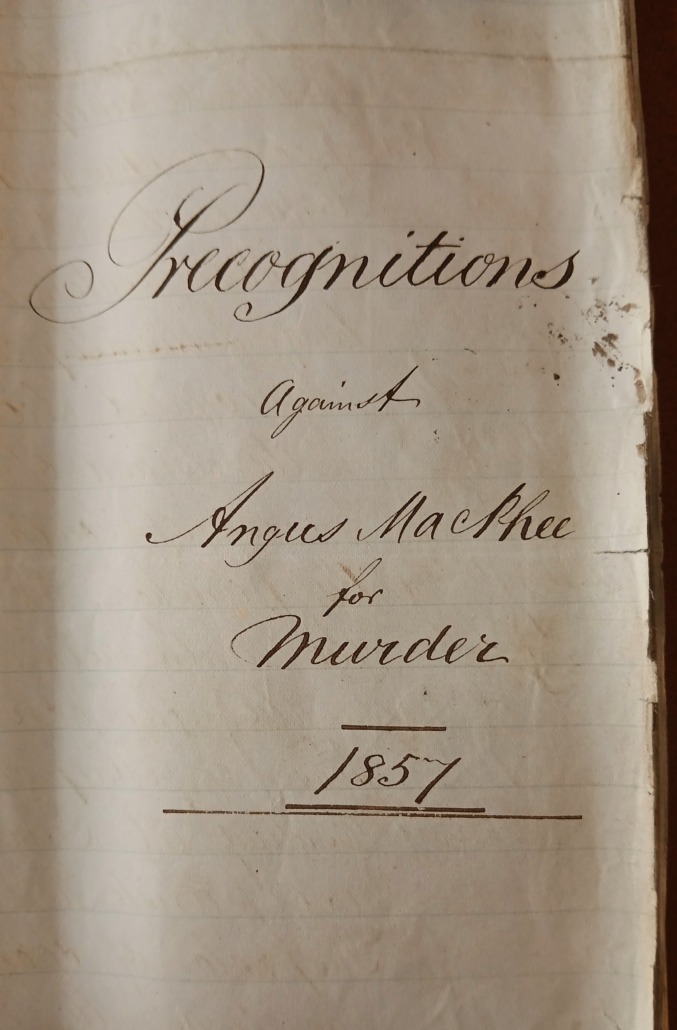
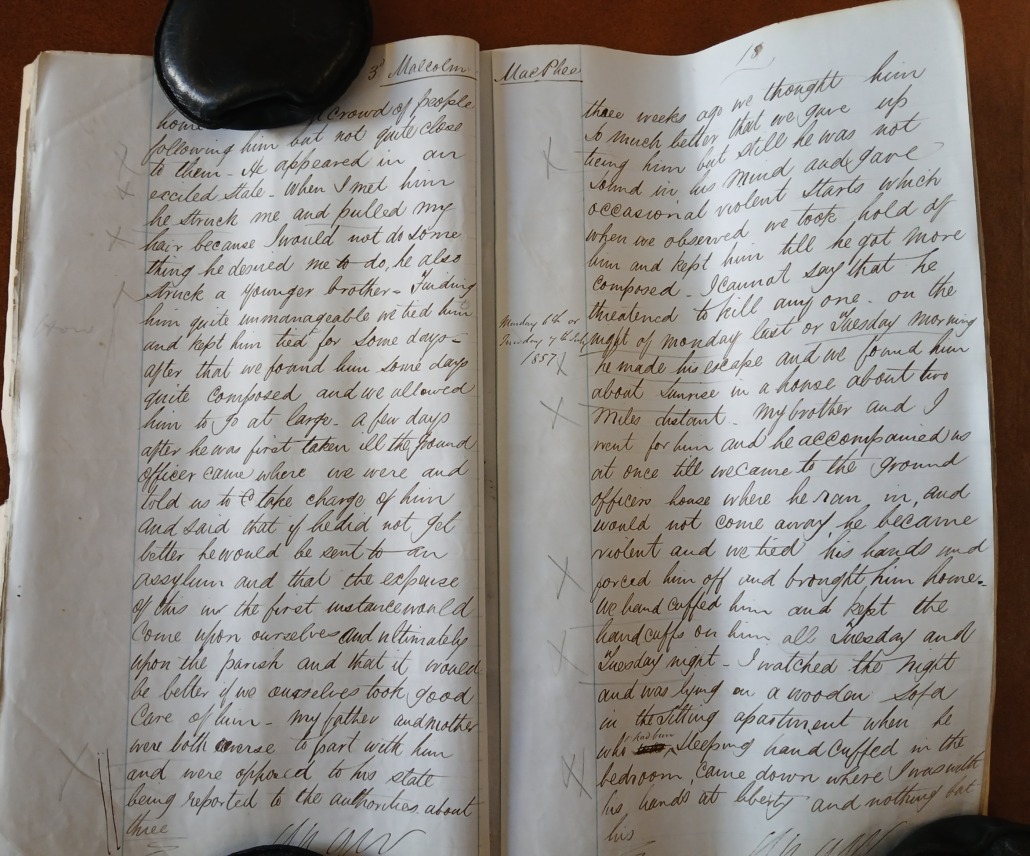
We have the National Records Office in Scotland, which contains all the documents relating to criminal cases going back to the 1800s. At that time, 1857, records of trials weren’t kept routinely, but what was in the archive were the “precognition statements.” These are basically witness statements that you would give to the police, and it’s what the witness would say at the trial. There were about 130 pages of those handwritten, completely original documents that I’m not sure anybody’s read before. I certainly haven’t seen references to them. Those 130 pages of precognition statements were the foundation of the book. Then there were also the legal documents, letters between lawyers and so on which were of less interest to me. It took me about a week or two to read through that material properly. It’s quite time consuming because it’s all handwritten. And I did other little bits of research into the historical side of what life was like in Benbecula at the time.
Photos: Archival materials from the National Records Office in Scotland. Photos courtesy of Graeme Macrae Burnet.
I think I heard you once say that you found archival material “evocating and inspiring.” What about it appeals to you and how does it inspire?
Partly it’s the physical documents. They come bundled up, tied with ribbon. Immediately you feel like you’re entering a secret world. And there’s the old vellum smell of the documents, and the handwriting, which changes depending on the author. They’re very evocative in that way. They almost transport you to the point when these documents were being created. It’s not like a print out of a Word document, which is just completely anonymous.
But it’s also the material that’s contained in these documents and the insight into the life of the characters that I was writing about. Little details like a young girl feeling that this character is following her along the path. Somehow you get surprising insights through reading these documents. I think any novelist would find that kind of material sort of inspiring and feel that it’s a starting point for a story.
And how much of it is real vs. fictional? It almost feels like true crime, assembling the basic plot from these real documents and the real case, but this is fiction which gives you the freedom to change the story.
That was the challenge for me because I was commissioned to write a fictional book and in some ways you could easily have written a nonfiction book about this case and the ramifications of the case. So very early in the writing, I decided to tell the story from the point of view of the murderer’s brother, Malcolm, and with that there’s two strands to the narrative. There’s the strand in which Malcolm describes the events leading up to his brother Angus’ murders and then there’s the strand in which Malcolm describes his current life in Benbecula. All the events in the past tense about Angus are based on the documents I read. All the present tense of Malcolm’s life is completely fictional. So it’s about 50/50.
Writing from Malcolm’s point of view was an interesting choice. To me, it gave the book a certain level of intimacy, a kind of disquieting intimacy as you realize he’s starting to go mad himself. And it also feels like a confession.
The decision to use Malcolm as the narrator was completely instinctive. The book had to be written quickly. I made that decision when I was in Kelvingrove Park in Glasgow. I sat there and wrote about five hundred words of what is now the opening. Of course as soon as you decide on your mode of narration, it imposes limitations on what you can write, but I stuck with it. Very quickly I realized that what I’m writing about is a man alone in an isolated cottage with his dark memories and he’s quite tormented in a disquieting way, as you would say.
Years ago when I was student, I was a massive aficionado of Samuel Beckett, particularly his trilogy of novels (Molloy, Malone Dies, and The Unnameable). I hadn’t read those books for thirty years, although they had a massive impact on me when I read them. I went back and listened to them as an audio book. There’s a brilliant reading by an actor called Sean Barrett which actually makes it more accessible because they’re quite avant-garde books. But I went back to Beckett because Beckett is writing about this increasingly disembodied voice, a person alone with his memories and you’re not sure what’s true and not true. I kind of drew on that Beckettian vibe.
I always found Beckett rather funny as well. I also think there’s a similar humour in Benbecula too.
I think it’s a very dark piece but the more times I went over it during the editorial process, weirdly I began to find it funnier and funnier, which probably says more about me than the book. A lot of it is quite grotesque, a really dark sort of humour. And it’s probably not very funny at all. I think I might have gone a wee bit mad writing the book.
Malcolm makes very rude remarks about his neighbors’ children or whatever, there’s a kind of humour there, but there’s also a sort of humour, and I don’t know if it’s even humour, but when something very violent or dramatic or unpleasant has happened, a paragraph will end with a nondescript observation or sentiment or an understatement. To me there’s a kind of humour in that which I think is quite Scottish.
You mentioned the Beckett influence, and it seems a lot of your work has a kind of existentialist bent to it. But were there any other influences on Benbecula?
Influence is a funny thing because you’re not always conscious of it. Somebody else might discern it or ascribe influence when you’ve never read that other text. But you’re right, I’m a dyed in the wool existentialist and I’m always concerned about questions of free will and agency and things like that. But I wasn’t thinking about that stuff when I was writing this book.
The only other thing I returned to mentally was Robert Louis Stevenson, Dr. Jekyll and Mr. Hyde, which I also reread when writing the book. There’s a couple of quite meaty illusions to Jekyll and Hyde. The reason I went back to that text is because to me I was trying to create layers of textures in the book. As I was writing, I was thinking about the relationship between Malcolm and Angus. Angus is the “id” in Freudian terms. He’s unbridled, unfiltered, lust and instinct. He has drives and just follows them. Malcolm is the more sensible, normal brother. But it’s the relationship between the two which becomes closer. Malcolm becomes less “civilized” to use another Freudian term. (I’m not a Freudian by the way). But yes, there’s a bit of a Stevenson influence.
In the afterword, you talk about the “maniac” label and how, for some people, it’s used as a way of writing them off or dismissing an attempt to understand. Do you see Benbecula as a way of understanding that madness? By comparing Angus and Malcolm, the reader gets to see someone outwardly mad and one that’s more internal.
Malcolm’s mental universe does not really allow him to question or try things in the way that we do now in the twenty-first century. We have a different vocabulary and frameworks of thinking about madness. I don’t think Malcolm is trying to understand Angus. He almost just accepts what Angus did. But of course, it’s for the reader to speculate about why Angus may have committed the acts he did. Even in the afterword, I didn’t really want to get into too much speculation about why Angus did it because it would be no more than that, speculation. But also because I like the reader to do some work. I don’t want to say here is my interpretation of what happened 150 years ago, because people tend to see the author’s view as authoritative and that closes down the relationship with the material. And we still use words like maniac to divert ourselves from trying to understand why a person has committed an act of violence.
I really enjoyed the afterword. Part of me wasn’t sure if it was supposed to be nonfiction or fictional.
I’ve always wanted to write a nonfiction book and I love dealing with the research, so the afterword is nonfiction. But that’s interesting to me because when I wrote His Bloody Project, that was a fictional case written in a documentary style. So many readers thought it was based on a true case or that all the documents were real. Whereas Benbecula is the exact mirror image. It’s a real case written in a fictional style. All my work has some device in which I’m the translator not the author of the novel or something like that, so I’ll be very curious to know if readers are like “Yeah, right, he’s pulling our leg again.”
Photo: On the island of Benbecula, Scotland.
Was it more challenging to take a real case and write it into a novel or was it easier the other way around?
It was in a way more difficult because with the real life aspects of this book, I felt tied to the actual events. And so I’m describing certain things that actually happened or at least describing the version that I have access to, but of course I have to fictionalize them to the extent that I invent dialogue and conflate characters, but there’s a restriction in that. Whereas with the wholly fictional parts, I immediately felt much more free in the writing of it. We are inside Malcolm’s head and I wanted in a way to create the feeling that these thoughts are tumbling out of his head. The two parts were quite different to write simply because the Angus bits are really anchored in the facts of the case.
Did you actually travel to Benbecula as well as part of your research? What was that like?
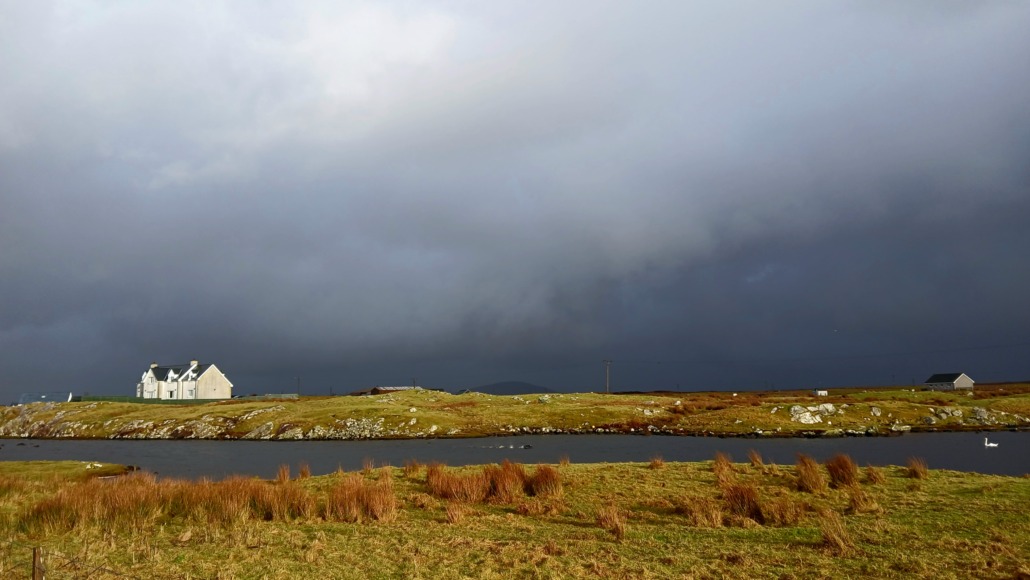
Yeah, I went there in late January or early February and it was in the middle of a really bad storm. You have to take a ferry there. My first trip was canceled because the ferry didn’t run. Then I rebooked for the following week. The storm was coming but I knew I would get there, but I didn’t know if I would get off. So I spent a lot of the time there just looking at the travel app to see if the ferry was leaving. But it was really important for me to get there because in a sort of vaguely ethical way, I would have felt it was wrong to write about a place that I’d never set foot in. But also in terms of imagining the book, it was absolutely crucial that I went and stood where that house was and saw the landscape. I could now see the small universe of the book.
I also had a copy of this hand-drawn map of the murder scene that I got from the archive, which is all wet now. And the reason that it’s all wet is because I took it with me just before the storm. It was really windy and I was in this completely desolate stretch of land. It’s not beautiful at all. And I’m going around and there’s two settlements on this map and there were two sets of ruins on this piece of land. I also had another map from 1851, which we called ordinance survey maps, that marked all the settlements. So I could kind of match up the hand-drawn map with the other map. I can’t be 100 percent sure, but I feel quite confident I found the ruins of the house. I think that sort of thing is quite cool. But I don’t think it’ll start a birth of tourism for Benbecula.
Is there anything you want people to take away from reading this book?
I want them to feel immersed in the world of the book. I felt, and this is going back a bit to Beckett, that if you’re writing in a shorter form it offers the opportunity to be slightly more experimental. I just really wanted to get inside the head of this guy who lived in this landscape. So I would like people to feel immersed in this book, and they can make whatever they want of it, but I want them to feel it’s vivid and have a kind of visceral feeling on reading it.
Precarious by Marcello Di Cintio was reviewed in Publishers Weekly: “Thorough and damning . . . While offering precise and useful insights into the Canadian system, Di Cintio also provides rich food for thought about the role migration plays in the global order.”
We’re Somewhere Else Now by Robyn Sarah was reviewed in the Montreal Review of Books: “We’re Somewhere Else Now marks a return to a voice both familiar and probing. [Sarah’s] poems carry an ease of camaraderie, a voice to commiserate with, lightly.”
UNMET by stephanie roberts was reviewed in Periodicities: “Crystalline and vibrant . . . UNMET, when finished, leaves the reader with more questions and thoughts, evaluating longings and appearances, pondering how to best meet the world with thoughtfulness and compassion.”
https://www.biblioasis.com/wp-content/uploads/2024/08/unnamed-scaled.jpg6172560biblioasishttp://biblioasis.com/wp-content/uploads/2014/12/BIBLIOASIS-Logo-500x500-White-300x300.pngbiblioasis2025-11-07 16:40:572025-11-07 16:41:29The Bibliophile: Gone a wee bit mad