
The sound of the crowd
Welcoming baseball season with an excerpt from On Sports by David Macfarlane
It’s the start of baseball season. I’m sure most of you already knew that. I don’t watch much baseball these days. To be honest, I don’t even really remember the rules, and can’t remember if I ever have. I love the movies though (Bull Durham, Field of Dreams, Angels in the Outfield, etc.) and have seen them countless times. They bring to mind happy memories. As a kid, they inspired me to play sports (badly) and watch games live, which gave me and my friends something to look forward to as the seasons and years went on. We’d rendezvous in the playground to discuss how our team (be it the Winnipeg Jets, Goldeyes, or the Bombers) were doing and what they should be doing better. Like I’m sure many of you have. But that was back then. Today watching pro sports can feel like kind of a drag. Like most things nowadays, too much money and greed has ruined a good thing. Now it’s harder than ever to enjoy sports because of online gambling, the increased cost of tickets to attend a game or even just to stream it, and the noise and spectacle that only distracts you from the game itself in an attempt to keep your attention to sell you more ads.
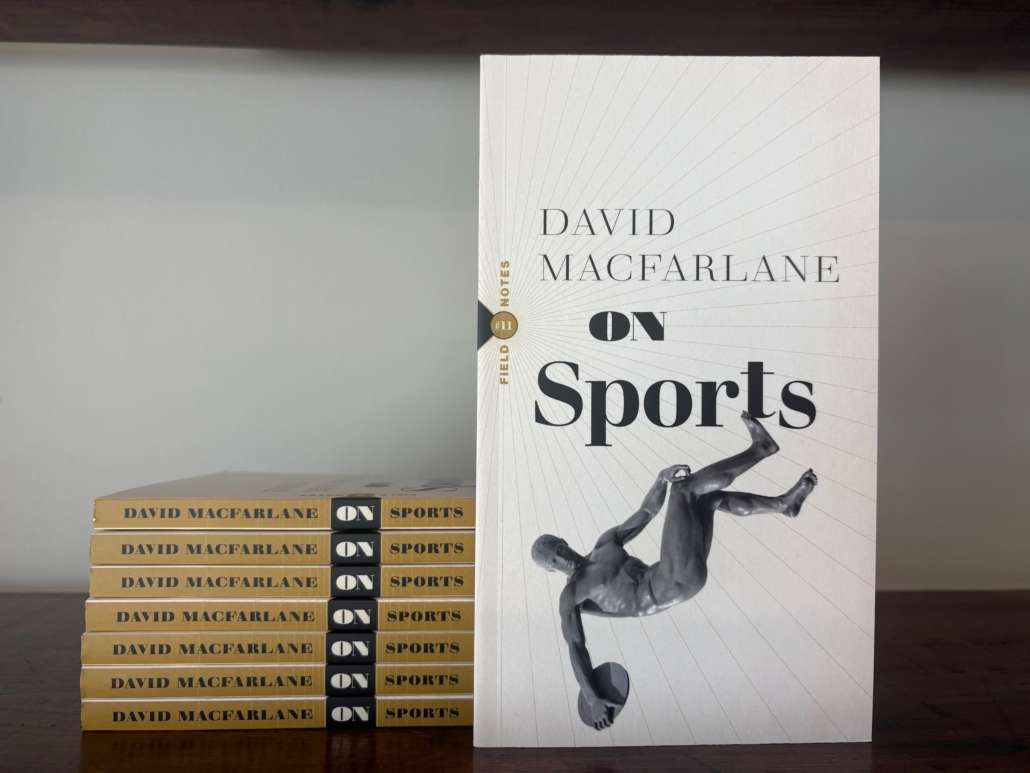
Something you may not know is that this week also saw the publication of David Macfarlane’s On Sports in Canada (it’s out in the US on April 7th), the latest addition to our Field Notes series. On Sports is a book that responds to our collective exhaustion with the commodification of sports, but in a charming, meandering way. This is a nostalgic book. At times it almost feels like an elegy to a time when watching sports was about the games and the athletes and less about people’s parlays and the TV incessantly hitting you with BetMGM ads. But it’s also rather funny and heartwarming. I found it to be a delightful love/hate letter from someone who cares deeply about sports and the amazing things athletes can do, and who is also deeply disappointed with the commercialisation of competition. Reflections on some of the biggest stories in the sports world are interspersed with anecdotes from his childhood and his days as a sports writer, and it’s wonderful how he’s able to weave all these threads together to paint of picture of what sports have meant to us and what they no longer mean today.
Personally, my experience with sports the last few years had been just occasionally glancing at the TV in whatever bar my friends and I happen to be in that day and sometimes commentating on what’s happening on screen but not really paying attention. Or rewatching Bull Durham. But reading On Sports, I was reminded of all the significant impressions sports have left on my own life, which is a beautiful thing a book can give you, and left me somewhat hopeful as reading how much Macfarlane cares for baseball, hockey, football or any sport really, made me pay more attention to them in a way I had almost forgotten how to do.
So to kick-off the start of the season, please find below a short excerpt from an early part of the book, where Macfarlane reminisces about attending a Blue Jays spring training game and reflects on the joys of being amongst fans just watching a baseball game.
All my best,
Ahmed
Publicist
Spring
An excerpt from On Sports
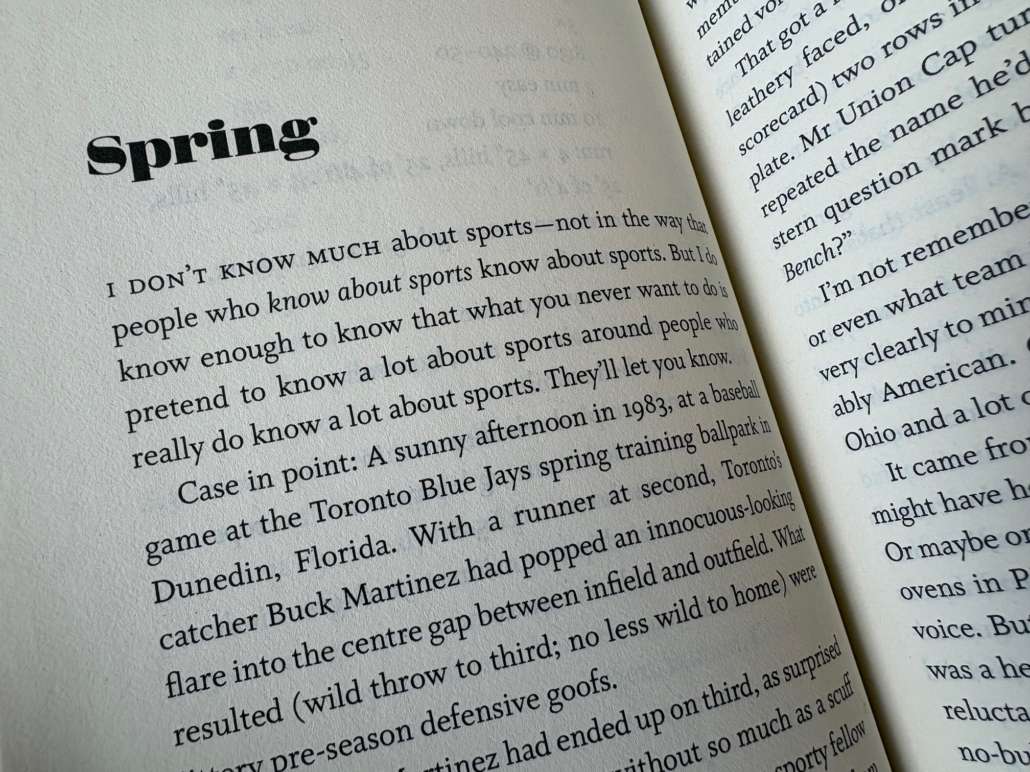
I don’t know much about sports—not in the way that people who know about sports know about sports. But I do know enough to know that what you never want to do is pretend to know a lot about sports around people who really do know a lot about sports. They’ll let you know.
Case in point: A sunny afternoon in 1983, at a baseball game at the Toronto Blue Jays spring training ballpark in Dunedin, Florida. With a runner at second, Toronto’s catcher Buck Martinez had popped an innocuous-looking flare into the centre gap between infield and outfield. What resulted (wild throw to third; no less wild to home) were jittery pre-season defensive goofs.
As a result, Martinez had ended up on third, as surprised as anyone to be standing there without so much as a scuff of baseline dirt on his pants. That was when a sporty fellow (lime-green polo shirt, cargo shorts) a few rows down from my seat stood and shouted, “Attaboy, Buck.”
I don’t think Mr Lime-Green expected to be heard so clearly by so many people. His exclamation happened to coincide with a momentary pause in the cheering, as if all the happy Toronto fans were catching their breath at the same time. Mr Lime-Green was suddenly conspicuous.
Having inadvertently claimed the attention of the crowd, he felt compelled to say something more than “attaboy.” Baseball is a sport that traditionally demands a certain wit and knowledge from its more outspoken audience members. So Mr Lime-Green added, jauntily and with sustained volume, “Johnny Bench has got nothing on you.”
That got a reaction. Specifically, it got a reaction from a leathery faced, old-school baseball fan (UAW ball cap, scorecard) two rows in front of me, a little closer to home plate. Mr Union Cap turned slowly and deliberately. He repeated the name he’d just heard and affixed not just a stern question mark but also, somehow, italics: “Johnny Bench?”
I’m not remembering the game. I can’t recall who won, or even what team Toronto was playing. What I can bring very clearly to mind, though, is that voice. It was unmistakably American. Gravelly. Unadorned. At a guess, I’d say Ohio and a lot of Luckies.
It came from an older generation of voices—voices you might have heard on an aircraft carrier in the Pacific in ’43. Or maybe on the line at a Ford plant in Dearborn or the coke ovens in Pittsburgh after the war. It didn’t talk a lot, that voice. But it knew claptrap when it heard it. It knew who was a hero and who wasn’t. It was a voice that, when it was reluctantly put to use, had something to say. The voice of a no-bullshit collectivity of America that is, alas, long gone. Lost and by the wind grieved. Missing in the din of podcasts and comments and panel debate. That tough old Lucky Strike voice. Is there a sadder lyric in the American songbook than “Where have you gone, Joe DiMaggio?”?
Martinez getting to third without so much as a pro forma slide on a midfield bloop that should have been a single, if that, was the cause of giddy celebration among Blue Jays fan—which is to say, in Dunedin, almost everybody. A hometown crowd’s volume doesn’t distinguish much between crazy-good luck and skill. A stand-up triple is a stand-up triple.
I thought I heard something in the cheering that was more than robust applause. There was a cocky effervescence that I wasn’t sure I’d heard from a Toronto crowd before. To call it a swagger would be an exaggeration—an Americanization, in fact—but it was a happy assertion of Canadianness that you wouldn’t have heard from northern visitors to Florida of previous generations—especially in regards to something as American as baseball. At least that’s what I wrote in my article, although it should be taken into account that I was a magazine writer looking for a story and inclined, therefore, toward meaningful explanations of things that may have had no meaning at all. The crowd’s cheerfulness may only have been the burble of sun-screened holidayers. Toronto fans simply happy to be warm.
Mr Union Cap did not burst the bubble of the crowd’s enjoyment. He was on the funny side of serious, but only just. There was something good-natured in his gruffness, as if he recognized that he was a stock character—a curmudgeonly, old-school baseball fan of the sort who was (as I did not then realize) an endangered species.
Before the advent of powerful sound systems and giant screens, sporadic volleys of unscripted commentary bounced back and forth between fans in the stands. There were always a few such self-appointed colour commentators per section, some of whom were funny, some of whom were knowledgeable, some of whom were both. They had something to say in a sort-of public, sort-of performative way.
The first real baseball game I went to (meaning a game with lights, players in uniform, umpires, ads on the outfield fence, green grass, red-dirt base paths, and thirty-five cent admission) was in the summer of 1960, in Grand Falls, Newfoundland. I was eight years old, in the company of my grandfather. Not a small man. Rarely seen without battered fedora and briar pipe. Known by everybody in Grand Falls. He was, shall we say, a colourful figure, and his voice was a voice with audibility in a crowd—perhaps because it was a few octaves lower than most.
“No need for a mound,” he garumphed as Corner Brook’s lanky pitcher unfolded his beanpole of a frame from the visitors dugout. “Dig him a hole, lads. Dig him a hole.”
Not the funniest line in the world, but one that has stayed with me all my life because I think it was the first time I heard somebody talk like that—a joke, a comment, an observation, made at a volume intended for public consumption but as if in a living room of friends, which is how ball parks used to sound.
By the end of the Grand Falls game, I’d concluded that half the fun of baseball was what my grandfather said about the players on the field and what the people around us said to my grandfather.
A lost art—killed by the kiss-cam. Drowned-out by ads and promotions. But there was a time when the expression of deep baseball insight from somebody a couple of rows over was part of the general fun of a ball game. They were characters, those guys. It was hard to know with old-school baseball fans if they were acting like they were in a Damon Runyan story or that’s the way they really were.
Mr Union Cap had something to say. It was what you used to expect at a ball park—a voice that knew baseball cutting through the cheerful hubbub of a crowd. Possibly, the tremolo of excitement in the Dunedin stands that afternoon was only the fun (rare then, almost extinct now) of going to a non-blaring, non-big-screen-dominant, non-merch- selling, non-ad-blasting ballpark to watch ballplayers play baseball. On a nice spring day. Undistracted by electronic loudness and pixelated screens and ads and contests and walk-up songs and who knows what all.

My friend, the writer Alison Gordon, who died unexpectedly in 2015, covered the Blue Jays for the Toronto Star for five seasons. (By way of establishing Gordon’s unusual range of life experiences, I shall here insert a segue-defying biographic detail: Some years before Alison Gordon became the first female reporter in the American League, she was in the hotel bedroom in Montreal with Yoko Ono and John Lennon when they recorded “Give Peace a Chance.” One of those voices is hers.)
Gordon had her likes and dislikes, and much as she loved baseball she didn’t care for the bombast of a contemporary ballpark. She once proposed to Blue Jays executives that a single home-game per season be designated Old-Fashioned Day and the ballpark be allowed to sound like ballparks used to. Ballparks where you could say something, if, that is, you had something to say. Ballparks where you could cheer when you felt like cheering. And jeer when you felt otherwise.
And what happened to her proposal, I asked her at the last baseball game we attended together. She passed me the unshelled peanuts while Mötley Crüe or AC/DC or Metallica loudly walked-up the next batter. What do you think happened, she shouted pleasantly.
A quaintly lower decibel level was one of the things that made spring training so much fun. Those old Florida ballparks were smaller, friendlier, quieter, more intimately idiosyncratic.
Spring training was a magical idea. It was proof to the skeptical Canadian that, even though it might seem otherwise (in the north, in February) planet earth wasn’t frozen in space. Winter, as far as Alison Gordon was concerned, was the dark side of the moon—a time to sip a whisky by the fire, talk with friends, laugh, and wait for the season to turn. As it would, of course. Eventually. But spring came earlier in Florida than it does in Toronto. It used to be fun to meet it at a ball game.
In good publicity news:
- Two of our Field Notes, On Book Banning by Ira Wells and On Oil by Don Gillmor, have been shortlisted for the Writers’ Trust Shaughnessy Cohen Prize for Political Writing! Biblioasis’s nominations were also covered in the Winnipeg Free Press.
- The Passenger Seat by Vijay Khurana has been flying through one round after another in the 2026 Tournament of Books! This morning it won the Zombie Round and will advance to the Championship final. Go Vijay!
- Cherry Beach by Don Gillmor received a starred review in Kirkus: “Gillmor really knows his stuff—in a dazzling range of areas. A layered portrait of a changing city in the guise of a gripping crime novel, for fans of Tana French and Dennis Lehane.”
- Silver Lake by Alex Pugsley (The Aubrey McKee Novels #3) also received a review in Kirkus: “Pugsley’s tone throughout is wry and self-aware, the ideal combination for capturing Aubrey’s mix of ambition and angst . . . A smart, witty Hollywood tale.”
- Smash & Grab: Stories by Mark Anthony Jarman was reviewed in the Winnipeg Free Press: “Jarman continues his mastery of the form, with seemingly no limits to his fervid imagination . . . brilliantly and seamlessly tackling any genre, from memoir to offbeat sci-fi to manic surrealism.”
- Robyn Sarah, author of We’re Somewhere Else Now: Poems 2016–2024 was interviewed on CKCU FM for Versefest Ottawa.
- Marcello Di Cintio, author of Precarious: The Lives of Migrant Workers, was interviewed about the book on the Track & Food podcast.