Description
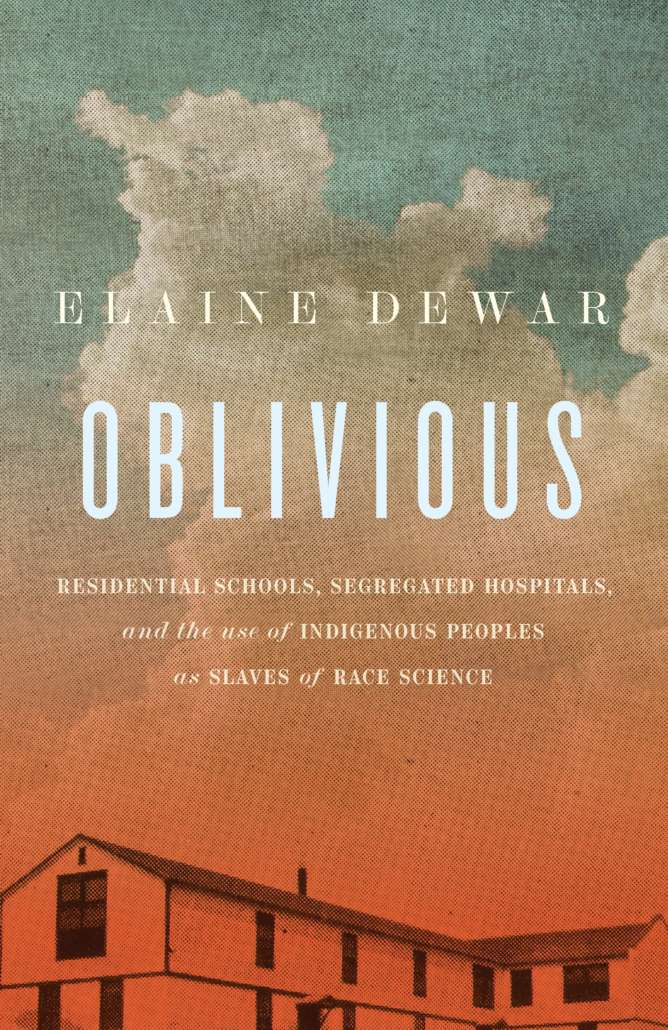
An investigative journalist reckons with the cost of her own—and the culture-at-large’s—obliviousness.
Over the last thirty years, Canadians have been forced to face their country’s genocidal attempt to destroy its Indigenous populations through segregation, poverty, coerced labour, and infectious diseases. Few have read the statements of claim, academic literature, or multi-volume commission reports setting out exactly what we stole and who we hurt (and how); and the policies and decisions which harmed generations of Indigenous people are still not broadly known.
In Oblivious, investigative journalist Elaine Dewar exposes the governmental and psychological machinery that allowed this to continue for so long. The granddaughter of settlers saved during their first Prairie winter by the generosity of Indigenous neighbours, Dewar explores how even well-meaning Canadians who glimpsed what was being done did nothing to stop it. In the process, she uncovers further evidence of crimes against Indigenous people, including unethical and cruel scientific experiments, a segregated and woefully inadequate health care system, and a callous indifference to Indigenous well-being that has almost entirely eroded the sense of trust true reconciliation must be based on.
Part memoir, part investigation, Oblivious tells the story of a Jewish girl from Saskatoon, Saskatchewan, who grew up in a society so segregated—its Indigenous people consigned to an alternate universe—that she, like so many of us, failed to notice their plight for decades.
Praise for Oblivious: Residential Schools, Segregated Hospitals, and the use of Indigenous Peoples as Slaves of Race Science
“Dewar’s last book . . . exposes, in new ways, the pitiless machinery behind residential schools, segregated hospitals and race-based exploitation that took place on the Prairies—all while settlers’ descendants invited west by the government prospered on the same lands.”
—Emily Donaldson, Globe and Mail
“Dewar has fashioned a sobering . . . whodunit that probes some of Canada’s darkest chapters.”
—Literary Review of Canada
“Dewar’s writing is engaging . . . It is an apt final story for a tenacious investigative journalist who dared to open a door of revelation.”
—Sheilla Jones, Winnipeg Free Press
“This riveting blend of exposé and memoir from the late Canadian journalist Dewar (The Handover) contends with the abusive experiments conducted on Indigenous people in Canada’s residential schools and segregated hospitals . . . It’s an earnest attempt to grapple with a massive injustice.”
—Publishers Weekly
“Elaine’s Oblivious adds an important dimension to the story of mistreatment and cruelty inflicted on Indigenous people by the Canadian state . . . We lost a very valuable friend and public watchdog, and I am afraid she is irreplaceable.”
—Mark Bourrie, author of Ripper: The Making of Pierre Poilievre
Praise for On the Origin of the Deadliest Pandemic in 100 Years: An Investigation
“[Dewar] has spent the pandemic following the politics, the scientific research, the news coverage—and the money . . . Her book casts a shadow over the wet market theory and points a finger at the Chinese government—and at some scientists and leading science journals for their single-minded support and promotion of this theory . . . The book reads almost like a detective novel.”
—Globe and Mail
“Dewar gets us to an acceptable truth about the origin and the travels of this coronavirus, and the significant tardiness and incompetence of governments and science to protect the public.”
—Winnipeg Free Press
“I would highly recommend [On the Origin of the Deadliest Pandemic in 100 Years] to anyone interested in knowing more about the origin of the COVID-19 pandemic. Her very thorough research, based on publicly available documents, shows how China badly managed the initial phase of the pandemic and manipulated the WHO which resulted in an underestimation of the problem and delays in putting in place measures to limit the damages of the pandemic in other countries.”
—Guy Saint-Jacques, former Canadian Ambassador to the People’s Republic of China
“In this age when reliable news is hidden in a cacophony of mis-information, dis-information, social media idiocy and the caterwauling of celebrity influencers, long-form journalism is coming back into its own. Elaine Dewar uses her formidable reporting skills to produce the story of the moment. The pandemic forced her to follow I.F. Stone’s dictum to work exclusively from published, public sources, and her story is the stronger for it. This is, of course, a detective story, a whodunnit, and Dewar is unstinting in exposing the cover-ups, the political expediency, the deceits, and the sloppy work and judgements of usually diligent scientists along the route to her conclusions.”
—Jonathan Manthorpe, author of Restoring Democracy in an Age of Populists and Pestilence