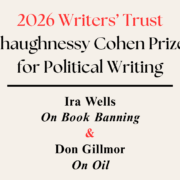
“Ira Wells offers direct and incisive writing that brings suppressed voices into the light and challenges readers to question the moral authority of censorship. Refusing both academic detachment and easy provocation, Wells presents rigorous research with clarity and balance, pairing the ridiculous with the brilliant. His work is passionate and compassionate, inviting sustained reflection on freedom, responsibility, and the imperfect humanity behind all writing, and leaving readers with a deeper, more self-aware engagement with literature.”
About On Oil, the jury wrote:
“At once a memoir, a meditation, and a polemic, Don Gillmor drills deep into one of Canada’s most controversial natural resources in On Oil. Drawing on his experience as a roughneck during the 1970s Alberta oil boom, he explores the central role the petroleum industry plays in Canadian politics and business. Stories from Gillmor’s life on the rig ground his examination of the ongoing tension between oil as a driver of prosperity and values held by many other Canadians. With humour and polite insistence, Gillmor asks the questions that are at the heart of Canada’s relationship with its resource bounty.”
The two books are part of the Biblioasis Field Notes series, which explores timely issues of public interest and features writers and thinkers from a range of disciplines: philosophy, public policy, history, economics, cultural criticism, and more.
The annual $40,000 prize, now in its 26th year, recognizes literary nonfiction about a political subject that is relevant to Canadian readers. The winner of this year’s prize will be announced in Ottawa at the Politics and the Pen gala on April 29.
A Finalist for the 2026 Writers’ Trust Shaughnessy Cohen Prize for Political Writing • A Winnipeg Free Press Best Book of 2025
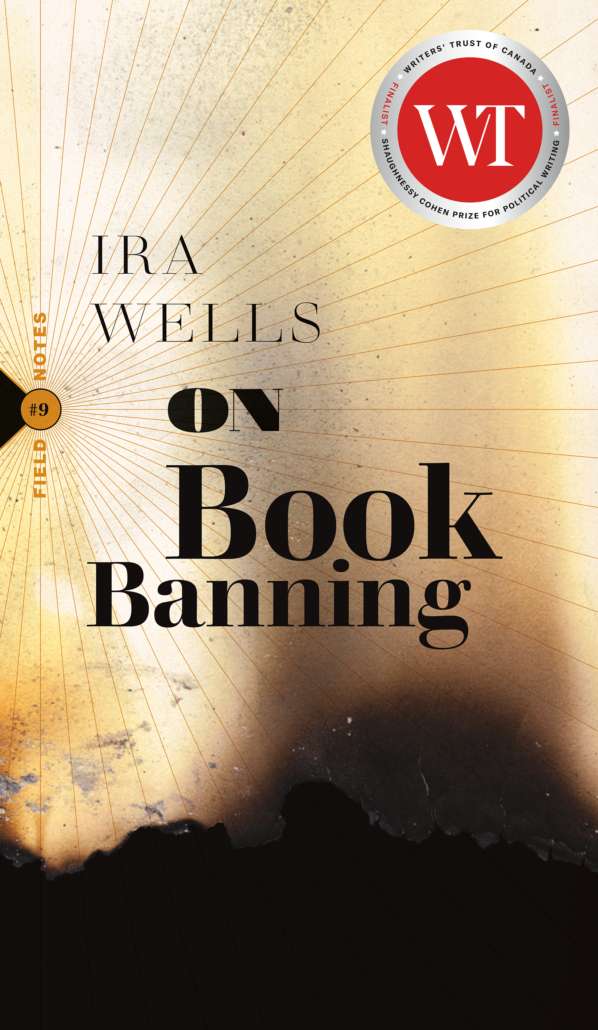
The freedom to read is under attack.
From the destruction of libraries in ancient Rome to today’s state-sponsored efforts to suppress LGBTQ+ literature, book bans arise from the impulse toward social control. In a survey of legal cases, literary controversies, and philosophical arguments, Ira Wells illustrates the historical opposition to the freedom to read and argues that today’s conservatives and progressives alike are warping our children’s relationship with literature and teaching them that the solution to opposing viewpoints is outright expurgation. At a moment in which our democratic institutions are buckling under the stress of polarization, On Book Banning is both rallying cry and guide to resistance for those who will always insist upon reading for themselves.
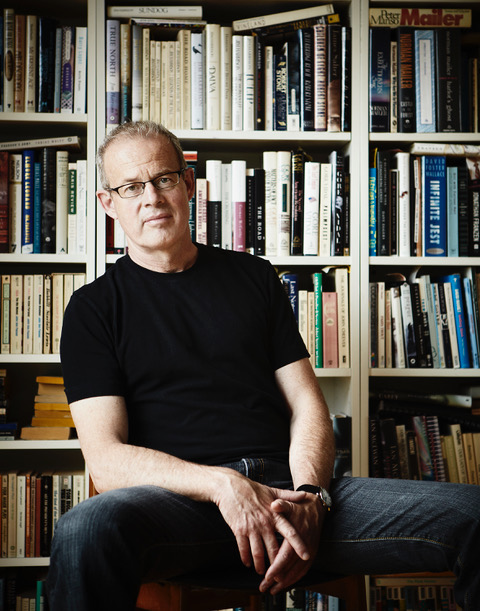
Ira Wells is a critic, essayist, and an associate professor at Victoria College in the University of Toronto, where he teaches in the Northrop Frye stream in literature and the humanities in the Vic One program. His writing has appeared in The Atlantic, Globe and Mail, Guardian, The New Republic, and many other venues. His most recent book is Norman Jewison: A Director’s Life. He lives in Toronto with his wife and children.
A Finalist for the 2026 Writers’ Trust Shaughnessy Cohen Prize for Political Writing
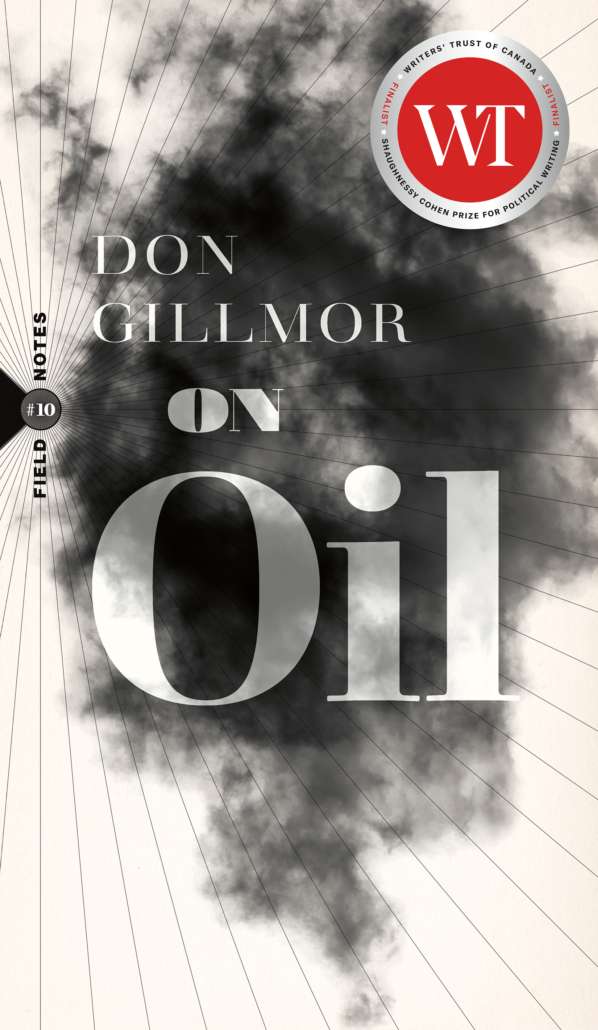
A journalist, and former roughneck, considers our long, complex, tortured relationship with oil.
Oil has dominated our lives for the last century. It has given us warmth, progress, and life-threatening pollution. It has been a gift and is now a threat. It has started wars, ended wars, and infiltrated governments—in some cases, effectively become the government. And now oil’s enduring mythology is facing a messy, complicated twilight.
In On Oil, Don Gillmor, who worked as a roughneck on oil rigs during the seventies oil boom in Alberta, looks at how the industry has changed over the decades and illustrates the ways our dependence on oil has led to regulatory capture, in Canada and elsewhere, and contributed to armed conflict and war across the world. Gillmor documents the myriad ways that oil companies have misdirected environmental action and misinformed the public about climate concerns and illuminates where we went wrong—and how we might yet change course.
Don Gillmor is the author of To the River, which won the Governor General’s Award for nonfiction. He is the author of five novels, Cherry Beach, Breaking and Entering, Long Change, Mount Pleasant, and Kanata; a two-volume history of Canada, Canada: A People’s History; and nine books for children, two of which were nominated for the Governor General’s Award. He was a senior editor at The Walrus, and his journalism has appeared in Rolling Stone, GQ, Saturday Night, Toronto Life, the Globe and Mail, and the Toronto Star. He has won twelve National Magazine Awards and numerous other honours. He lives in Toronto.
https://www.biblioasis.com/wp-content/uploads/2026/03/writers-trust-scp.png8002000biblioasishttp://biblioasis.com/wp-content/uploads/2014/12/BIBLIOASIS-Logo-500x500-White-300x300.pngbiblioasis2026-03-18 17:03:172026-03-18 17:03:37ON BOOK BANNING and ON OIL finalists for the 2026 Writers’ Trust Shaughnessy Cohen Prize!
An interview with Ivana Sajko, author of Every Time We Say Goodbye
***
Want to get new excerpts, musings, and more from The Bibliophile right away? Sign up for our weekly online newsletter here!
***
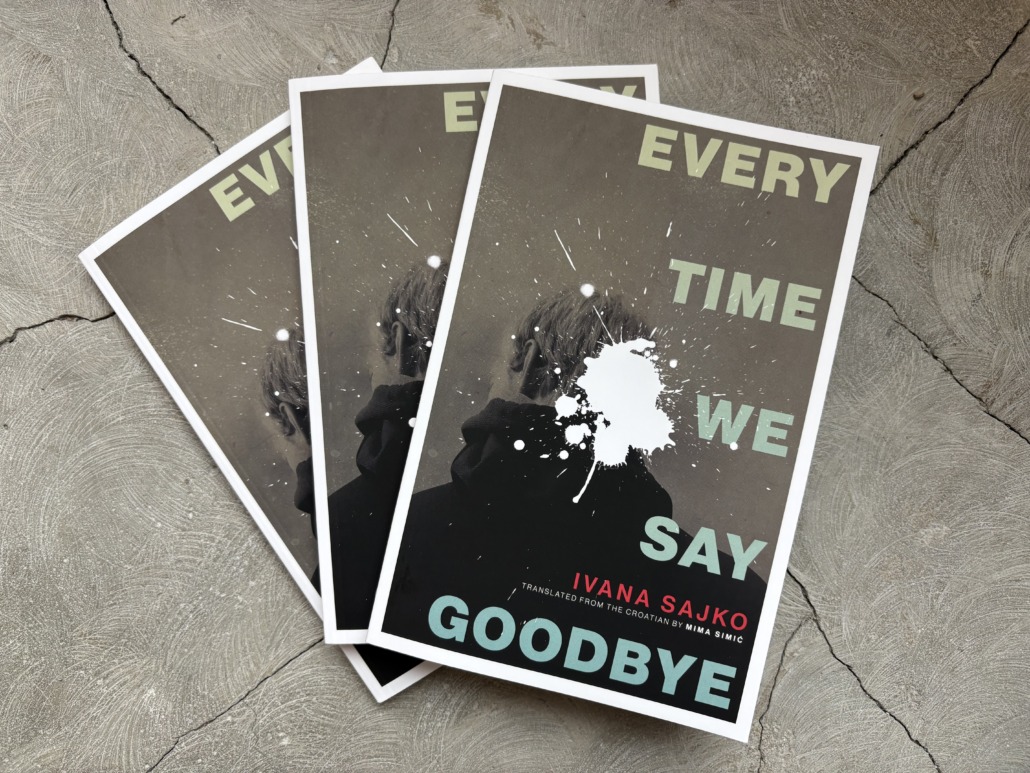
Photo: Every Time We Say Goodbye by Ivana Sajko (trans. Mima Simić). Cover designed by Ingrid Paulson.
We first became aware of Ivana Sajko’s work when her previous novel showed up on the shortlist for the 2023 Dublin Impac Award. We read here in office the two or three books that had yet, that year, to find a North American publisher, but it was Ivana’s that made the rounds the fastest. The manuscript passed from hand-to-hand-to-hand-to-hand over the course of the week, each of us tearing through it in a single sitting. This wasn’t just because of its size, coming in as it did at barely one hundred pages: it was its manic, frenetic energy, its humour, its black, beating heart, its humanity. This was something quite different than anything else we’d read, a voice so superbly translated by Mima Simić that it did not read like a translation at all. Love Novel was a brutal, brilliantly immersive experience, and we were thrilled to have her, and it, for our list. I decided then that I would follow her anywhere and work to bring and break her out in English. I sensed then what I am convinced of now: that Ivana Sajko is as good a writer as any at work today in any language.
The publication of her new novel, Every Time We Say Goodbye, again in an exceptionally energetic translation by Mima Simić, merely confirms my opinion. Sajko is an author who demands to be read by those who love the work of Tokarczuk and Ernaux, among others, though Sajko’s voice is very much her own. In a world racked by so much death and destruction, this is a novel about the most painful death of them all: the death of love. As our narrator leaves his homeland of Croatia for Berlin, watching the countryside slide by his window, he attempts to avoid the full crushing heartache of this more private death, and his role in its occurrence, by reflecting on the recent history of Europe and his inability as a failed journalist to document what is happening in a way that might affect change: this is a novel very much about our current terrifying moment. But lest you feel that this is too bleak, there is a real thread of hope running through the book as well, even if it is only the hope of starting anew knowing the mistakes that have brought you to this point, and your determination in the face of habit and exhaustion not to give in to the same destructive impulses again. Simić’s translation of Sajko’s prose moves with the same rhythm of the train her protagonist is escaping on, offering its own very real pleasures as it pins you, in its extended sentences, to your seat, determined to make you look clearly at what has been wrought.
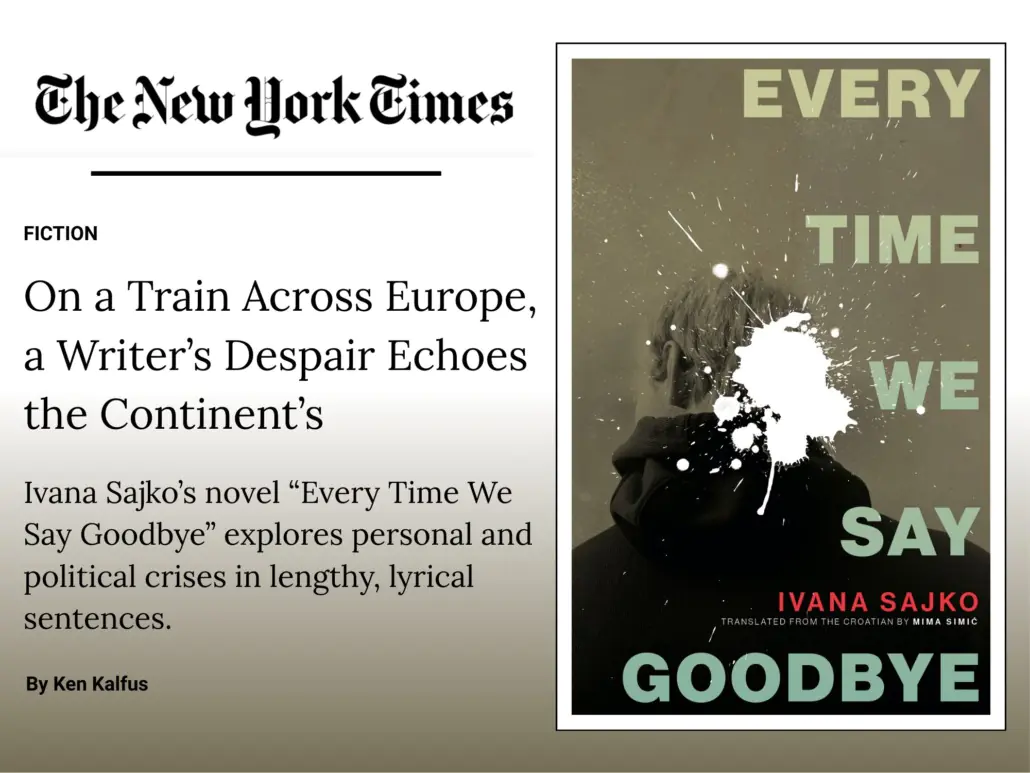
Published on Tuesday, today it received a rave review in the New York Times, while also making the Globe and Mail’s Spring reading list. Below, we have a short clip of Ivana reading from this book, as well as an excellent interview conducted by Ahmed Abdalla.
Dan Wells, Publisher
An Interview with Ivana Sajko
Author of Every Time We Say Goodbye (trans. Mima Simić)
Photo: Ivana Sajko. Credit: Peter Stamer.
Can you tell me a bit about yourself and how this book came about?
I am a playwright and prose writer who has been living in Berlin for over ten years. Before that, I moved around Europe, and whenever I returned to Croatia it was most often to the Adriatic coast, which always had a huge influence on my life. From there comes my close relationship with the sea, its blueness, with the Mediterranean province and the conflict between its positive and negative sides. Every Time We Say Goodbye is my fourth novel, written during the first year of lockdown in Berlin, when we were living in a kind of vacuum, with enough time to reflect on our fragility, to mourn our losses, and to reimagine how the post-Covid society could look like (seems we missed that particular opportunity).
What readers of the English translation cannot fully experience is that the book was written in the masculine grammatical gender. Most Slavic languages allow narration from a specific gender—masculine, feminine, or neuter (although neuter is typically associated with inanimate objects, so while it is grammatically possible to write from it, it sounds semantically strange). Those of us who grew up with a Slavic language—as I did with Croatian—know how deeply we are shaped by the gender through which we have to speak. Choosing to write in the masculine somehow altered the course of the novel as it unfolded. It helped me step outside myself, and outside the female voice I had always used, the voice with an entirely different tone and destiny. I would not dare to call this a trans experience, but it certainly made me aware of how strongly we are determined by language. Language truly makes us who we are—not only in social interaction, but also in the most intimate sense.
Every sentence in the book is like a long journey, moving through different spaces and times. But isn’t that also the way we remember?
Ivana Sajko
But how did the book come into being? I think that with every book I return to certain obsessive motifs of mine: the departure, and the experience of the foreigner. In Berlin, for example, one can clearly distinguish different categories of being a foreigner, one can differentiate between an emigrant, an expat, a refugee, a tourist, and these categories are often predetermined by national, religious, or even racial prejudices. As for me, I have been an emigrant for most of my life, but my artistic profession enabled me to do it with dignity and to call it my decision, not my necessity. That was my rebellion—to leave. My family history is traditionally one of emigration. They originated from the small city at the Adriatic coast from where they traveled as far as Argentina, returning only in the 1940s. In Yugoslavia, emigration meant going to Germany. I grew up with emigrant stories, and perhaps I was simply waiting for the right moment to write my own.
In the book, he’s someone who chooses to leave. But he does encounter those for whom it’s not a choice.
Yes, there are always those who are forced to leave their homeland—because of war, because of poverty—and those who leave because they have imagined a better place. This second option carries a certain romantic aura; it recalls a time when American writers moved en masse to Paris, traveled through Europe, and created the literary male figure of the foreign wanderer who owns nothing but a typewriter, cigarettes, and—to make the style more convincing—a hat. That male figure has accompanied me while I was young, and I envied him, because very few women were ever allowed such freedom. Perhaps this is also why I chose to write in the masculine gender: to appropriate that position of power and choice for myself.
Anyhow, the question of those who are forced to leave is one of the great questions of our time, and it places us before a moral test. Especially in Europe, where the arms industry profits enormously in the very countries from which refugees come. These millions of refugees continually confront us with a tragedy in which we are, if nothing else, implicated through our silence and inertia. I live in the center of Berlin, and across the street from my building there is a reception center for refugees from Ukraine. When I lived in Zagreb in my early twenties, on the same street there was a hotel housing war refugees from eastern Croatia. In this sense, exile is not an abstract or distant concept for me; it has always been my neighbourhood.
In my Berlin district there are very few Germans. Most residents are Arabs and people of Turkish origin. Their families have lived in Berlin for several generations, yet do not hold citizenship, do not vote, and do not participate in shaping the fate of the country they depend on. On the one hand, neighbourhoods like mine are vibrant and alive; they fascinate tourists because they show how cultures, religions, and languages can coexist. But beneath this colourful multicultural label lie deep inequalities and unresolved issues.
Can you talk about the structure and why you chose to write each chapter as one long sentence?
I tend to write long sentences, because my inner experience of text and writing is essentially an experience of music and composition. This may stem from the theatre, which is my professional background: for many years I performed on stage with musicians, and I wrote texts almost aloud, repeating and varying them until they would fit my own throat (so to say), the rhythm of my breathing, the dynamics of my speech.
Every sentence in the book is like a long journey, moving through different spaces and times. But isn’t that also the way we remember? When we sink into memory we are caught in a stream which is volatile, full of ellipses, fictions, inner conflicts. Memory is not structured into sentences and paragraphs. Memory is carried by chance and emotion, like a rushing stream of water. I wanted to tame that torrent into a rhythmic flow that would guide the readers, their attention and their feelings. This approach is akin to directing a text in the theatre, where the director ultimately guides the spectator’s gaze.
One of the epigraphs to the novel is a quote from the playwright Goran Ferčec saying he’s only interested in writing that exhausts the world. Is that what you’re trying to go for? To exhaust this one man’s entire world as a way of moving forward?
Moving forward while looking back, because with the distance, things, people and relationships appear differently.
I have never been a writer of grand narratives. I am more interested in exploring micro-situations and human states. I am driven to find the richness of great conflicts and unexpected interpretations in seemingly unremarkable, pale moments—to dig deep and to discover a scandal in the middle of nowhere, or to uncover disputes and arguments in the silence, among the unuttered sentences. These are my passions as a writer.
The same is true of this book. It follows a man on a train journey, between point A and point B, between the place he has left and the place he has not yet reached—in the in-between space of disappointment and hope. And although he does nothing much but sit in his seat, there is the history of his family across several generations unfolding before us. The history marked by departures and violence.
I’ve heard you describe this book as kind of hopeful, but there’s a lot of dark stuff in there. I’m wondering where you see that? Is it in the idea of leaving and starting fresh?
Yes, I truly believe that hope lies at the core of this book. Hope that it is possible to break the chain reaction of the recurring destinies, and that it is indeed possible to heal the inherited traumas. In this book, there is a way out. And it starts at the beginning, from the beginning, from zero, almost in a Zen Buddhist sense: point is in emptying the cup before you can fill it with tea again.
I found it interesting in the book that you never name where he’s from, but you do name where he’s going. Why is that?
The place I come from—Croatia—is heavily exoticized from the perspective of Western Europe, where I now live. On the one hand, Croatia is often subsumed into the mythical territory of the Balkans, imagined as a cursed part of Europe steeped in barbarism; on the other, it is viewed through the lens of the civil war in which Yugoslavia collapsed during my youth. My wish is to avoid this kind of exoticization, partly because I do not want to condone the idea that European barbarism is tied to its Southeast, when it is in fact deeply embedded in the historical legacy of west Europe: its imperialism, the theft of cultural heritage and material resources from other peoples, as well as contemporary forms of barbarism: the silence surrounding the genocide in Gaza, the racism directed at Syrians in distress, and the cowardice shown in defending democracy and international law, which for years have been attacked from one side by Putin and from the other by Trump. For this reason, I do not want to write from a national perspective in my books. And honestly, I no longer truly have one. I have lived in many European cities and I consider myself a European writer who observes this small, complicated, and often arrogantly self-assured European nest with a critical eye. At the table in our kitchen, German, English, and Croatian are spoken simultaneously, and that is why I consciously write about Europe, rather than about Croatia alone.
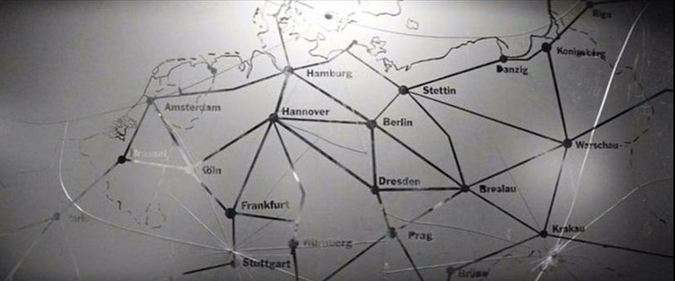
Photo: Still from Europa (1991).
Can you talk about the influence of film in the book?
Lars von Trier’s film Europa is the code that grants entry into the novel, the keynote that sets the tone for the journey the book offers, a journey in which the train, rushing forward, in fact moves backward. I often draw on other people’s art, music, visual works, films. This is also my way of entering into dialogue with artists I admire and who inspire me.
Is there anything you hope people take away from reading this book?
I would like readers to carry with them the belief that the end can be the beginning, that there is immense beauty even in sorrow, that there is a memory of love after the love is gone, that a failure opens millions of new possibilities and that in every place of loss, something still blooms.
In good publicity news:
Every Time We Say Goodbye by Ivana Sajko (trans. Mima Simić) received two great excellent publicity during it’s pub week:
Review in the New York Times: “[A] captivating new novel . . . translator Mima Simić shows great dexterity in her rendering of Sajko’s lyrical, run-on sentences. They hurtle forward like a TGV, making manifest Iv.’s struggle to speak of his despair and the continent’s.”
Featured in the Globe and Mail’s Spring Books Preview: “The form suits the novel’s action, which involves a disillusioned Croatian journalist travelling by train to Berlin, where he reflects on a Europe in crisis, personal trauma and the losses that have left him alienated from his work, past and sense of belonging.”
Oblivious by Elaine Dewar was also included in the Globe and Mail’s Spring Books Preview: “Dewar’s last book (completed shortly before she died last year) exposes, in new ways, the pitiless machinery behind residential schools, segregated hospitals and race-based exploitation that took place on the Prairies—all while settlers’ descendants invited west by the government prospered on the same lands.”
Precarious: The Lives of Migrant Workers by Marcello Di Cintio was reviewed in Alberta Views: “Recommended reading for anyone who is concerned about the treatment of migrant workers in Canada. But . . . a must-read for anyone who has never thought much about the migrants living among us.”
On Sportsby David Macfarlane was mentioned in Toronto Life: “On Sports explores his personal love of the game and distaste for the commercialization of competition.”
https://www.biblioasis.com/wp-content/uploads/2024/08/unnamed-scaled.jpg6172560biblioasishttp://biblioasis.com/wp-content/uploads/2014/12/BIBLIOASIS-Logo-500x500-White-300x300.pngbiblioasis2026-03-06 17:06:282026-03-06 17:06:53The Bibliophile: Every Sentence a Journey
A week at Winter Institute, and reconnecting with booksellers across the border.
I realize that the Bibliophile has been pretty quiet so far in 2026, which is all the evidence you need for how busy things have been at the Bibliomanse proper, and no week illustrates this as much as this last one.
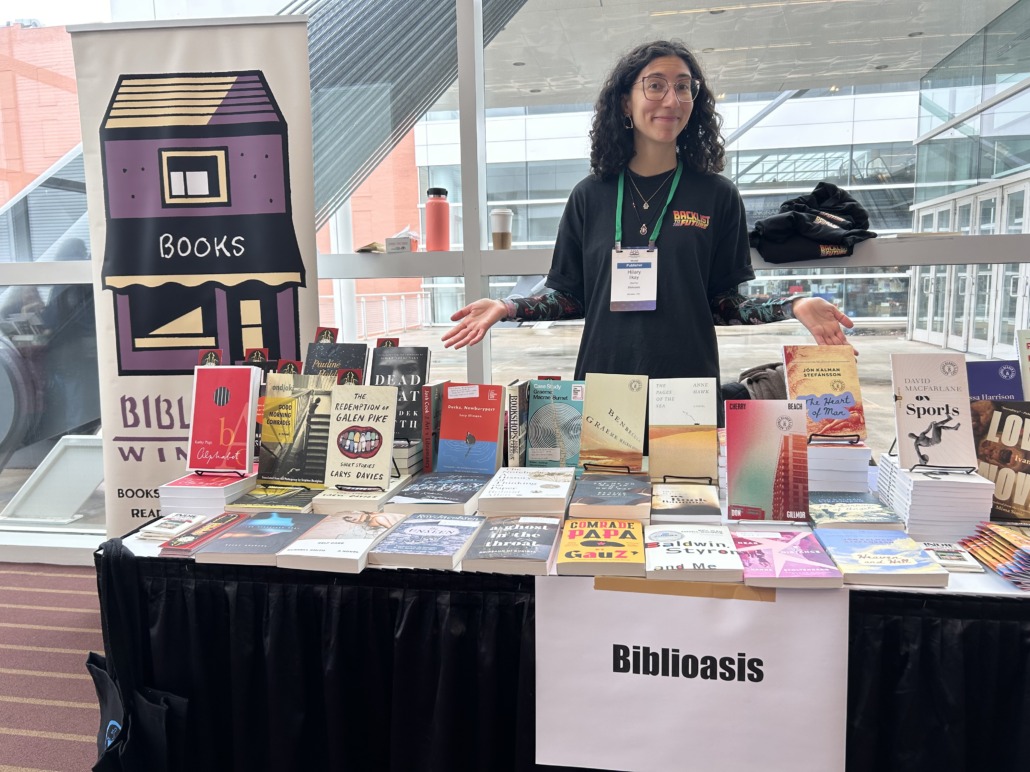
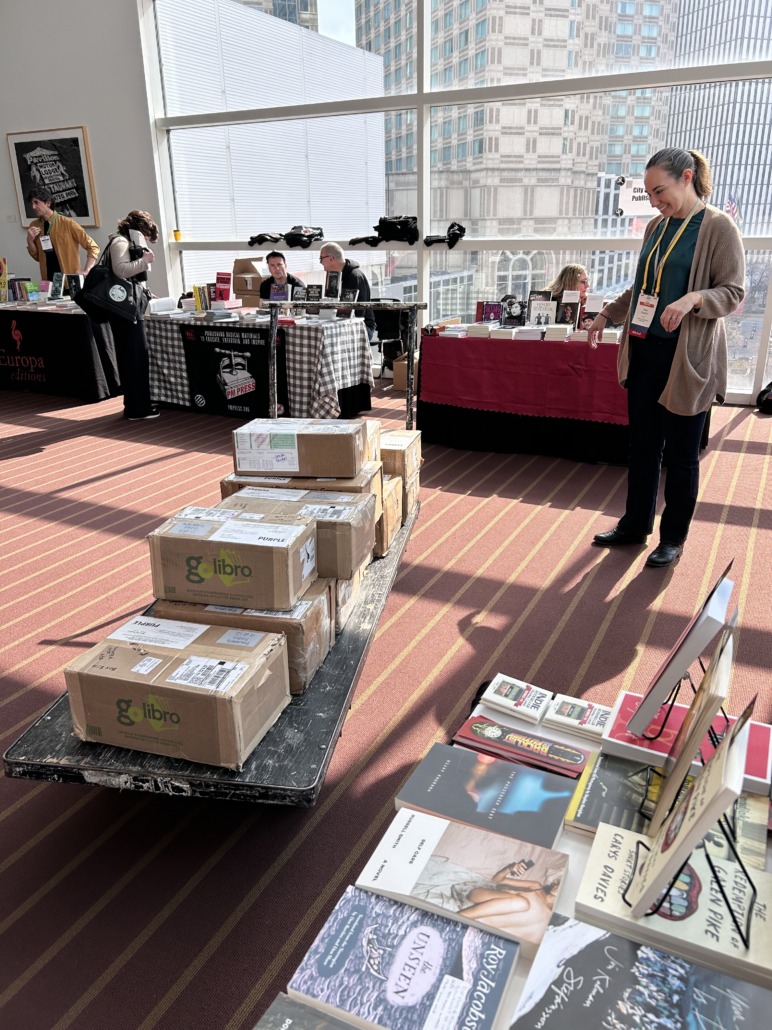
Our intrepid sales coordinator Hilary, decked in Backlist to the Future swag, manning the Biblioasis booth at Winter Institute.
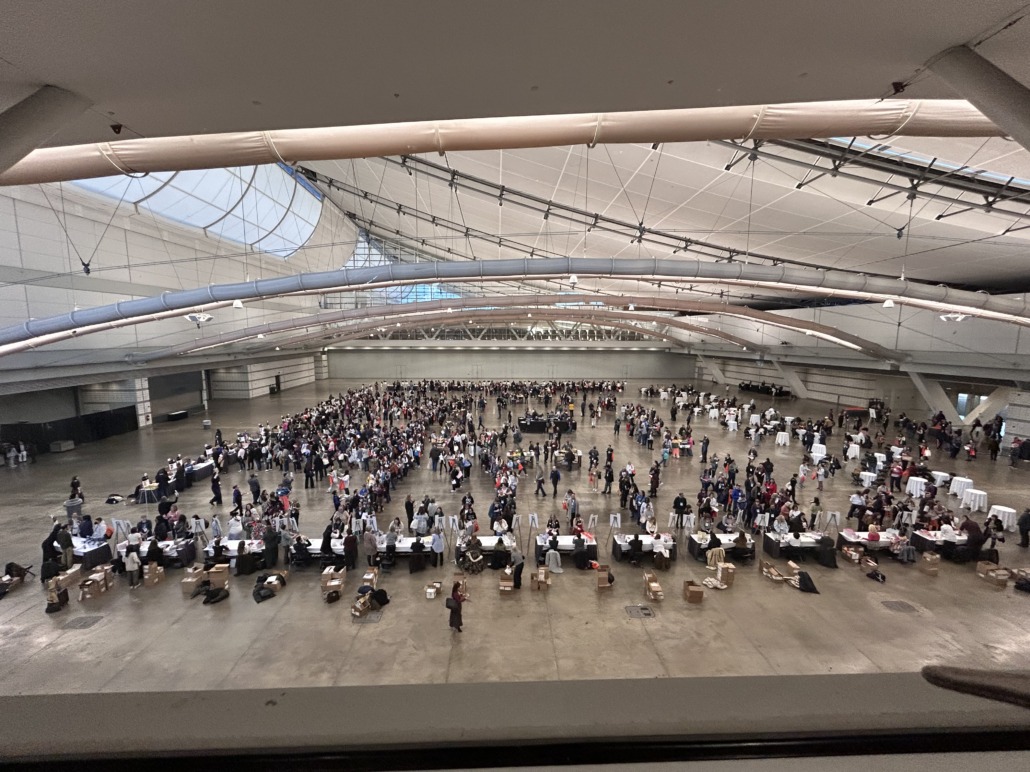
Saturday I worked with Jeff, our operations coordinator, from 7 am till past 9 at night to re-ready everything for the American Bookseller Association’s Winter Institute in Pittsburgh after UPS, who promised a 2-3 day delivery (Pittsburgh is only 4.5 hours from Windsor, about an hour closer to us than Toronto), failed to get our books to the city on time. The boxes took 13 days before they finally arrived mid-fair, looking like they’d barely escaped a war zone. Winter Institute is one of our biggest investments in American bookseller relations every year, the place where we launch several forthcoming books: to be there without any stock would have been a disaster (which was the word I used with UPS when I tried, with increasing frustration, to illustrate the D in our tracking code—D is for Disaster—to the displeasure of our off-shore quote-unquote customer service clerk). I cancelled my flight and left Sunday in my son’s CRV between the second and third period of the Men’s Gold Medal hockey game, worried that the border guards might not let me cross: the border has become increasingly erratic over the last six months and crossing with commercial goods is dependent very much on the agent one gets. Mine thankfully was quite decent, happy my paperwork was in order so that he could get back to watching the game. I wondered if my experience would have been different had I left after the game had finished.
Our books arrive midway through the 2nd day of the 3-day fair. General cheering ensues.
The days since have run between 16-20 hours as I tried to manage the day-to-day, alongside promoting our books and authors as part of Meet the Presses, a three day book fair in which we met hundreds of booksellers across the US, refining our pitches in real time and pressing books into eager hands (and transforming skeptical booksellers, hopefully, into superfans).
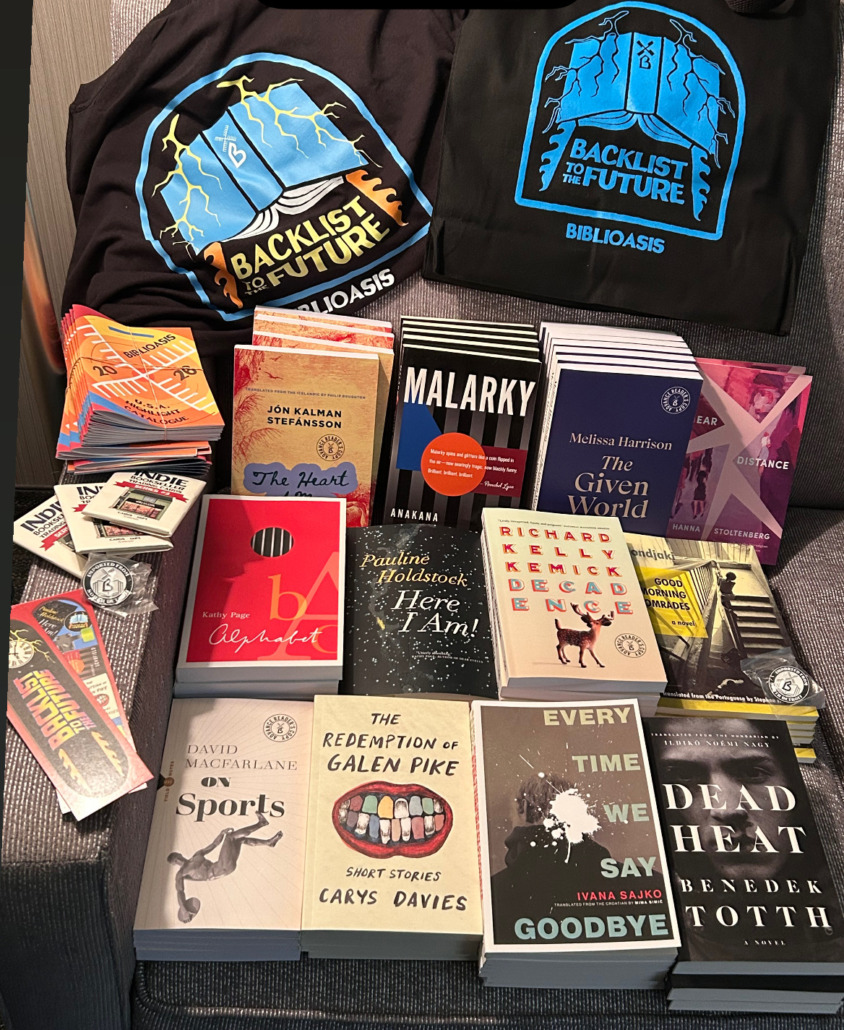
Prepping the merch in the hotel room.
It’s both exhausting and exhilarating. But to see the genuine excitement that readers feel for forthcoming books like Richard Kelly Kemick’s Decadence, Ivana Sajko’s Every Time We Say Goodbye, Don Gillmor’s Cherry Beach, Melissa Harrison’s The Given World, and Jón Kalman Stefánsson’s The Heart of Man, the concluding volume in his Trilogy About the Boy, among many other titles, recharges the spiritual batteries, as does the general awareness among American independent booksellers for Biblioasis and our titles.
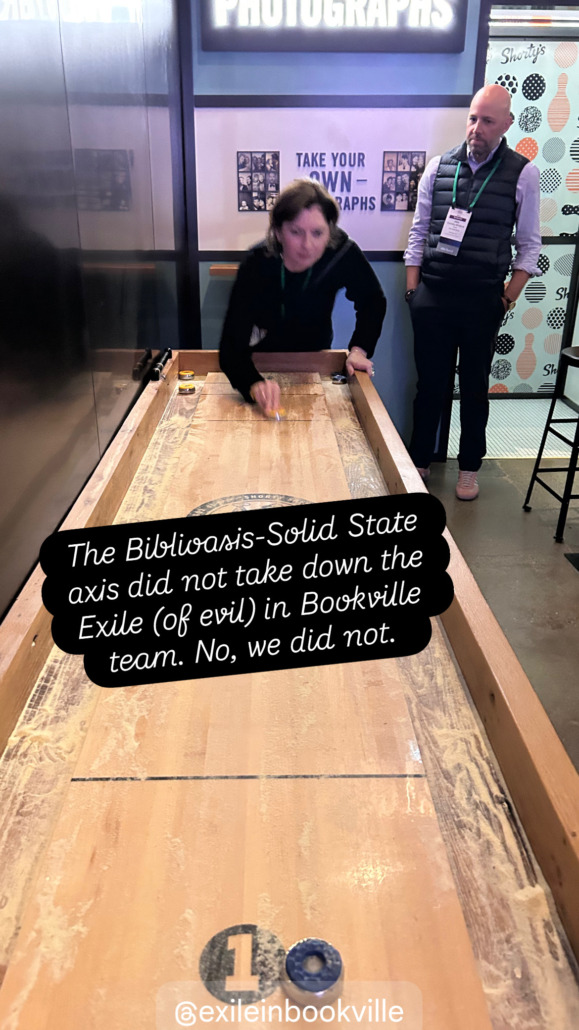
Kristen Ramirez (Exile in Bookville) and Jake Cumsky-Whitlock (Solid State) on the most sluggish shuffleboard table on the continent)Fun and games and the Biblioasis/D&Q bookseller party.
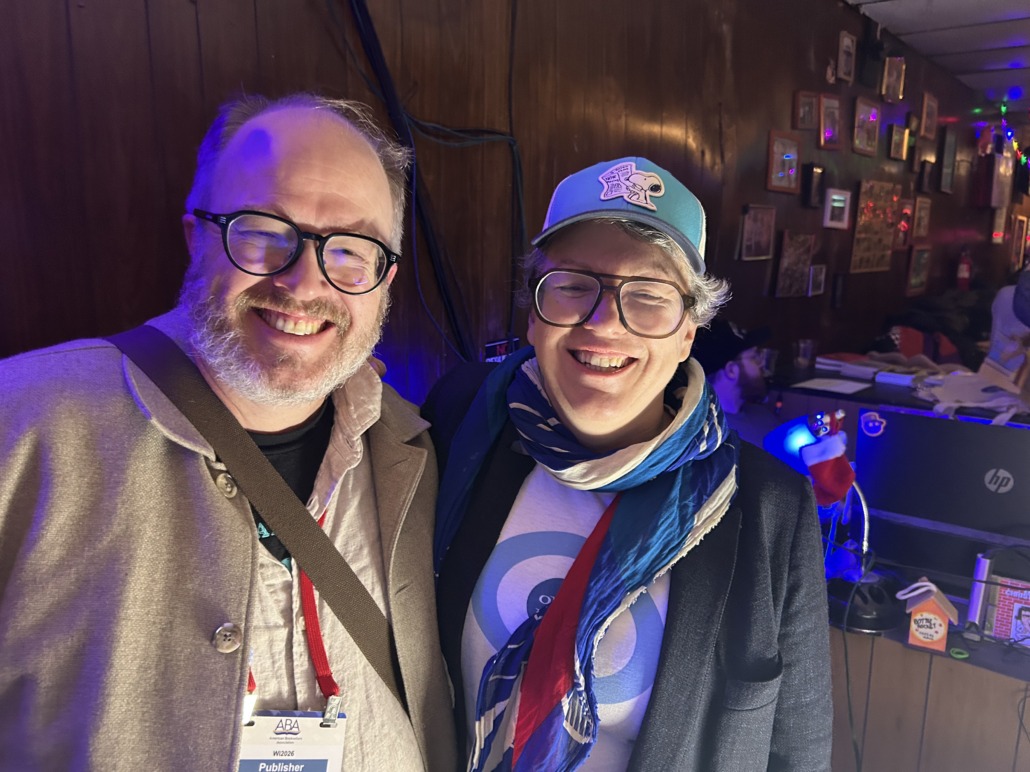
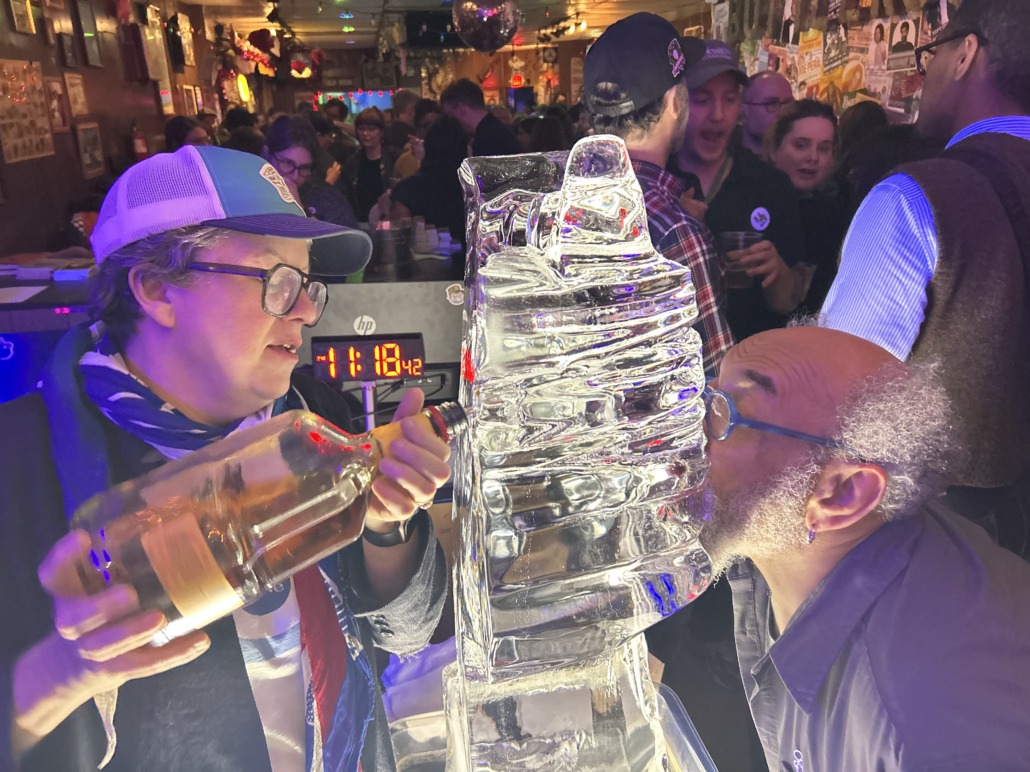
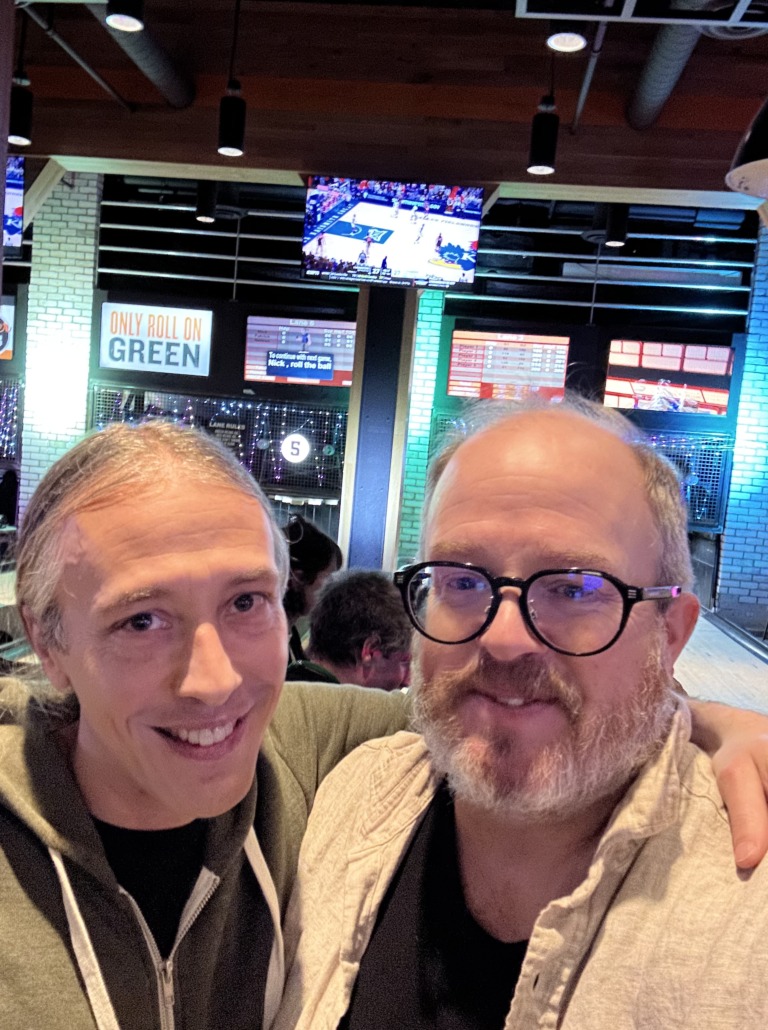
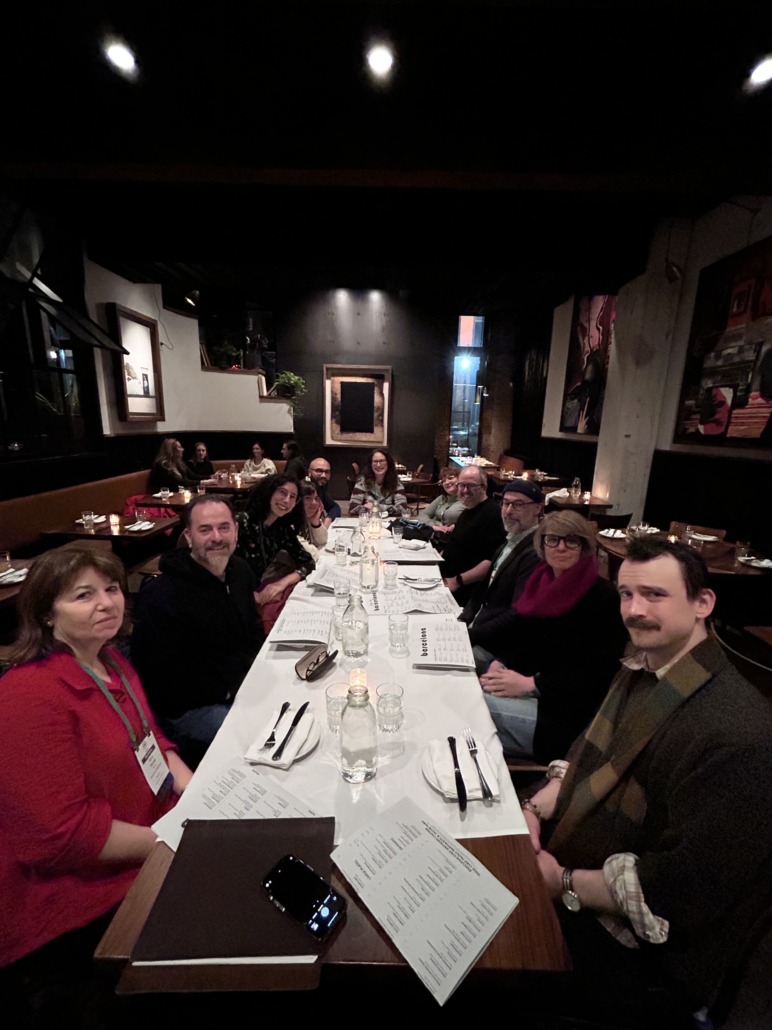
When we started going to this years ago, booksellers knew nothing about us; now, many search us out specifically. We hosted, alongside our bookselling and publishing compatriot Drawn & Quarterly, a wonderful Duck-pin bowling party on Monday; a dinner with booksellers both familiar and new on Tuesday; then joined our American compatriots Seven Stories and Two Dollar Radio in another dinner on Wednesday before heading to another party that evening where I joined Peggy Burns of Drawn & Quarterly in pouring Fireball Whiskey into booksellers’ maws (and down their chins) through an intricate ice sculpture.
Dan with Peggy Burns at the IBC afterpartyPeggy pouring Fireball into a bookseller’s maw.
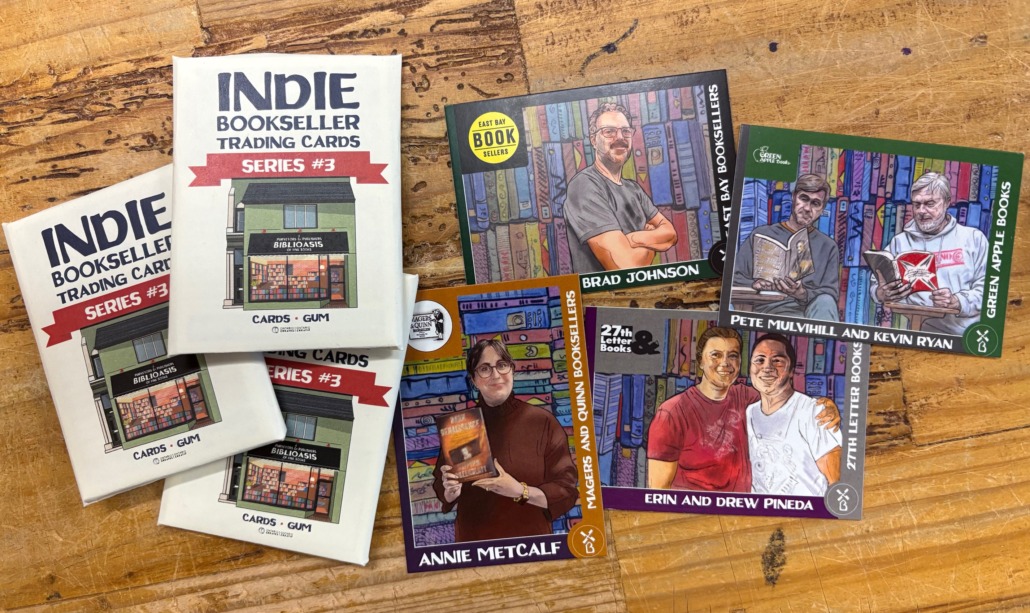
After a year hiatus, we unveiled the new edition of our improved bookseller trading cards, and, tired of the perpetual frontlist hustle, tried to engage booksellers (with some real success) in our Backlist to the Future campaign, more on which will follow.
A sampling of featured booksellers from the Indie Bookseller Trading Cards: Series #3. Pictured here: Brad Johnson (East Bay), Pete Mulvihill and Kevin Ryan (Green Apple), Annie Metcalf (Magers and Quinn), and Erin and Drew Pineda (27th Letter).
There were impromptu meetings with booksellers and our American distributors, with American media, other Canadian and American publishers, and even with a couple of our favourite writers, including Daniel Mason and Douglas Stuart.
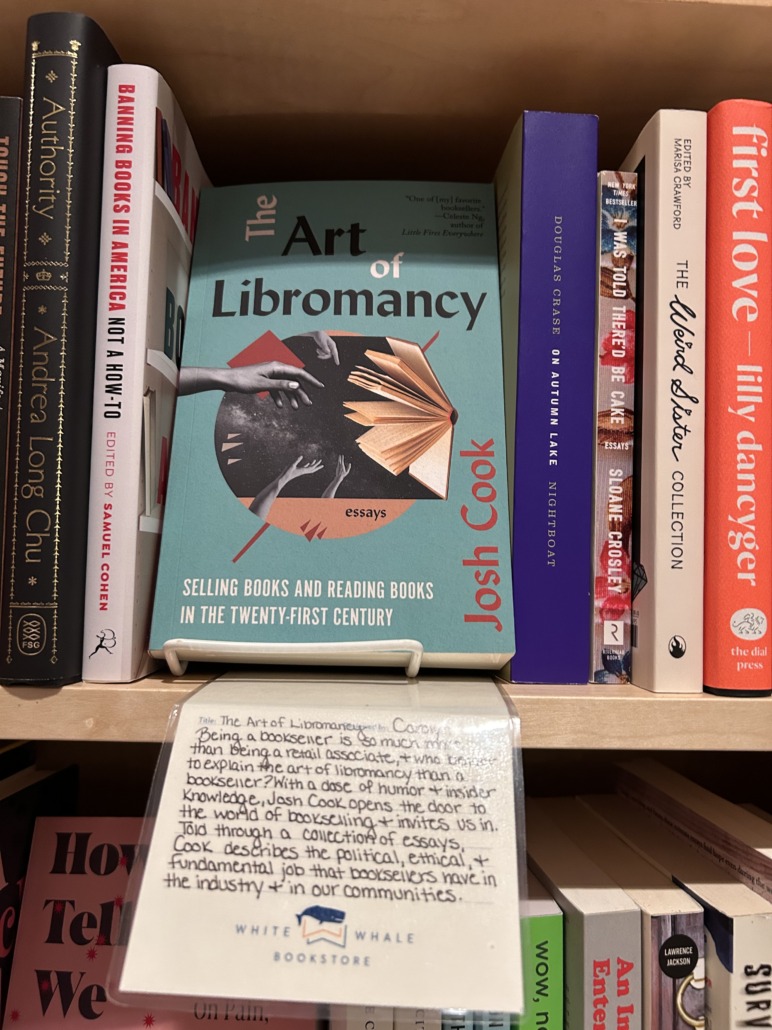
A visit to Pittsburgh’s fabulous White Whale, where Josh Cook’s Art of Libromancy was on display, among many other titles.
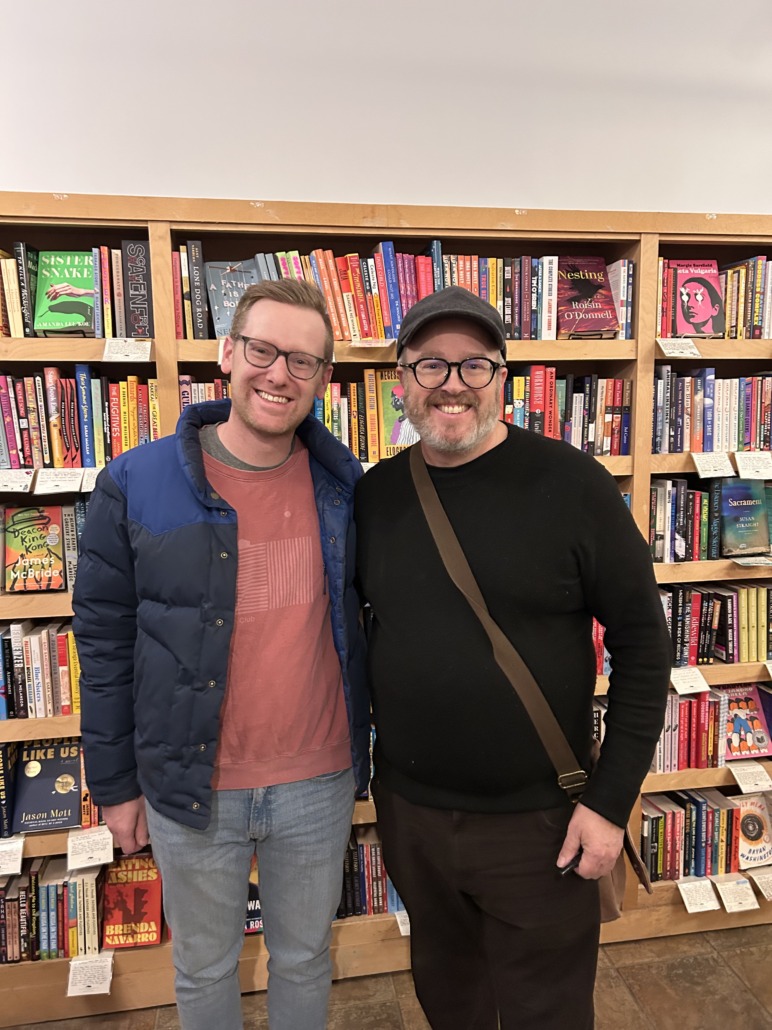
There were bookstore visits, and great conversations throughout all four days. As a bookseller I haven’t seen in years told me when we said goodbye, the last day felt like the end of summer camp, with repeated hugs and tears as we packed our tents and readied to go home. But I was grateful for the time I got to spend among some of my favourite people in the world, and I look forward to the next time I get to do so.
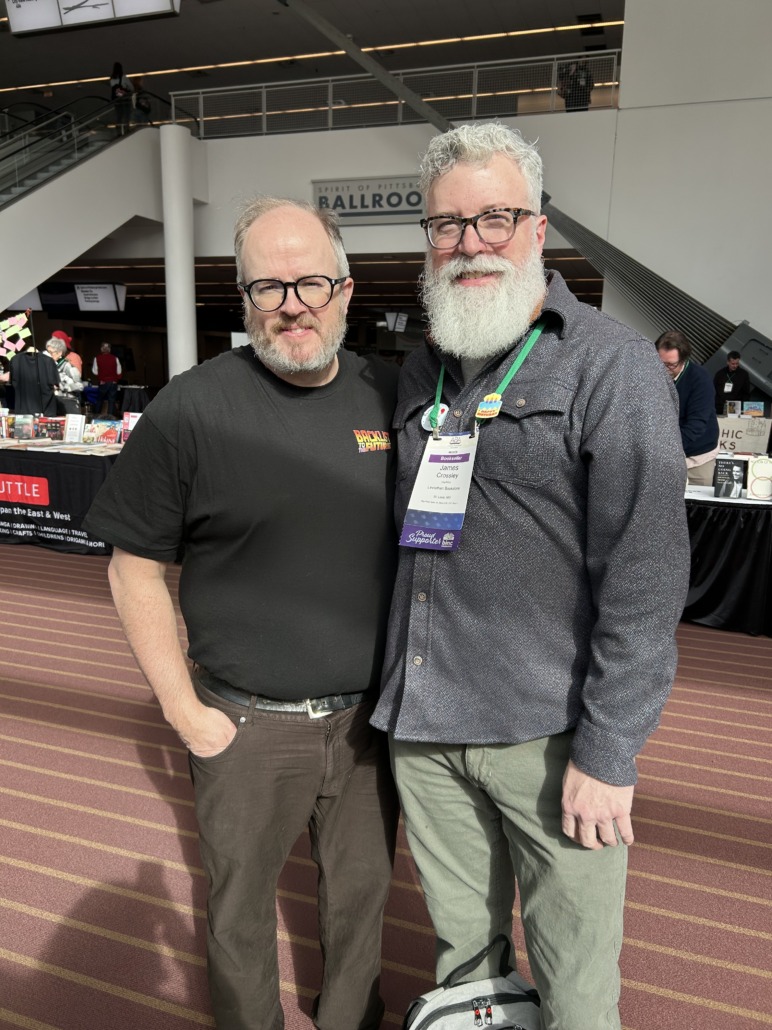
Dan with James Crossley (Leviathan).Dan with Bryan Seitz (Literati).Dan with Jeremy Garber (Powells).Sam Kaas (Norwich), Nina Barrett (Bookends and Beginnings) and many others.
I have so much more to unpack about the past week, things I wish I had the time to better explore, and hope to do so in a later Bibliophile. We need to talk about the total lack of Canadian booksellers at this event (D&Q and Biblioasis were the only two this year, and we were really there in a publishing capacity) and the dangers of letting what is going on alienate us from our American compatriots on the front line of the fight against fascism. Books are a battleground in both countries for very obvious reasons, and we’d be much better keeping the lines of communication open between our communities than cutting them off in a fit of nationalistic spite. When we allow the current American administration to separate us, we are giving them exactly what they want.
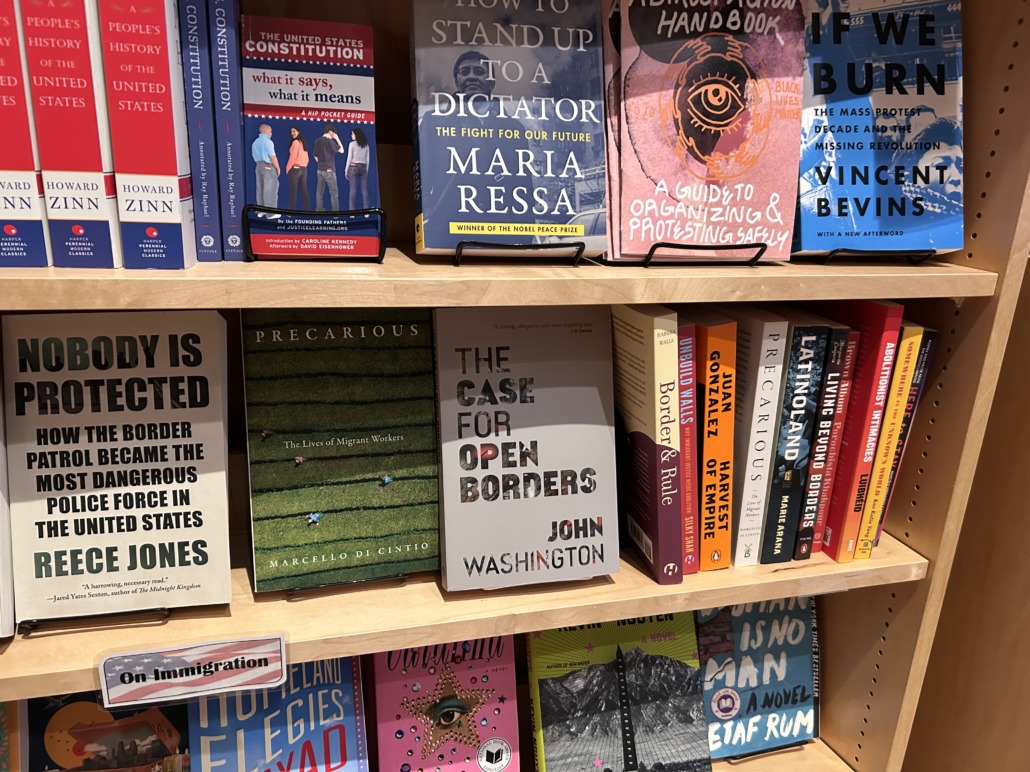
Marcello Di Cintio’s Precarious on display at White Whale.
I’d like to write about the essential connection events like Winter Institute make clear between independent publishers and booksellers, and how we could work better together for the betterment of both, and about the real hope and possibility that comes from talking with one another. I have so many ideas from conversations with Javier and Kristin Ramirez (Exile in Bookville), James Crossley (Leviathan), Kate Layte (Papercuts), Lori Feathers (Interabang), Carrie Koepke (Skylark), Sam and Emma Kaas (Norwich), Greg Kornbluh (Downbound), Miriam Chotiner-Gardiner (Three Lives), Bryan Seitz (Literati), and so many others. But that will have to keep. I think the only thing that kept me from driving off the highway on the return home was Barq’s root beer, chocolate, the Messthetics and the Ramones (Hey Hey Hey, why is it always this way just keeps cycling on my internal jukebox).
The author reception.
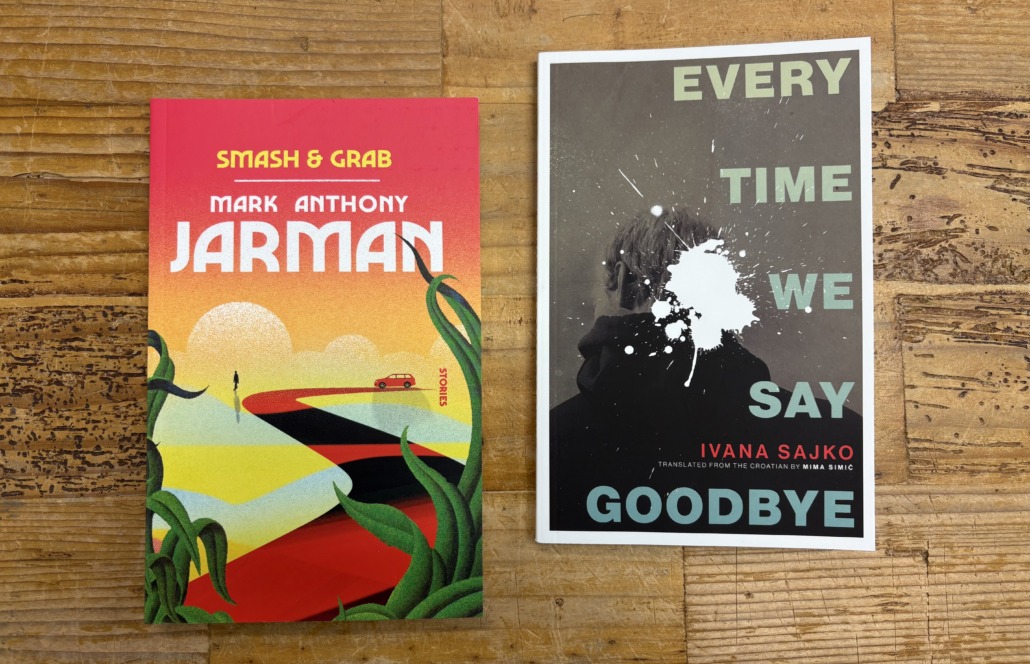
But before I go, two quick things for Bibliophile readers: our first book of 2026 officially launched this Tuesday. Mark Anthony Jarman’s Smash & Grab, a literal grab bag of fictions united solely by Jarman’s febrile imagination and wordplay, will be a treat for fans old and new. And our second, Ivana Sajko’s brilliant Every Time We Say Goodbye, launches next Tuesday: it’s already been assigned for a NYT review, and we’re expecting this to become one of the handsell titles of the year. So please head to your favourite independent wherever you are, and pick up a copy of each. I promise that neither will disappoint.
Dan Wells, Publisher
(L) Smash & Grab by Mark Anthony Jarman. Cover designed by Kate Sinclair. (R) Every Time We Say Goodbye by Ivana Sajko, trans. by Mima Simic. Cover designed by Ingrid Paulson.
The award is presented annually by TWUC in recognition of work that is passionately supportive of access to books and the freedom to read. Wells was nominated for the Freedom to Read Award by a fellow Canadian author, and the nomination reads (in part):
Author Ira Wells, born in Alberta, is well-known for his long-held stance against censorship. This is witnessed by his record of publications, which often touch on the subject of societal thought control. His most recent book, On Book Banning is an extended exploration of the ways libraries have been ransacked, often under the guise of “protecting children.”
Congratulations to Ira!
https://www.biblioasis.com/wp-content/uploads/2024/08/unnamed-scaled.jpg6172560biblioasishttp://biblioasis.com/wp-content/uploads/2014/12/BIBLIOASIS-Logo-500x500-White-300x300.pngbiblioasis2026-03-02 09:59:422026-03-02 09:59:46The Bibliophile: There and Back Again
Poets, send us your collections! Our 2026 reading period for poetry manuscripts is now open from now until Sunday, May 31st.
Biblioasis poetry submission guidelines:
We can only consider unpublished work. Individual poems in the manuscript may have appeared in journals or anthologies, but the collection as a whole must not have appeared as a print or digital edition.
Manuscripts should range between 48 and 100 pages in length.
Manuscripts must be entirely human-created. We do not accept work that was written, developed, or assisted in any capacity by artificial intelligence (AI) tools such as ChatGPT.
Only one submission per writer will be reviewed. Multiple submissions will be deleted unread.
Only electronic submissions will be accepted. To submit, please send your manuscript to our Duosuma submission portal. PDF, .doc, .docx, and .rtf files are accepted, though PDF is preferred. We will send confirmation that your submission has been received. Please send your manuscript only once: revised and updated versions will not be read, so make sure you’re happy with your text before submitting.
Please include a cover letter outlining your previous publications and relevant experience. Include your cover letter as the first page of your manuscript.
Simultaneous submissions are fine! If your manuscript is accepted by another publisher, kindly reach out to let us know your good news so that we can withdraw it from our consideration.
This is not a contest and we do not guarantee that any manuscripts will be accepted for publication. If your manuscript isn’t quite ready for this reading period, we encourage you to continue working on it and submit it during our next period: we want to see your best work. If you have any further questions, please reach out to submissions@biblioasis.com.
https://www.biblioasis.com/wp-content/uploads/2026/02/Poetry-Call-2026-1.png8002000biblioasishttp://biblioasis.com/wp-content/uploads/2014/12/BIBLIOASIS-Logo-500x500-White-300x300.pngbiblioasis2026-02-09 11:56:002026-02-09 12:38:29Biblioasis: Poetry Manuscript Submissions Now Open Until May 31!
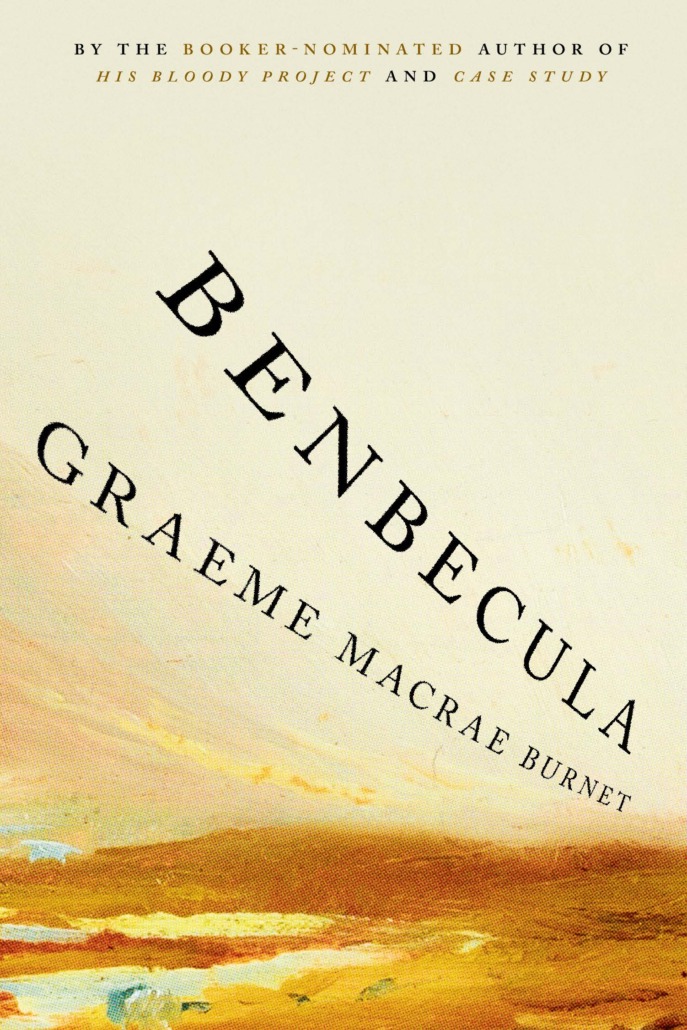
We’re excited to share that Benbecula by Graeme Macrae Burnet is one of the twelve books longlisted for the 2026 Walter Scott Prize for Historical Fiction! The announcement was made today, February 5, and you can view the full longlist on their website here.
The Walter Scott Prize for Historical Fiction is one of the most prestigious literary prizes in the world. Now in its sixteenth year, the Prize is unique for rewarding writing of exceptional quality in books first published in the UK, Ireland, or the Commonwealth, and set at least 60 years in the past.
The Prize was founded in 2009, and is traditionally awarded at the Borders Book Festival in Melrose, Scotland, in June every year. The winner receives £25,000 and shortlisted authors each receive £1,500. The Prize is managed by The Abbotsford Trust, the independent Scottish Charity responsible for Sir Walter Scott’s extraordinary Borders home, and is supported by Hawthornden Foundation and the Buccleuch Living Heritage Trust.
Booker-nominated Graeme Macrae Burnet returns to the historic Scotland of His Bloody Project to tell the multi-layered story of madness and murder in the MacPhee family.
During the summer of 1857 on the distant Scottish island of Benbecula, Angus MacPhee, returning from a fortnight’s work at a house a few miles away, seems to have lost his mind, forcing his family to keep him shackled to his bed. When he is finally allowed to go at large, his erratic behaviour leads to the conviction that he should be committed to an asylum.
Five years later, Malcolm MacPhee is living alone in the house where his brother’s madness led to horrifying ends. Isolated, ostracised by his small community, Malcolm is haunted, the stench of his brother’s crimes lingering as the reek cleaves to the thatch. Is he afflicted by the same madness? And to where has his sister Marion disappeared?
Drawing on letters, asylum records, and witness statements, Graeme Macrae Burnet returns to the historic Scotland of His Bloody Project to construct a beguilingly layered narrative about madness, murder, and the uncertain nature of the self.
Graeme Macrae Burnet is the author of six novels: the Booker-shortlisted His Bloody Project, which has been published in over twenty languages; the Booker-longlisted Case Study (named as one of the New York Times’ 100 Notable Books of 2022); Benbecula; and the Georges Gorski trilogy, comprising The Disappearance of Adèle Bedeau, The Accident on the A35, and A Case of Matricide. Graeme was born in Kilmarnock and now lives in Glasgow.
https://www.biblioasis.com/wp-content/uploads/2026/02/Benbecula-Prize.jpg8002000biblioasishttp://biblioasis.com/wp-content/uploads/2014/12/BIBLIOASIS-Logo-500x500-White-300x300.pngbiblioasis2026-02-05 12:34:312026-02-05 12:34:33BENBECULA longlisted for the 2026 Walter Scott Prize for Historical Fiction
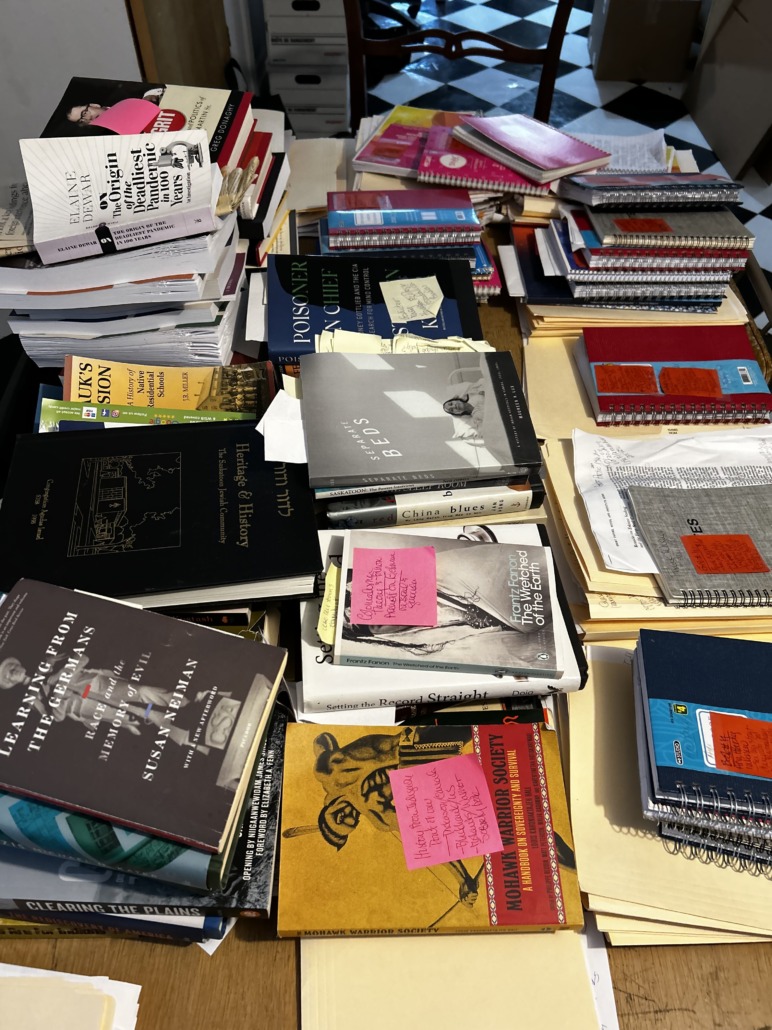
On Tuesday morning I took the 5:35 train to Toronto to spend the day down in Elaine Dewar’s home office, helping the family sort through papers and ready things for a possible archive acquisition. It was strange to be down there again: though the bookshelves were a little more bare than they had been in September, her desks were as she had left them when she took a break to go on vacation last August; when she went to the hospital she never expected that she’d not be back down there again.
Photo: Elaine Dewar’s piles of notebooks and research material for Oblivious, as she had left it.
I put together some bankers boxes and got to work, and as I began to read and sort and label I was reminded repeatedly of her fierce dedication to what she understood to be her journalistic vocation. There were the dozens of notebooks recording the interviews that went into the making of Oblivious: Residential Schools, Segregated Hospitals, and the use of Indigenous Peoples as Slaves of Race Science, that we will be publishing later in April; the files of fact-checking, the piles of books that looked as if they’d been torn through in a rage: they were folded and scored and bent and scribbled on, though organized in piles directly related to what she was working on. There were boxes of newspaper clippings and academic research papers; the folders of freedom for information requests and her correspondence with officials about their delays or withholdings; there were notes-to-self about things to follow-up on. There was a budget for the production of the book that she had produced for a funding body as part of a grant application: working on a shoestring, she estimated the book would cost her more than $75,000.00. Between advance and some small works-in-progress grants I could direct her way I may have got her close to a third of that amount. I know that she got a Canada Council grant and some additional provincial funding, but far too much of that total would have come out of her own pocket. Which is, far too often, what is required of Canadian writers, especially of researched nonfiction.
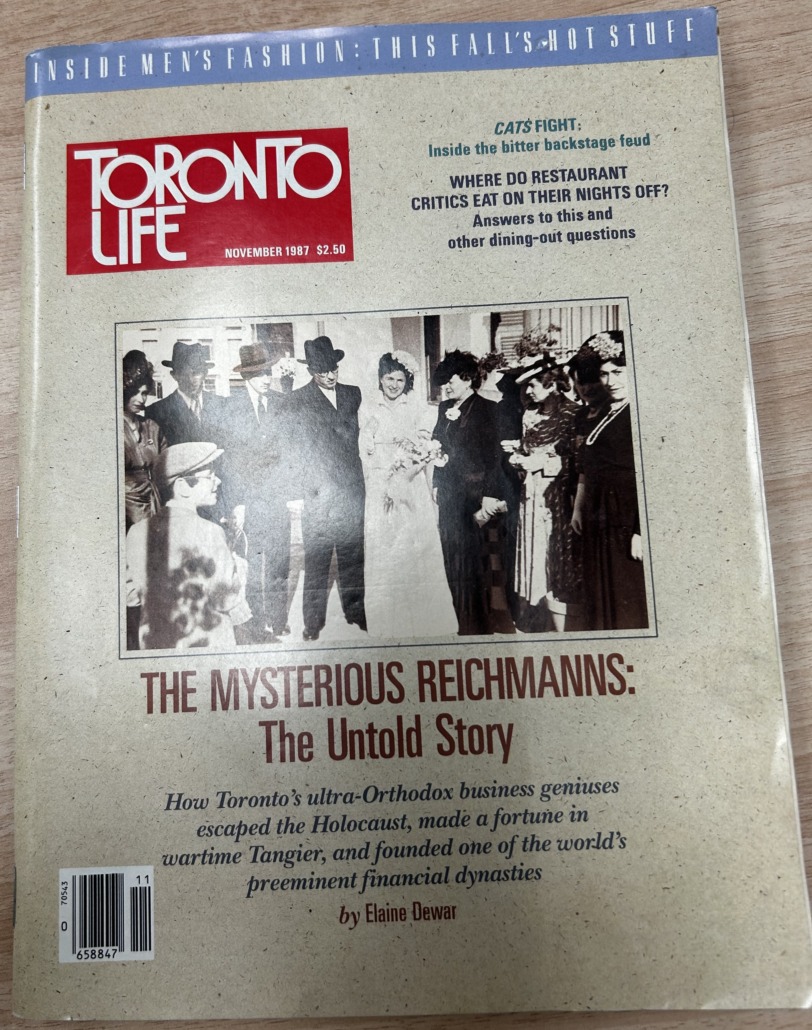
Photo: A copy of the November 1987 issue of Toronto Life magazine, featuring Elaine Dewar’s profile “The Mysterious Reichmanns.”
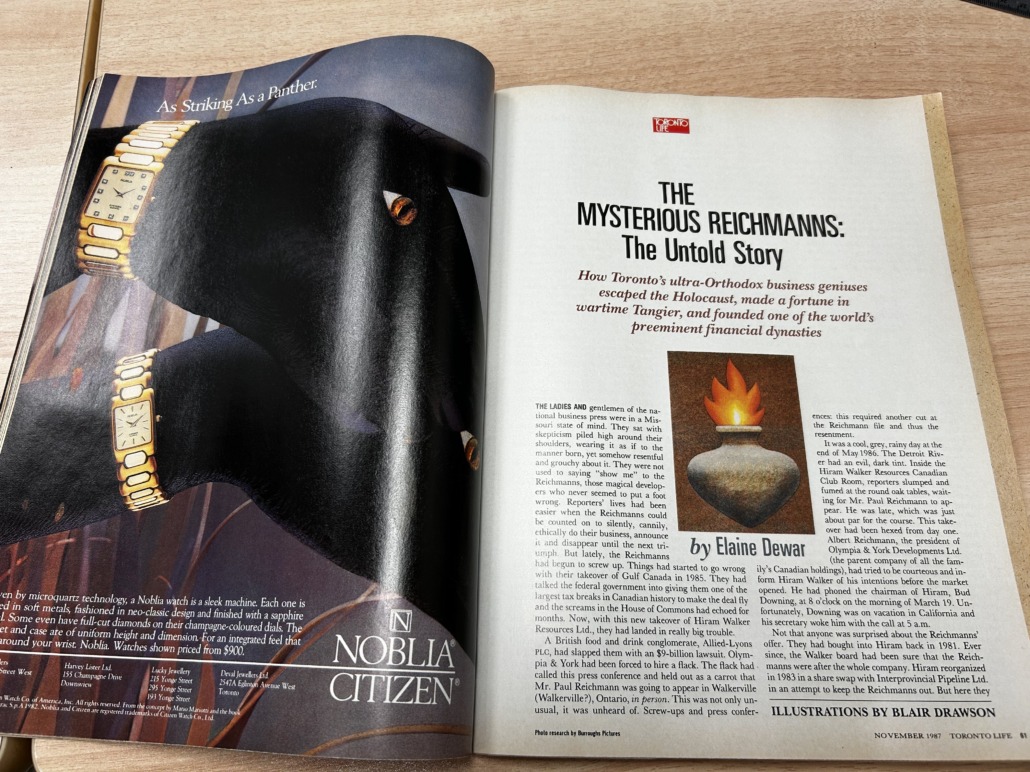
I filled 10 bankers boxes with the materials that went into the making of Oblivious, and then moved onto boxing up other documents, including some early essays I found by a teenage Elaine Landa where her voice and vocation was already evident. But what I’ve been thinking about since I located them was approximately a foot of documents tied to the Reichmann trial that resulted from her November 1987 Toronto Life profile “The Mysterious Reichmanns: The Untold Story.” This resulted in the Reichmann’s suing Elaine and Toronto Life, as I’ve heard more than one commentator say, into the stone age, costing her a book deal with Random House worth, if memory serves, $60,000, an estimated $250,000 in other lost revenue, the destruction of years of work, damage to her reputation, and an inhuman amount of stress. Lesser mortals, which means almost all of us, would have crumpled under the weight of it all, as was no doubt expected of Elaine. And yet in these surviving documents, and in the supreme court dispositions and typescripts, which must total close to 800 pages, you can see Elaine fighting back and continuing to kick against the pricks, refusing to give up her sources, maintaining her dignity and fighting for her profession and her own professional life. Sitting down in that cold and increasingly bare office, I couldn’t help but cheer her on forty years after the fact. I felt such an appreciation for how she conducted herself, not just for herself but for all of us. And though almost no one under a certain age remembers this trial or knows of its significance, what Elaine endured helped to change the shape of libel law in this country and made it safer for writers to do the work that they needed to get to the truth, and, as Elaine believed, to afflict the comfortable and comfort the afflicted.
Photo: The first page of the article, “The Mysterious Reichmanns.”
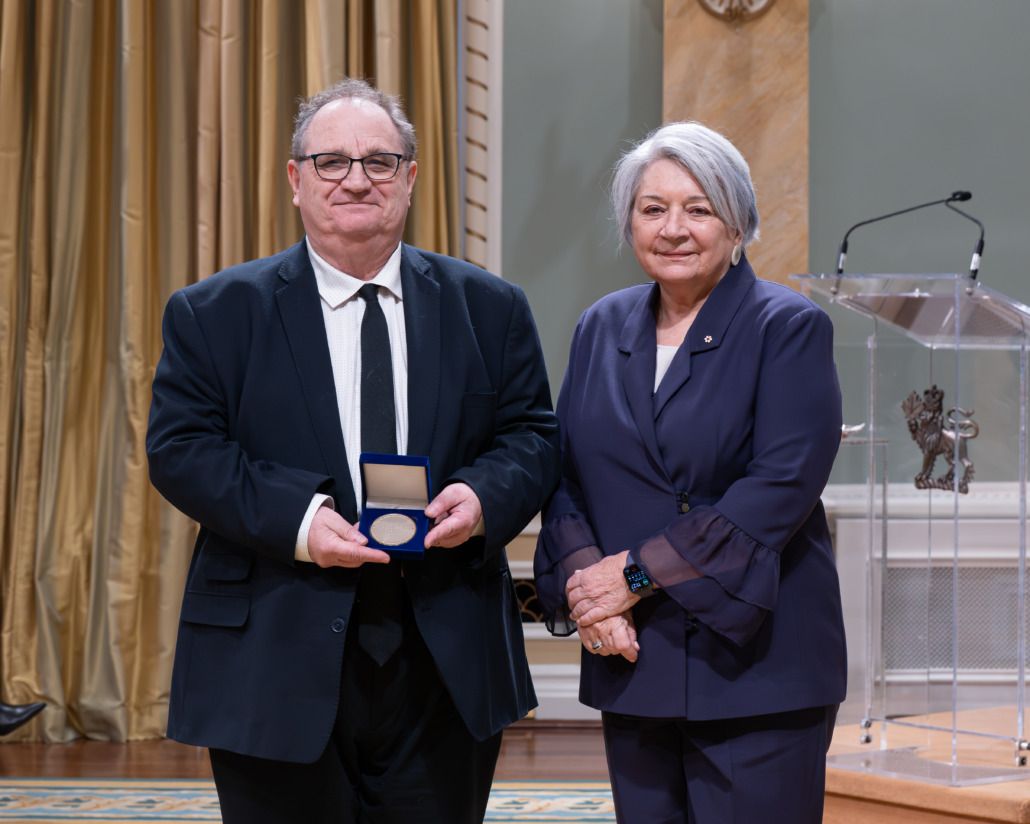
Among the notes I found was a request she made for me to have Mark Bourrie read her manuscript for libel when it was finished. So I sent a note off to Mark about it, forgetting that at that moment he was receiving the Pierre Berton Award from the Governor General. He gave a speech at its reception that he’s just posted on his own excellent Substack, which you can read here, but which I will selectively quote from below because it ties into something I’ve been thinking about since finding those files in Elaine’s office:
I want to talk about the fact right now we are in the midst of a revolution. Anybody who chooses to ignore it is simply going to find that out later. This is “elbows up” time in Canada. You would not know it from our policy-setters, who have let our country’s publishing and historic story-telling wither. We will be celebrating at the Canadian Museum of History tomorrow. Not everyone in the building will be happy—67 people in that organization have been told they are going to lose their jobs because of federal cuts.
. . .
I would like to be able to do more advocacy. We need to find ways to get the word out about our books. We need to fix the problems with the Copyright Act that, effectively, gave schools the “right” to take our work without paying. And we need to have a funding system that takes the financial risk of producing public history off the shoulders of families like mine.
The problem, of course, is that it has always been thus, at least when it comes to the cultural life of this country. Change has always been dependent on individuals, families, or small groups who resist the powerful or the indifferent and push forward despite the very real costs of doing so. I don’t anticipate at this moment that we’re in for substantial change for the better, however much I wish it were otherwise. Mark Carney may have quoted Thucydides and Václev Havel in his Davos speech, but almost a year into his leadership of the country I don’t think I’ve yet heard him say anything in defence of Canadian culture. If we’re going to improve things, we’ll have to take matters into our own hands, and this is why the examples of people like Elaine Dewar and Mark Bourrie (and so many of my small press publishing colleagues) mean so much to me at the moment. It’s difficult, it’s impossible, but they carry on. Which reminds me of a quote I first read on Derek Weiler’s arm, taken from an Irish writer I’ve since grown to love.
You must go on. I can’t go on. I’ll go on.
Greg Kelly, CBC Ideas producer, was in town yesterday to give a speech to the University of Windsor’s Humanities Research Group. Titled “Quiet Piggy: Private Codes as Public Discourse,” it was about the breakdown between the private and public and the hijacking of so-called authentic expression in the service of authoritarianism. During his conclusion he spoke of the necessity of action as a form of faith. There’s no guarantee that what we do will make any difference, though we know quite clearly what the consequences of our inaction are. It is through the slow accretion of our efforts, hopefully alongside others, that things change. This is a faith I can accept as my own. Perhaps it’s the remaining glow from my Italian sojourn, but I remain hopeful that we can continue to nudge the cultural needle in the right direction. After all, what choice do we have?
Dan Wells, Publisher
In good publicity news:
Benbecula by Graeme Macrae Burnet was featured in the Historical Novels Review: “While Benbecula is a tragic story of murder, the empathy that the author feels for his characters and the circumstances that they’re living in is beautifully expressed . . .Consider this reader fully engaged by Benbecula.”
Smash & Grabby Mark Anthony Jarman was reviewed in Quill & Quire: “Jarman packs more into his sentences than any half dozen other authors combined . . . [Smash & Grab’s] cumulative riches are plentiful and unique to one of the most invigorating and unconventional writers of short fiction around.”
On Sports by David Macfarlane was reviewed in The Seaboard Review: “An authentic and resonant read, On Sports should appeal to sports fans who have had their misgivings about sport and where it’s headed, though anyone interested in sports more generally might enjoy reading about Macfarlane’s experiences, his emotional connections to sport, and his philosophical musings about its pros and cons.”
https://www.biblioasis.com/wp-content/uploads/2024/08/unnamed-scaled.jpg6172560biblioasishttp://biblioasis.com/wp-content/uploads/2014/12/BIBLIOASIS-Logo-500x500-White-300x300.pngbiblioasis2026-01-31 11:41:242026-02-13 11:51:03The Bibliophile; A Certain Faith
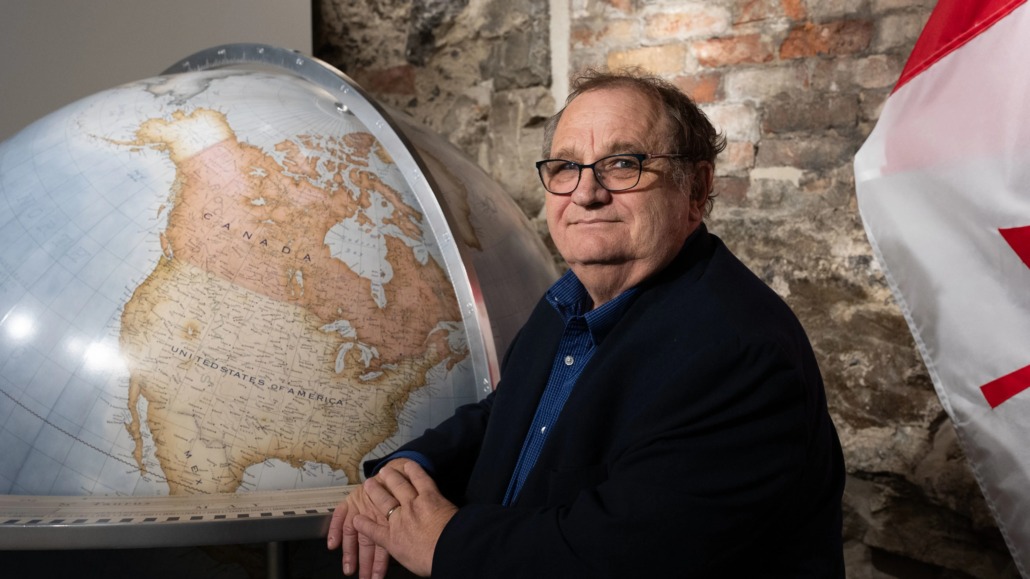
Photo: Mark Bourrie (courtesy Canada’s National History Society)
Mark Bourrieis an Ottawa-based author, lawyer, and journalist. He holds a master’s in journalism from Carleton University and a PhD in history from the University of Ottawa. In 2017, he was awarded a Juris Doctor degree and was called to the bar in 2018. He has won numerous awards for his journalism, including a National Magazine Award, and received the RBC Charles Taylor Prize in 2020 for his book Bush Runner: The Adventures of Pierre-Esprit Radisson. His most recent books include Big Men Fear Me: The Fast Life and Quick Death of Canada’s Most Powerful Media Mogul, the national bestseller Crosses in the Sky: Jean de Brébeuf and the Destruction of Huronia, and Ripper: The Making of Pierre Poilievre.
The Governor General’s History Award for Popular Media: the Pierre Berton Award recognizes individuals who have helped increase understanding of Canadian history through popular media, including but not limited to publications, film, radio, television, theatre, or digital media platforms. The $5,000 Pierre Berton Award, as it is also known, is administered by Canada’s National History Society, with the support of the Government of Canada through the Department of Canadian Heritage, and Power Corporation of Canada.
In their press release, president and CEO of Canada’s History Society Melony Ward praises,
“Mark Bourrie makes our country’s history as vivid as anything happening today. He embraces the complexity of the past to create works that brim with conflict, struggle, and larger-than-life characters, all firmly grounded in research.”
The eleven recipients being honoured by this year’s history awards, will receive their awards from Governor General Mary Simon at an upcoming ceremony in Ottawa.
A huge congratulations from all of us at Biblioasis to Mark!
https://www.biblioasis.com/wp-content/uploads/2026/01/Bourrie_PierreBerton.jpg8002000biblioasishttp://biblioasis.com/wp-content/uploads/2014/12/BIBLIOASIS-Logo-500x500-White-300x300.pngbiblioasis2026-01-20 13:07:252026-01-20 13:07:27Mark Bourrie wins the 2025 Governor General’s History Award for Popular Media: The Pierre Berton Award
We’re thrilled to share that today, the National Book Critics Circle Award announced their finalists for the 2025 Gregg Barrios Book in Translation Prize, which includes Wendy H. Gabrielsen’s translation of Near Distance by Hanna Stoltenberg! View the full list of finalists on their website, here.
As judge Mandana Chaffa describes, the Barrios shortlist features “remarkable books by notable authors, which are only available to English readers because of the gifted translators and committed publishers who bring them to life.”
The NBCC’s Gregg Barrios Book in Translation Prize, launched in 2022, seeks to highlight the artistic merit of literature in translation and recognize translators’ valuable work, which expands and enriches American literary culture by bringing world literature to English-language readers. The prize honors the best book of any genre translated into English and published in the United States.
A finalists reading will be be held on March 25, 2026; the awards ceremony and reception will be on March 26, and is open to the public.
A Finalist for the 2025 Gregg Barrios Book in Translation Prize
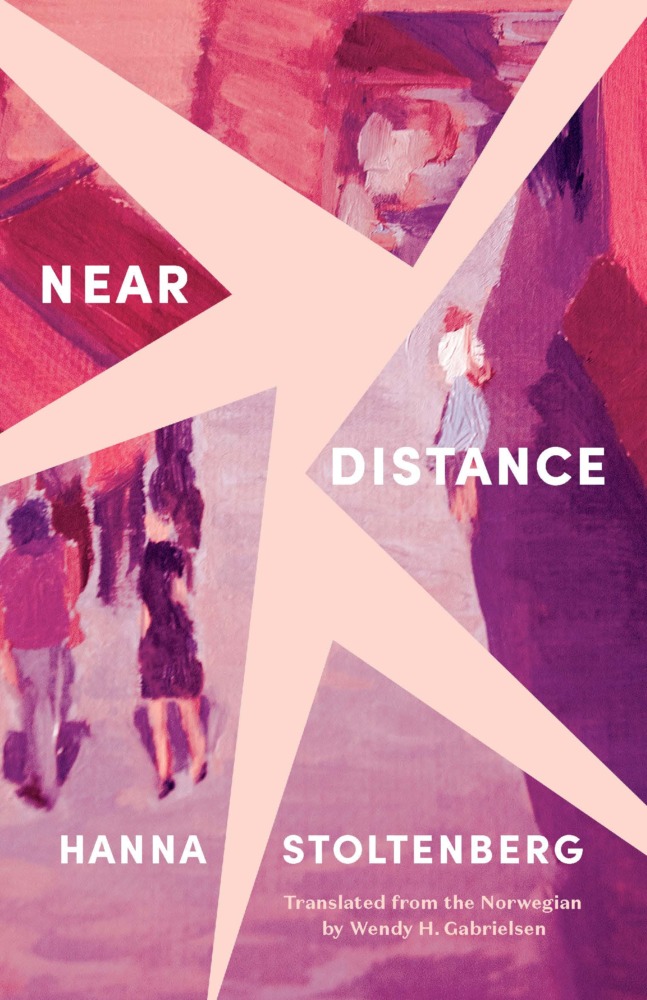
For her entire life, Karin has fled anything and anyone that tries to possess her. Her job demands little, she mostly socializes with men she meets online, and she’s rarely in touch with Helene, her adult daughter. But when Helene’s marriage is threatened, she turns, uncharacteristically, to her mother for commiseration, and a long weekend away in London. As the two women embark on their uneasy companionship, Karin’s past, and the origins of her studied detachments, are cast in a new light, and she can no longer ignore their effects—on not only herself and her own relationships, but on her daughter’s as well.
An unnerving, closely observed study of character—and the choices we do and do not make—Near Distance introduces Hanna Stoltenberg as a writer of piercing insight and startling lucidity.
Wendy Harrison Gabrielsen moved to Oslo in 1987 after completing an MA in Translation at the University of Surrey. She has translated works of fiction as well as nonfiction, and in 2022 she was awarded the Wigeland Prize by the American-Scandinavian Foundation for an excerpt from her translation of Hanna Stoltenberg’s Near Distance.
Hanna Stoltenberg (born 1989) grew up in Oslo and studied English at the University of Bristol. She is a regular contributor to the Norwegian literary journal Vinduet and works as an editor at the Munch museum. Her first novel, Near Distance (Nada in Norwegian) was published in 2019. It won the prestigious Tarjei Vesaas first book award and the NATT&DAG Oslo prize for best literary work. She is currently working on her second novel.
https://www.biblioasis.com/wp-content/uploads/2026/01/NBCC_Near-Distance_finalists.jpg8002000biblioasishttp://biblioasis.com/wp-content/uploads/2014/12/BIBLIOASIS-Logo-500x500-White-300x300.pngbiblioasis2026-01-20 12:31:522026-01-20 12:31:54NEAR DISTANCE shortlisted for the NBCC 2025 Gregg Barrios Book in Translation Prize!
Want to get new excerpts, musings, and more from The Bibliophileright away? Sign up for our weekly online newsletterhere!
***
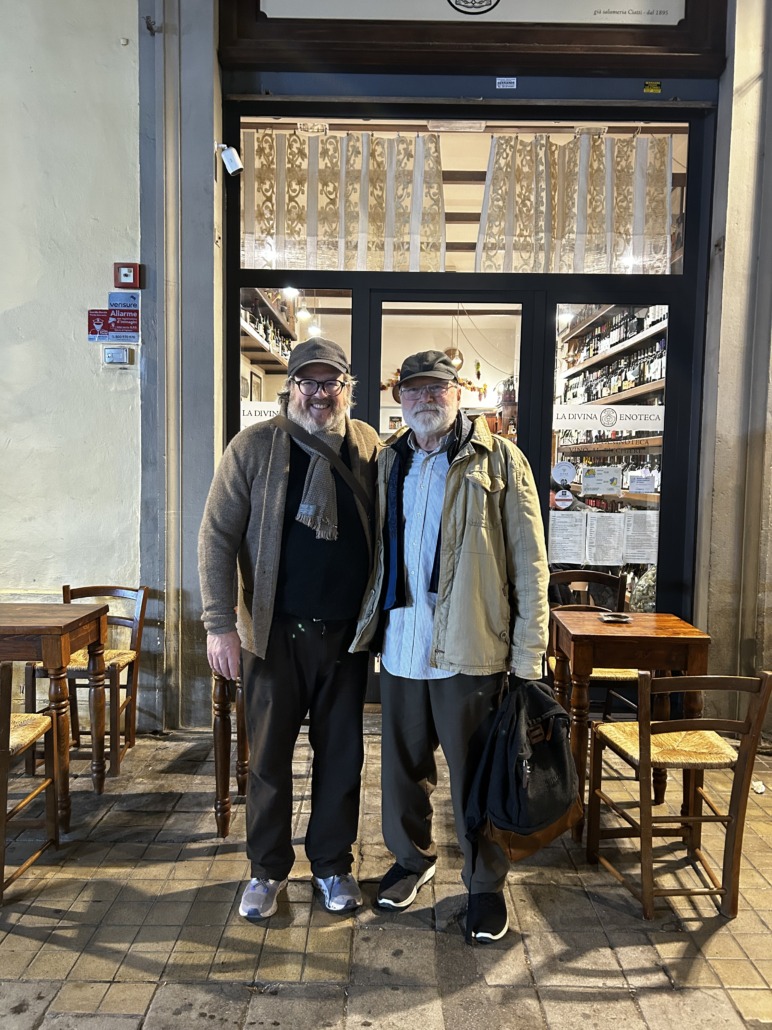
We took an extended break this year at the Bibliomanse, and my own was extended further still by five inches of snow in Paris and Amsterdam, even if a short purgatory in Dante’s city is nothing to kvetch about. Besides, it came with the added benefit of having a couple of drinks with the author of our first title of the season, Mark Anthony Jarman.
Photo: Our globetrotting publisher Dan Wells (left) meets up with Mark Jarman (right) in Florence.
Still, I’m not sure I’ve ever been so happy to be back behind this desk and working on new books, while planning to help broaden the spotlight to include some of our previously published ones as well. (Backlist is Bullshit.) This is only my third full day in office this year (if you don’t count my cramped work at 35,000 feet over the Atlantic) and I’m grateful for many things as we begin 2026, including the great people I get to work with during the creation of these many books, and their enthusiasm and willingness to try new things as we continue to figure out how to make this most difficult of professions make sense, while having a little fun along the way.
Rather than overwhelming you with the complete list of everything we have coming over the first half of this year, or even during the Winter Season, we thought we’d share the first three titles we’re publishing in 2026, breaking this preview up over a few posts over the coming weeks.
A mischievous medley of stories that blur the lines between the real and the imagined.
Photo: Smash & Grab: Stories by Mark Anthony Jarman. Cover designed by Kate Sinclair.
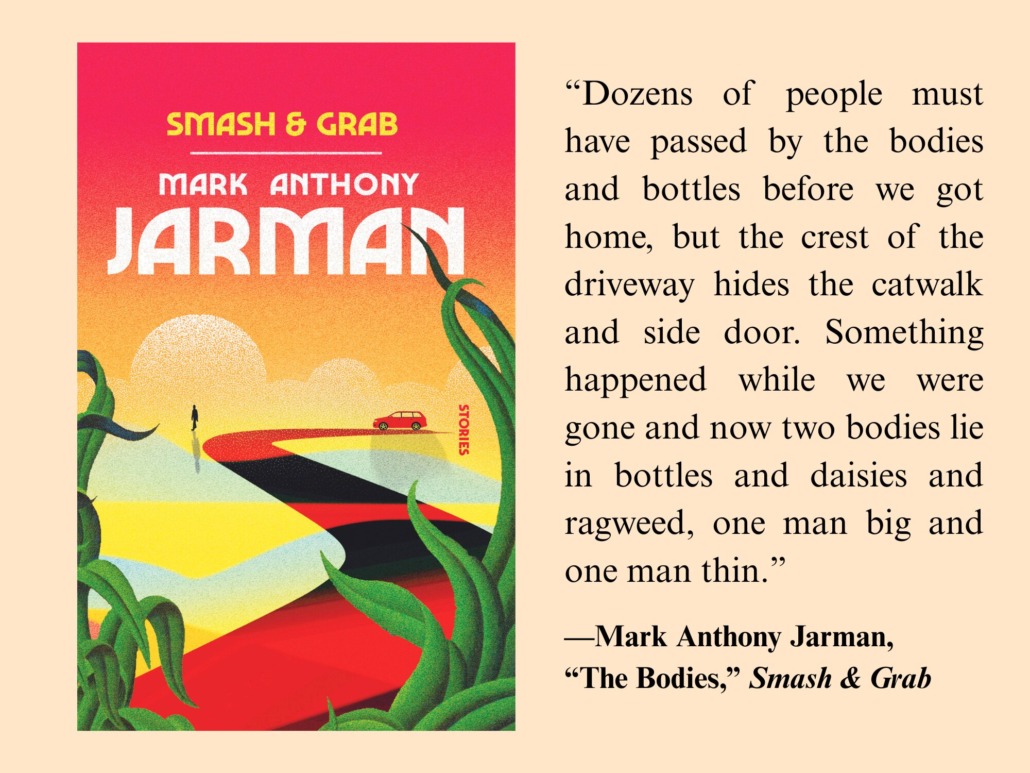
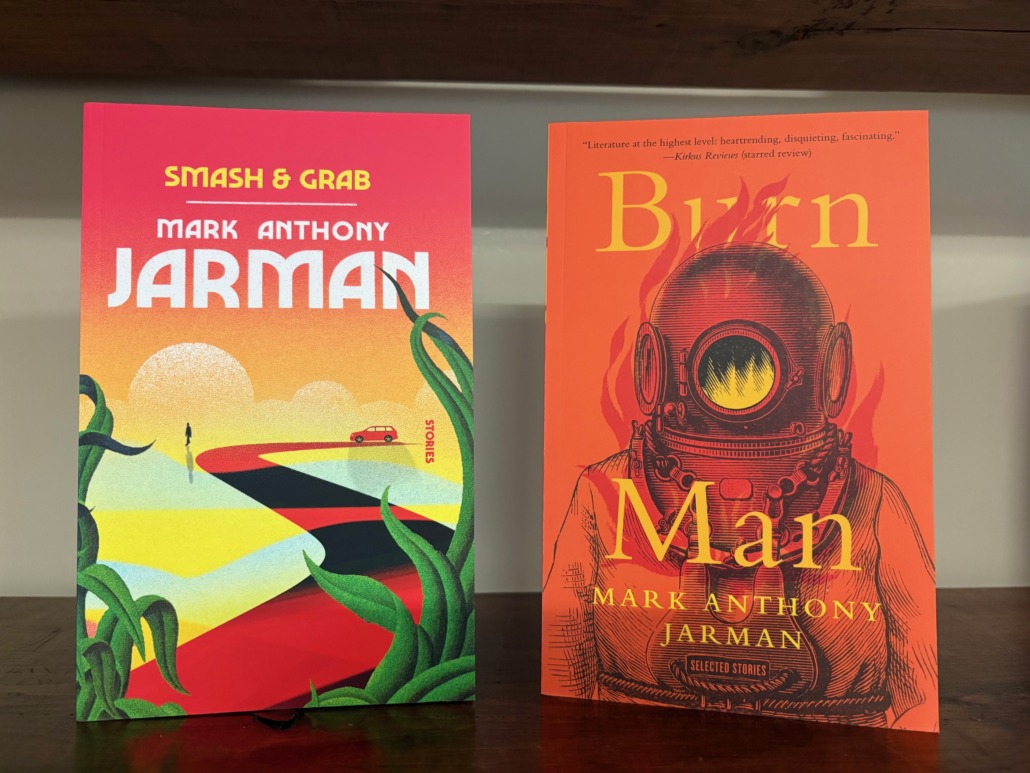
Smash & Grab brings together fourteen new stories . . . or performances . . . or pieces by one of the most inventive prose stylists at work today, blurring the line between the real and the imagined. His first new collection of short fiction in more than a decade—and first since we collected the best of his previous work in Burn Man: Selected Stories, a book that saw rave reviews from the New York Times, Wall Street Journal, Kirkus, Globe and Mail, and elsewhere—these are stories that work their own musical magic distinct from that of any other writer today, stories shaped like strange loops, which gather in the reader’s mind as a collage might, layering word and image.
Photo: Smash & Grab alongside Mark Jarman’s previous book, Burn Man: Selected Stories (cover designed by Michel Vrana).
His language, as Jarman himself said of one of his literary idols Barry Hannah, is “a weird mixture of Elizabethan and cracker”; his world, whether it is set in Venice or the deep south or on the bloody moon, is violent and bizarre and always slant. Reading an excellent Jarman story—and this book has several of them—will leave you slightly off-kilter. It doesn’t matter what they’re about—the summary of some of them have the feel of a barroom joke: ie, a former military policeman, a veterinarian, and a French poet walk into a bar and debate the Vietnam War—it’s the experience of them that counts. So go ahead . . . experience them. Smash & Grab is already finding its way into bookstores, though it only officially launches five weeks from now.
by Ivana Sajko, translated from the Croatian by Mima Simić
An extended soliloquy of self-examination, upheaval, loss, hope, disillusionment, ambition, and failure; and a profoundly stark and furious novel.
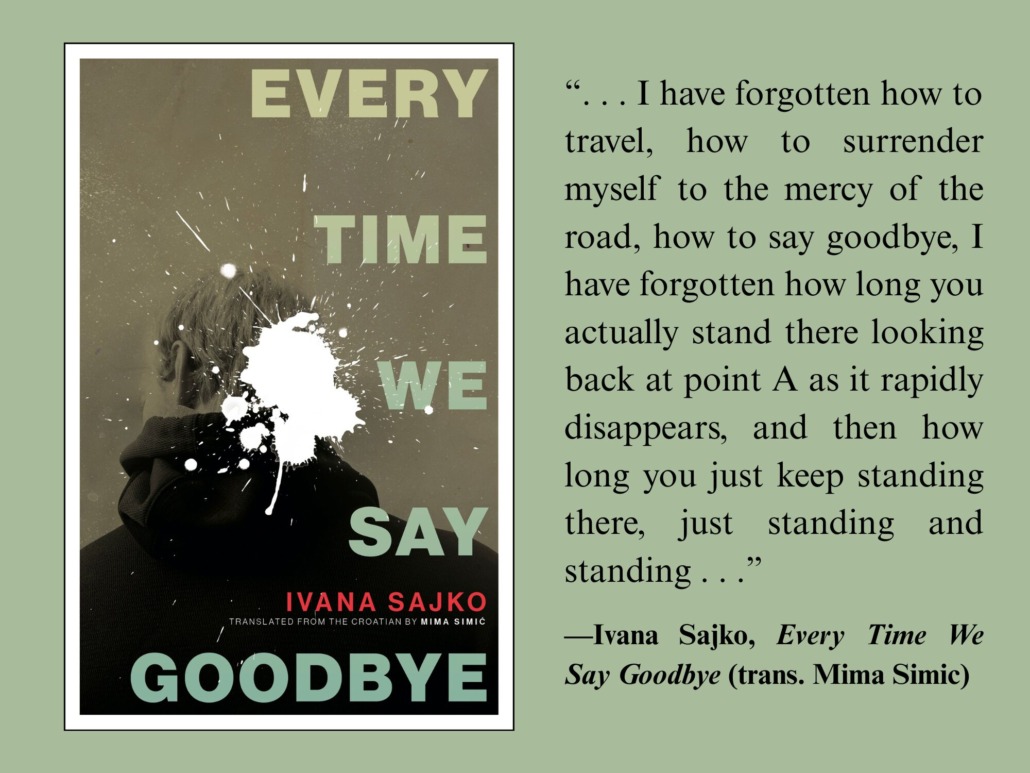
Photo: Every Time We Say Goodbye by Ivana Sajko, translated by Mima Simić. Cover designed by Ingrid Paulson.
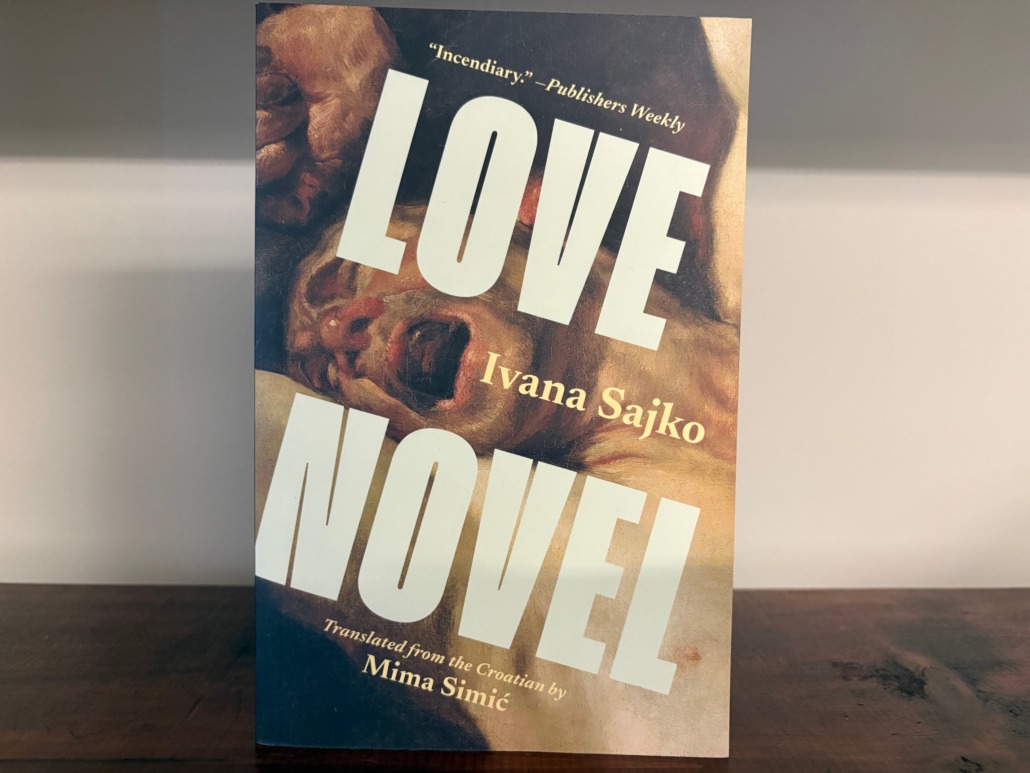
We discovered Ivana Sajko when her first book in translation, Love Novel, made the Dublin Literary Award shortlist a few years ago. Three of us read it here in as many days, more or less each in a sitting, and each of us were blown away, in the fantastic translation by Mima Simić, by its energy and humour, its compassion and rage. We went on to publish it in February 2024 as our own anti-Valentine to the literary world.
Photo: Love Novel by Ivana Sajko, translated by Mima Simić. Cover designed by Jason Arias.
Reading Sajko is intense and claustrophobic, pleasurable and energizing. A longtime playwright and theatre director, her work often takes the form of a dramatic monologue, which is the case in her next novel, Every Time We Say Goodbye, which we will be publishing in March. A man on a train, propelled from his small town on the eastern edge of Europe to Berlin by a pattern of violence from which he is trying to flee, meditates feverishly on everything that has brought him to this point, moving further and further away from the only person he’s ever loved.
Ivana Sajko, photo credit: Peter Stamer.Mima Simić, photo credit: Bronwyn Lewis
Reading Sajko is not for the faint of heart: Every Time We Say Goodbye is a bruising book, a book relevant to this moment and time, but also one that is deeply personal, since all failings begin as such. Yet despite this, there is hope here, as the narrator moves fatefully on towards his final destination, and this feeling has lingered with me in my memory as much as the bleakness and blackness her narrator refuses to look away from. There are very few writers to whom we are as committed as Sajko. Read this book, and Love Novel, and everything that follows: she is one of the very best writers working in any language.
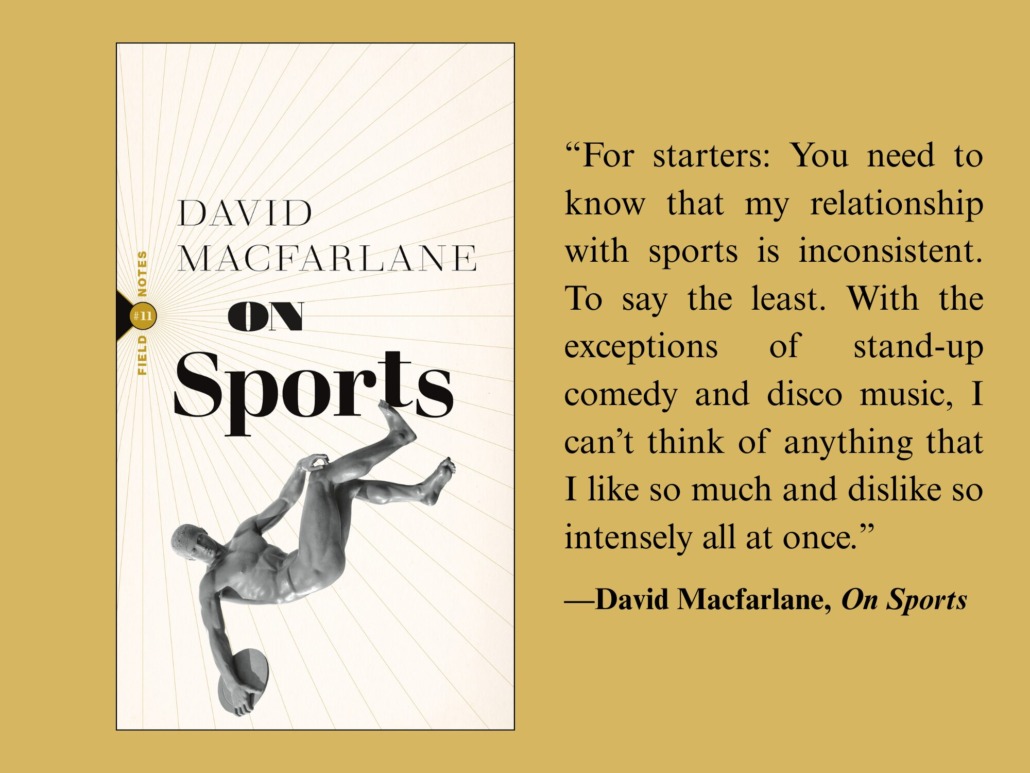
In On Sports, journalist David Macfarlane considers the origins of his love of sport against his discomfort with their commodification.
Photo: On Sports by David Macfarlane. Cover designed by Ingrid Paulson.
On Sports, the latest volume in our Field Notes series, reads like a conversation between friends at the ballpark in those golden days before the kiss cam and college co-eds with T-shirt cannons spoiled the fun; a book that feels of the sun on your forehead and the breeze in your hair, beer and laughter on your lips; a book that celebrates communion and friendship and the beauty of these games—whether it be baseball or football or soccer or tennis or cricket—that we’ve designed to distract ourselves from the end of the world. It is a book about what 7Up tastes like when drunk from the Grey Cup, which, true story, a young Macfarlane once found in the china cabinet at a childhood friend’s house, and into which they poured their favourite soft drink, raising it to their lips like their heroes, detecting notes on the palate of lime, dust, and Silvo. It’s about everyday heroism and the near impossibility of language to properly capture athletic excellence. It’s about the beauty of excellent sports copy; the ephemerality of even the biggest sports story; how it remains perpetually powered by the eleven-year-old still residing in all of us. It’s a book about rediscovering the spirit of sport before online gambling and the manufactured spectacle that most professional sports have become suffocates the last of it.
Photo: David Macfarlane.
I came to sports late as a kid, but became one of the most fanatical of sports fans, especially for baseball: I could probably still quote Rick Monday’s and Fergie Jenkins’ and Mike Schmidt’s 1983 baseball stats from the back of their OpeeChee cards. But over the years I’ve become increasingly ambivalent about sports. Macfarlane shares and acknowledges this ambivalence, but also reminds us of their beauty and humanity. Less an argument than a gentle, generous meander, On Sports has helped once again make me a sports fan, and I think it could appeal broadly to anyone who feels wonder about what feats humans can perform with their bodies, or, otherwise, almost all of us.
Photo of far side of the moon: NASA/Goddard Space Flight Center/Arizona State University.
Precarious: The Lives of Migrant Workers by Marcello Di Cintio was reviewed by Anne Logan on I’ve Read This: “Unflinchingly presents an inequitable Canadian system that contradicts what we consider Canadian values of kindness and acceptance.”
Ripper: The Making of Pierre Poilievre by Mark Bourrie was reviewed in Alberta Views: “Read this book for Bourrie’s wrathful takedown of the egotism, infighting, backbiting and corruption that threaten Canadian democracy.”
https://www.biblioasis.com/wp-content/uploads/2024/08/unnamed-scaled.jpg6172560biblioasishttp://biblioasis.com/wp-content/uploads/2014/12/BIBLIOASIS-Logo-500x500-White-300x300.pngbiblioasis2026-01-16 16:04:062026-01-16 16:04:09Biblioasis Winter Preview: Part I